Overview
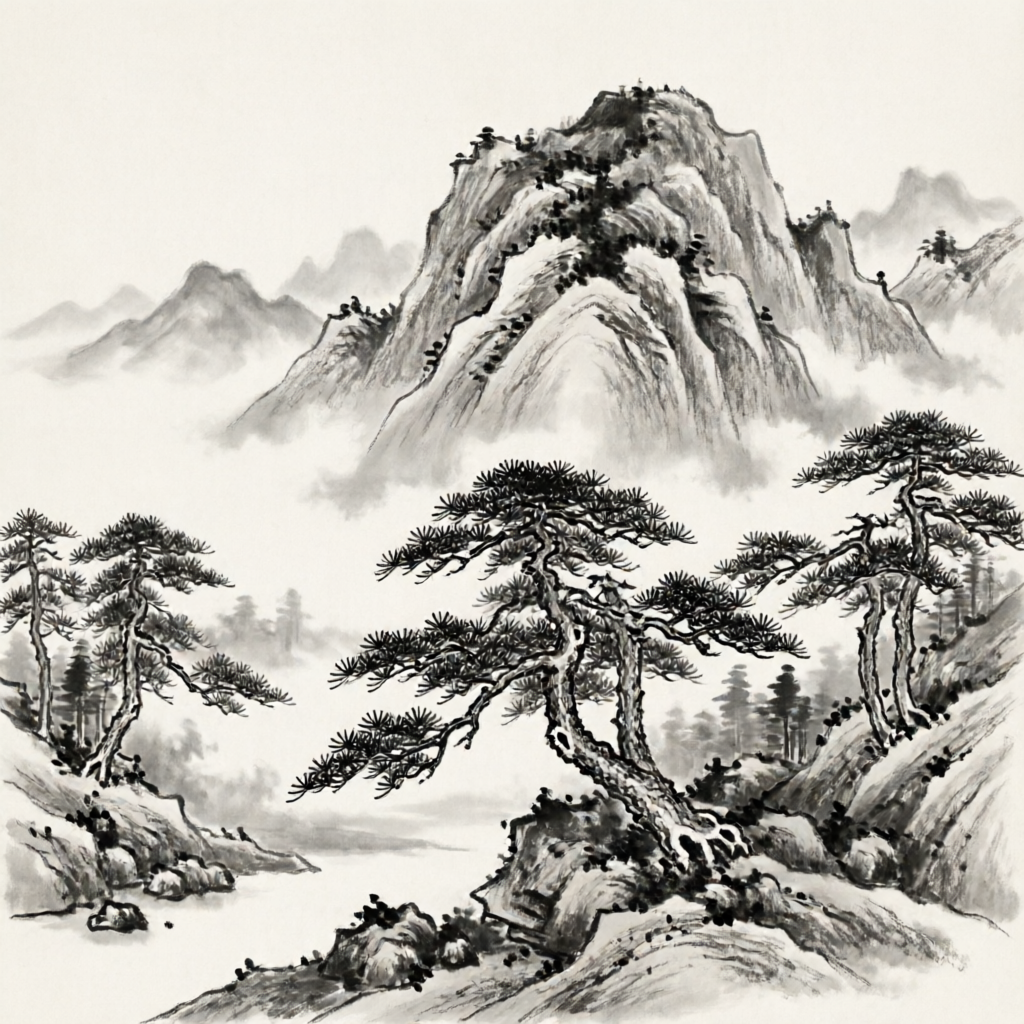
Chinese painting, known natively as guóhuà (国画) or zhōngguó huà (中国画), constitutes a vital pillar of traditional East Asian visual culture. Distinguished from Western oil painting, it primarily utilizes flexible brushes, soot-based ink, and absorbent materials such as rice paper (xuanzhi) or silk. The art form relies fundamentally on the modulation of line and ink tone rather than perspective or chiaroscuro to define form and space. Classical compositions are organized through rhythmic brushwork and the strategic use of negative space (liúbái). Traditional works are executed on various formats, including monumental murals, folding screens, hanging scrolls, album leaves, and fans. Thematically, the tradition is broadly categorized into three principal genres: figure painting, landscape (shānshuǐ), and bird-and-flower painting.
History
The development of Chinese painting traces back to the late Zhou dynasty, with mature figurative works emerging during the Han and Wei-Jin periods. By the Sui and Tang dynasties, landscape and floral-avian motifs had evolved into independent genres. The Five Dynasties and Song periods witnessed an explosion of artistic lineages, with monochrome ink landscape painting reaching its zenith and becoming a dominant scholarly pursuit. The literati (wénrén) painting tradition, initially taking shape in the Song, flourished during the Yuan dynasty, marking a decisive shift toward expressive spontaneity (xiěyì) and subjective interpretation. The Ming and Qing dynasties, alongside the early modern era, saw continued stylistic diversification, with regional schools codifying inherited techniques while experimenting with bold innovations.
Techniques and Styles
The technical vocabulary of Chinese painting is highly systematized. Artists employ a repertoire of brush methods, including outlining (gōu), texture strokes (cūn), dotting (diǎn), and wash application (rǎn). Ink tonalities are manipulated across a spectrum of density, ranging from rich black to pale gray, utilizing dry, wet, thick, and light consistencies. Compositional balance is governed by principles of light and shadow, front and back, void and solid, and sparse versus dense arrangements. Stylistically, works are classified primarily into gōngbǐ (meticulous, detailed brushwork with fine outlines and layered colors) and xiěyì (freehand, expressive brushwork emphasizing spontaneity). Other formal approaches include line drawing (gōulè), color application (shè sè), and ink wash (shuǐmò). The aesthetic doctrine dictates that the artist must internalize natural forms to achieve spiritual resonance, prioritizing expressive vitality over strict anatomical accuracy.
Key Information
| Category | Details |
|---|---|
| Native Name | 中国画 (Zhōngguó huà) / 国画 (Guóhuà) |
| Primary Medium | Ink, water-based pigments, rice paper (xuan), silk |
| Core Tools | The Four Treasures of the Study: brush, inkstick, paper, inkstone |
| Major Genres | Landscape (Shānshuǐ), Figure, Bird-and-Flower |
| Principal Styles | Gongbi (Meticulous), Xieyi (Freehand), Ink Wash |
| Philosophical Basis | Daoism, Confucianism, Chan Buddhism |
| Historical Peak | Song to Yuan dynasties (960–1368 CE) |
Cultural Significance
Rooted in classical Chinese philosophy, painting is regarded as an intellectual and spiritual discipline rather than mere craftsmanship. The foundational maxim "learn from nature outwardly, realize from the heart inwardly" underscores the pursuit of capturing the vital spirit (qì yùn) rather than superficial likeness. Due to the shared origin of brush and ink, painting maintains an inseparable bond with calligraphy and seal carving; both arts rely on the rhythmic quality of the line and the expressive potential of pressure and speed. The tradition heavily incorporates poetic inscription, creating a unified aesthetic where text, image, and seal interact harmoniously on the surface. This integration reflects the literati ideal of the "three perfections" (poetry, calligraphy, and painting), serving as a vehicle for self-cultivation, moral reflection, and the expression of scholarly detachment.
Modern Status
In the modern and contemporary eras, Chinese painting has undergone significant transformation through cross-cultural dialogue and technical experimentation. Early 20th-century reformers like Xu Beihong integrated Western academic realism to revitalize figure painting, while Lin Fengmian pioneered the synthesis of Chinese expressive ink with modern Western compositional theories. Qi Baishi successfully bridged folk art vitality with elite literati traditions, expanding the thematic and aesthetic boundaries of the medium. Today, Chinese painting continues to thrive in a globalized context, balancing heritage with avant-garde practices. Contemporary artists engage in "new ink" movements, utilizing digital media, abstract forms, and conceptual frameworks while preserving the core materiality and philosophical ethos of traditional brushwork. It remains widely taught, collected, and exhibited as a dynamic, evolving pillar of world art.
References
- Sullivan, Michael. (1996). The Arts of China (4th ed.). University of California Press.
- Bush, Susan; Shih, Hsio-yen, eds. (1985). Early Chinese Texts on Painting. Harvard University Press.
- Cahill, James. (1960). Chinese Painting. Skira/Rizzoli.
- Silbergeld, Jerome. (1985). Chinese Painting Style: Media, Methods, and Principles of Form. University of Washington Press.
- Murck, Alfreda, ed. (2000). Words and Images: Chinese Poetry, Calligraphy, and Painting. Princeton University Press.