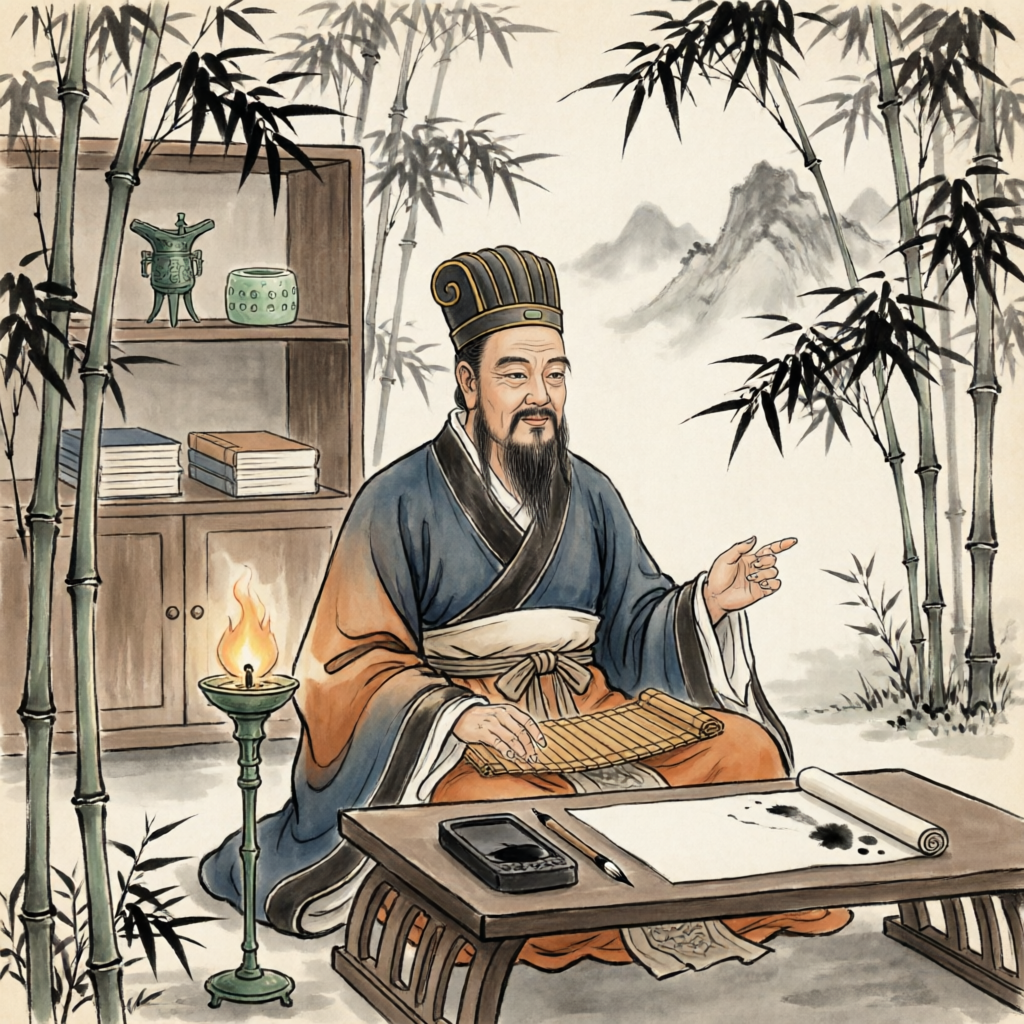
Confucius
Overview
Confucius (551-479 BCE), born as Kong Qiu (孔丘) and styled Zhongni (仲尼), was an influential Chinese philosopher and teacher whose ideas have profoundly shaped East Asian civilization. His philosophy emphasized personal and governmental morality, social relationships, justice, and sincerity. These values gained prominence in China over other doctrines, such as Legalism or Taoism, during the Han Dynasty (206 BCE-220 CE) and were further established as the core of traditional Chinese philosophy and religion. Confucius's thoughts have been developed into a system of philosophy known as Confucianism, which continues to influence various aspects of life in China, Korea, Japan, and Vietnam.
History
Noble Origins
Confucius's ancestry can be traced back to the royal house of the Shang Dynasty through his sixteenth ancestor, Duke Jia of Song, who was the brother of King Zhou of Shang. Confucius's great-grandfather, Duke Fang, served as an official in the state of Lu. His father, Shuliang He (叔梁纥), was a warrior known for his strength and courage. At the age of 66, Shuliang He married a 19-year-old woman named Zhengzai (颜徵在), which was considered irregular according to the propriety of the time ("野合" or "irregular union"). Confucius was born from this union in 551 BCE in the Zouyi area of Lu (present-day Qufu, Shandong Province).
Early Life
Confucius lost his father at age three and was raised in poverty by his mother. After her death when he was about 13, he observed mourning rites that were beyond his years. By age 15, Confucius had determined to dedicate himself to learning. At age 19, he married a woman from the Qiguan family and later had a son named Li (鲤), also known as Boyu.
Political Career
Confucius began his political career around age 20, working first as a manager of granaries and later as a supervisor of livestock. His reputation as a scholar grew, and by age 30, he had established a reputation for learning. Around this time, he also began teaching, establishing what is considered the first private school in Chinese history.
Confucius entered government service in Lu around age 50, eventually rising to the position of Minister of Justice (大司寇). In this role, he famously executed the influential scholar Shaozheng Mao (少正卯) after only seven days in office, an act that has been debated by scholars throughout history. During his three-year tenure in high office, Lu became a well-governed state, causing neighboring states to take notice.
However, political intrigue and changing circumstances led Confucius to leave Lu in 497 BCE, beginning a 14-year period of traveling through various states in search of a ruler who would implement his political ideals.
Travels Among the States
Confucius and his disciples traveled through the states of Wei, Song, Chen, Cai, Chu, and others, seeking positions where they could implement their political vision. During these travels, Confucius faced numerous difficulties, including misunderstandings, danger, and periods of extreme hardship, including a famous episode where he and his disciples were besieged and nearly starved in the state of Chen.
Despite these challenges, Confucius continued to teach and refine his philosophy. During this period, he engaged in numerous philosophical discussions with rulers and other thinkers, further developing his ideas about governance, morality, and education.
Return to Lu and Final Years
In 484 BCE, Confucius returned to Lu at the invitation of Duke Ai, following the military success of his disciple Ran You. Though he was not given an official position, Confucius spent his final years teaching, editing classical texts, and writing the Spring and Autumn Annals (春秋).
Confucius died in 479 BCE at age 73. His followers mourned him deeply, and his disciple Zigong (子贡) maintained a vigil at his tomb for six years. Eventually, a community grew around his tomb, which was developed into the Temple of Confucius in Qufu, one of China's most important historical sites.
Key Information
| Aspect | Details |
|---|---|
| Chinese Name | 孔子 (Kongzi) |
| Personal Name | 孔丘 (Kong Qiu) |
| Courtesy Name | 仲尼 (Zhongni) |
| Birth Date | September 28, 551 BCE (traditional date) |
| Birthplace | Zouyi (陬邑), State of Lu (present-day Qufu, Shandong) |
| Death Date | April 11, 479 BCE |
| Death Place | State of Lu |
| Major Works | The Analects (论语), Spring and Autumn Annals (春秋) |
| Key Disciples | Yan Hui (颜回), Zengzi (曾子), Zigong (子贡), etc. |
| Philosophical Focus | Ren (仁, benevolence), Li (礼, ritual propriety), Xiao (孝, filial piety) |
Cultural Significance
Confucius's teachings, collected by his disciples in The Analects (论语), have had an immeasurable influence on Chinese culture and East Asian civilization. His emphasis on moral cultivation, social harmony, and proper conduct created a framework for Chinese society that lasted for over two millennia.
The "Five Constant Virtues" (五常) of Confucianism—ren (benevolence), yi (righteousness), li (ritual propriety), zhi (wisdom), and xin (integrity)—became the foundation of Chinese ethics. The Confucian emphasis on education and meritocracy, despite the reality of aristocratic privilege, created a cultural ideal that continues to influence Chinese society.
Confucius's influence extended beyond China to form the cultural foundation of Korea, Japan, and Vietnam. The examination system based on Confucian classics, established in the Sui Dynasty (581-618 CE) and lasting until 1905, created a bureaucratic system based on merit rather than birth, influencing civil service systems worldwide.
Modern Status
Confucianism experienced a decline in the early 20th century as China underwent modernization and Westernization. The May Fourth Movement (1919) criticized Confucianism as a hindrance to China's development, and during the Cultural Revolution (1966-1976), Confucianism was officially condemned.
In recent decades, however, there has been a revival of interest in Confucian thought. The Chinese government has promoted "Confucian socialism" as a distinctively Chinese approach to development, and Confucius Institutes have been established worldwide to promote Chinese language and culture.
Academic interest in Confucianism has also grown, with scholars reevaluating Confucian thought in light of contemporary issues such as human rights, environmental ethics, and global governance. Confucian concepts like harmony (和), the mean (中庸), and reciprocity (恕) have found new relevance in discussions of global ethics.
References
-
Ames, Roger T. and Henry Rosemont Jr. The Analects of Confucius: A Philosophical Translation. Ballantine Books, 1998.
-
Brooks, E. Bruce and Taeko Brooks. The Original Analects: Sayings of Confucius and His Successors. Columbia University Press, 1998.
-
Nylan, Michael. The Five Confucian Classics. Yale University Press, 2001.
-
Schwartz, Benjamin I. The World of Thought in Ancient China. Harvard University Press, 1985.
-
Tu Wei-ming. Confucian Thought: Selfhood as Creative Transformation. State University of New York Press, 1985.