Overview
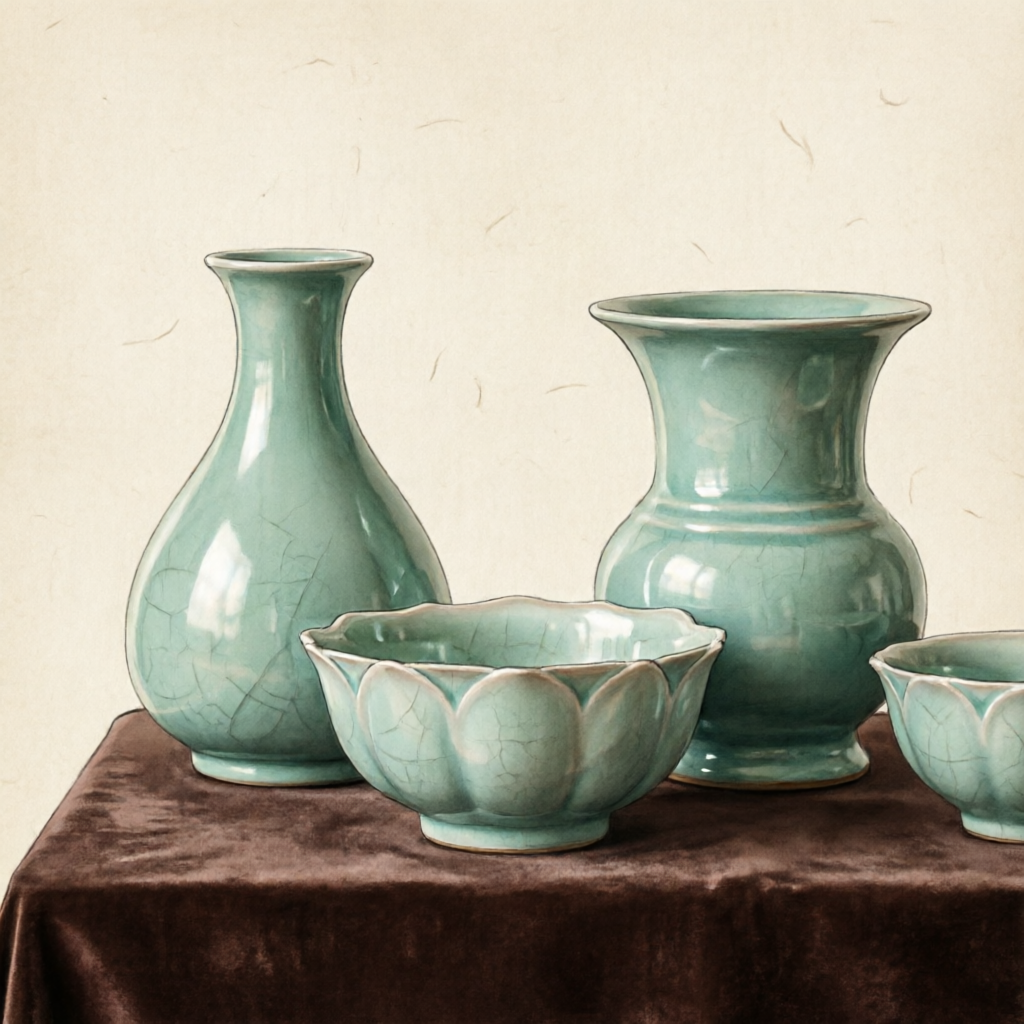
Longquan celadon represents one of China's most significant contributions to ceramic art, renowned for its "green as jade, bright as a mirror, and sound as a chime" qualities. This distinctive pottery tradition, originating from Longquan City in Zhejiang Province, China, has evolved over centuries, developing two primary styles known as "Ge kiln" and "Di kiln". The craft achieved such prominence during the Song Dynasty (960-1279) that it was ranked among the Five Great Kilns of that era, alongside Guan, Ru, Ding, and Jun wares. Longquan celadon has not only shaped Chinese aesthetic traditions but also influenced ceramic arts across Asia and beyond, earning recognition as both a National Intangible Cultural Heritage and part of UNESCO's Representative List of the Intangible Cultural Heritage of Humanity.
History
The origins of Longquan celadon can be traced back to the Han Dynasty (206 BCE-220 CE), when celadon production first emerged in China. However, the craft truly flourished during the Five Dynasties and Ten Kingdoms period (907-979), when potters in Longquan began developing their distinctive techniques. By the Northern Song Dynasty (960-1127), Longquan had established itself as a major center for celadon production.
A significant development occurred in the mid-20th century when, following Premier Zhou Enlai's directive in 1957 to "restore celadon production," a team of eight experts was assembled to revive the traditional techniques. The following spring, they successfully fired the first experimental kiln, marking the beginning of Longquan celadon's modern revival.
Archaeological discoveries in the 1970s revealed that celadon production in the Longquan area may date back even further than previously believed. Excavations of ancient tombs from the Three Kingdoms to the Jin Dynasties (220-420 CE) uncovered pottery that differed slightly from the more famous Yue ware, suggesting these may represent early Longquan products. This finding pushed the documented history of Longquan celadon back by over 600 years.
The Southern Song Dynasty (1127-1279) marked the golden age of Longquan celadon, particularly with the development of the celebrated "powder blue" (fenqing) and "plum green" (meiziqing) glazes. These innovations, achieved through precise control of kiln atmosphere and glaze composition, produced ceramics with the jade-like translucence that became Longquan's signature aesthetic. During this period, Longquan celadon reached unprecedented levels of technical sophistication and artistic refinement.
Key Information
| Feature | Description |
|---|---|
| Origin | Longquan City, Zhejiang Province, China |
| Classification | Ge kiln (black body with crackle glaze) and Di kiln (white body with smooth glaze) |
| Notable Periods | Five Dynasties (907-979), Northern Song (960-1127), Southern Song (1127-1279) |
| Recognition | National Intangible Cultural Heritage (2006), UNESCO Intangible Cultural Heritage (2009) |
| Production Statistics | 700+ enterprises, 10,000+ workers, ¥1.2+ billion annual output (2013) |
| Distinctive Features | "Green as jade, bright as mirror, sound as chime" qualities |
Cultural Significance
Longquan celadon holds profound cultural significance in Chinese history and aesthetics. The craft embodies the Chinese aesthetic principle of "绚烂之极,复归平淡" (绚烂之极,复归平淡) - "from绚烂之极,复归平淡" - "from extreme brilliance returning to simplicity," which resonated deeply with Song Dynasty philosophical ideals. The subtle color variations and refined forms of Longquan ware reflect Confucian values of harmony, restraint, and balance.
Two prominent legends illustrate the cultural importance of Longquan celadon. The first tells of two brothers who were potters, with the older brother's superior craftsmanship inciting his younger sibling's jealousy. The younger brother secretly added plant ash to his brother's glaze mixture, resulting in the distinctive crackle patterns that became characteristic of Ge ware. Rather than ruining the pieces, these "imperfections" created a new aesthetic that was highly prized, establishing the Ge kiln tradition.
A second legend involves a young woman named Ye Qingji who sacrificed herself to save her father and fellow potters from execution when they failed to produce acceptable imperial wares. After her death, her father succeeded in creating exceptionally beautiful celadon, which the potters believed was Qingji's spirit manifesting in the clay. To honor her, they referred to their finest work as "Qingci" (青瓷), which sounds similar to "Qingji" (青姬) - "Green Beauty" - in the Longquan dialect.
These stories reveal how Longquan celadon is intertwined with local identity, moral values, and the spiritual significance of craftsmanship in Chinese culture. The craft represents not just technical achievement but a connection between humanity, nature, and the divine.
Modern Status
Longquan celadon continues to thrive in the contemporary era, maintaining its traditional techniques while embracing innovation. The industry has experienced remarkable growth, with production value increasing from ¥320 million in 2009 to over ¥1.2 billion in 2013, when there were more than 700 enterprises and 10,000 workers in the region. This represents an average of one artisan for every 1,000 residents of Longquan City.
The craft has received significant institutional support. In 2014, the Longquan Celadon Collaborative Innovation Center was established to promote research and development. The following year saw the founding of the Longquan Celadon Sword Technician School, which integrates traditional craftsmanship with modern technical education. In 2019, the Longquan Celadon Research Association was formed to further scholarly and artistic exchange.
Recent archaeological discoveries continue to enhance our understanding of Longquan celadon's historical significance. In 2022, underwater archaeologists excavated an元代 (Yuan Dynasty) shipwreck near Shengbei Isle, recovering 58 intact celadon pieces, including plates, bowls, high-footed cups, and incense burners, providing valuable insights into the maritime trade of these ceramics.
Contemporary Longquan celadon artists have expanded the traditional palette, developing new glaze colors such as purple copper, high-temperature black, tiger-spotted, ochre, tea-dust, black gold, and sky blue. Master artisans like Xu Chaoxing, Xia Houwen, Mao Zhengcong, and Zhang Shaobin have received national recognition for their contributions to preserving and innovating the tradition. Zhang Shaobin, in particular, restored several Song Dynasty techniques that had been lost for centuries, including "thin body with thick glaze" and "gold wire iron line" decoration.
References
-
Li, J. (2015). The History of Chinese Ceramics. Cambridge University Press.
-
Wang, C. (2018). Longquan Celadon: Artistry and Tradition. Zhejiang Cultural Publishing House.
-
UNESCO. (2009). Longquan Celadon Traditional Firing Craftsmanship. UNESCO Intangible Cultural Heritage Collection.
-
Chen, X., & Liu, Y. (2020). Archaeological Discoveries and Technical Analysis of Longquan Celadon. Journal of East Asian Archaeology, 12(3), 245-267.
-
Zhang, W. (2017). Revival and Innovation in Contemporary Longquan Celadon. Chinese Ceramics Review, 45, 78-95.