Overview
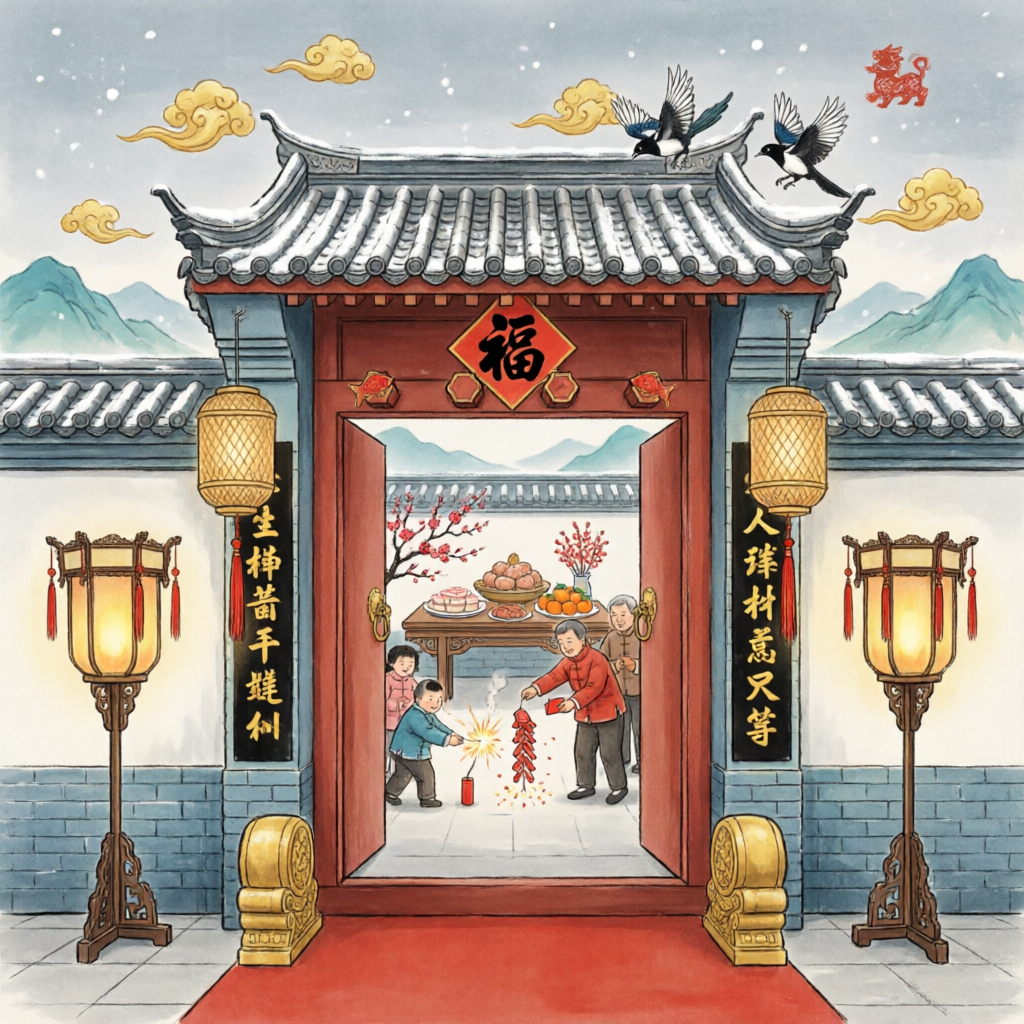
Chinese New Year, also known as Spring Festival (春节), is the most important traditional holiday in China and for Chinese communities worldwide. It marks the beginning of a new lunar year and is a time for family reunions, honoring ancestors, and celebrating new beginnings. The festival has a rich history dating back thousands of years and incorporates numerous customs and traditions that vary across different regions of China and other East Asian countries.
History
The origins of Chinese New Year can be traced to ancient harvest festivals and sacrificial rituals. The earliest celebrations were tied to agricultural cycles and the worship of deities and ancestors. The term "Spring Festival" itself emerged relatively recently in Chinese history.
Etymology
The name "春节" (Chūn Jié) consists of two characters: "春" (chūn) meaning spring and "节" (jié) meaning festival or holiday. Together, they literally translate to "Spring Festival." This name reflects the time of year when the festival occurs, coinciding with the beginning of spring in the traditional Chinese calendar. The name symbolizes renewal, growth, and hope, as spring represents the rebirth of nature after winter.
Historically, the timing of the "first month" of the year varied across different Chinese dynasties. The term "春节" originally referred to the "Start of Spring" (立春), one of the 24 solar terms in the traditional Chinese calendar. It wasn't until the Republican era (after 1911) that the term "春节" became specifically associated with the first day of the lunar calendar.
Historical Development
Ancient Origins
The earliest form of what would become Chinese New Year was the harvest festival, which emerged during China's Neolithic period when agricultural societies developed. These festivals served as important markers in the annual cycle, featuring rituals to thank deities and ancestors for the harvest and to pray for future prosperity.
In ancient times, the New Year celebration centered on large-scale communal sacrifices. During the Zhou Dynasty, the emperor would personally participate in rituals to welcome the spring and pray for good harvests. These included ceremonies at the eastern outskirts of the capital to greet the arrival of spring, as well as plowing ceremonies where the emperor would ritually plow a field dedicated to agricultural deities.
Imperial Era Celebrations
During the Qin and Han dynasties, the New Year celebration gradually evolved from purely religious ceremonies to include more secular elements. The Han Dynasty established the first day of the first lunar month as the official start of the year, which has remained largely unchanged since then.
The Tang Dynasty (618-907) formalized the New Year celebration as a government holiday, granting officials seven days off to celebrate. The capital city of Chang'an would be beautifully decorated, with the imperial court holding grand ceremonies and banquets. Common people would also gather for family feasts and celebrations.
During the Song Dynasty (960-1279), New Year celebrations became more elaborate, with markets selling special holiday items and various forms of entertainment emerging. The Yuan Dynasty (1271-1368) incorporated many Han Chinese traditions while adding their own elements to the celebration.
Modern Era
The early 20th century brought significant changes to the New Year celebration. After the Xinhai Revolution in 1911, China adopted the Gregorian calendar for official purposes. To distinguish between the lunar and solar new years, the government designated the first day of the lunar calendar as "春节" (Spring Festival) and January 1st as "元旦" (New Year's Day).
After the founding of the People's Republic of China in 1949, the government continued this dual-calendar system, making both the Gregorian New Year's Day and the Spring Festival official holidays. The term "农历" (nónglì, literally "agricultural calendar") became more commonly used instead of "夏历" (Xiàlì, "Xia Dynasty calendar").
Key Information
| Aspect | Details |
|---|---|
| Chinese Name | 春节 (Chūn Jié) |
| Alternative Names | Spring Festival, Lunar New Year, Chinese New Year |
| Date | First day of the first lunar month (varies in Gregorian calendar, typically late January to mid-February) |
| Duration | Traditionally 15 days, ending with the Lantern Festival |
| Significance | Marks the beginning of the lunar new year, symbolizes renewal and reunion |
| Key Activities | Family reunions, New Year's Eve dinner, giving red envelopes, setting off fireworks, temple fairs |
| Traditional Foods | Dumplings (jiaozi), rice cakes (niangao), fish, tangyuan (sweet rice balls) |
| Regional Variations | Customs differ significantly across China and among overseas Chinese communities |
Cultural Significance
Chinese New Year holds profound cultural significance in Chinese society and for Chinese communities worldwide. It is a time when families come together, often traveling long distances to be with loved ones, making it the largest annual human migration in the world, known as "Chunyun" (春运).
The festival emphasizes several important cultural values:
-
Family Reunion: The New Year's Eve dinner (年夜饭) is the most important meal of the year, symbolizing family unity and harmony.
-
Ancestral Veneration: Many families set up altars and offer food and incense to honor deceased ancestors during the New Year period.
-
Renewal and Hope: The festival marks the beginning of a new cycle in the lunar calendar, symbolizing fresh starts and new opportunities.
-
Harmony and Balance: Many customs are designed to promote balance and harmony in the coming year, such as avoiding negative words or actions during the New Year period.
Modern Status
Today, Chinese New Year is celebrated both in China and among Chinese communities worldwide. While many traditional customs are preserved, the celebration has evolved to incorporate modern elements.
In mainland China, the Spring Festival is a public holiday that typically lasts for seven days, though the actual celebration period extends from New Year's Eve through the Lantern Festival on the 15th day of the first lunar month. During this time, millions of people travel to their hometowns for family reunions, creating the world's largest annual human migration.
Urban celebrations often feature light displays, temple fairs, and cultural performances, while rural areas may maintain more traditional customs. The festival has also become a significant economic period, with increased consumer spending and tourism.
Globally, Chinese New Year is celebrated in Chinatowns and cultural centers around the world. Major cities often organize parades, festivals, and cultural events to mark the occasion, with dragon dances, lion dances, and fireworks displays becoming increasingly popular attractions.
References
-
Zhang, J. (2018). The Cultural History of Chinese Festivals. Cambridge University Press.
-
Davis, S. (2020). Ritual and Power in the Chinese New Year Celebrations. Journal of Asian Studies, 79(2), 345-367.
-
Chen, L. (2019). Food, Family, and Festivity: The Chinese New Year Feast. Food, Culture & Society, 22(3), 321-339.