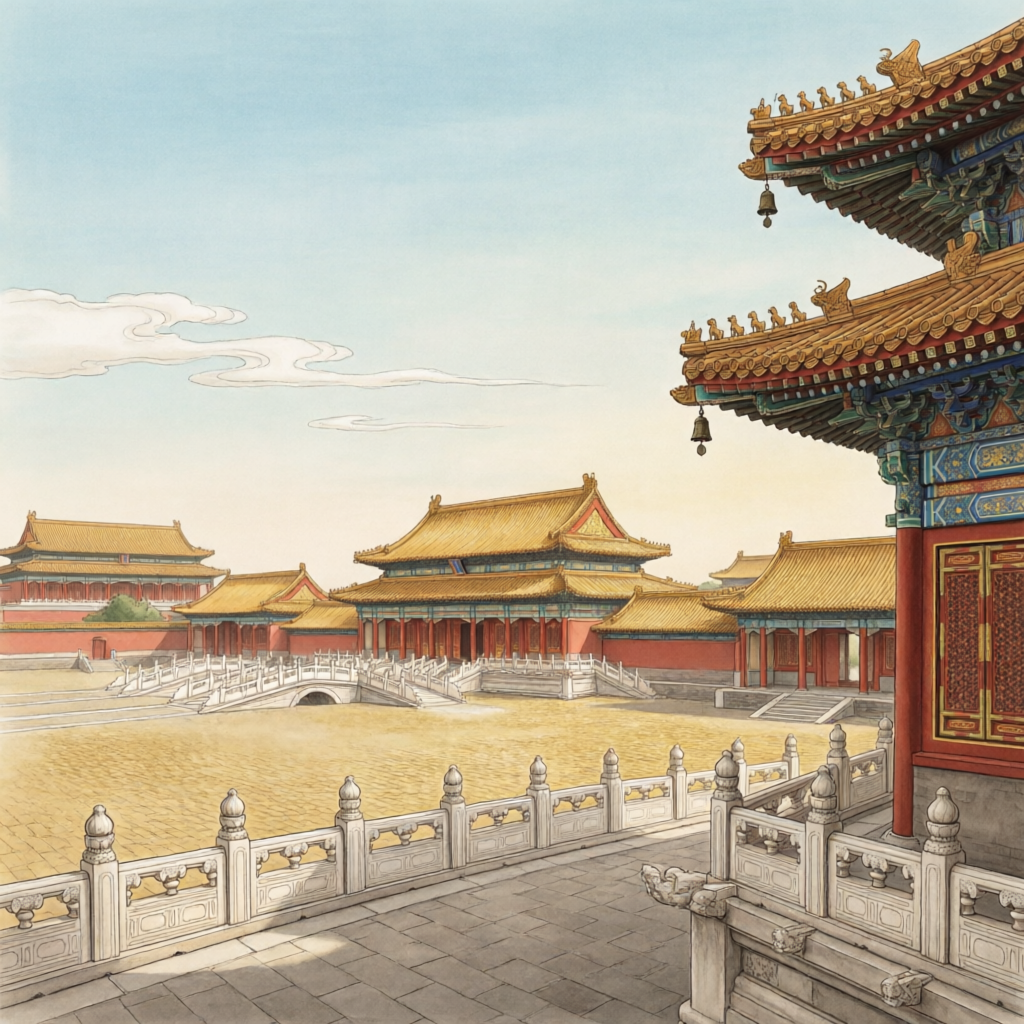
Overview
The Forbidden City, also known as the Palace Museum or Purple Forbidden City, is a magnificent palace complex located in the center of Beijing, China. As the imperial palace for 24 emperors during the Ming and Qing dynasties (1420-1912), it represents the pinnacle of traditional Chinese architecture and embodies the cultural and political significance of imperial China. Covering an area of approximately 720,000 square meters (with a building area of about 150,000 square meters), the Forbidden City is the world's largest palace complex and has been recognized as a UNESCO World Heritage Site since 1987.
History
Name Origins
The Forbidden City derives its name from the ancient Chinese concept of "Tian Ren He Yi" (天人合一), which emphasizes the correspondence between celestial bodies and earthly structures. The term "Purple Forbidden" comes from the belief that the celestial emperor resided in the Purple Forbidden Palace (Ziweigong) in the North Star, and the earthly emperor, as the "Son of Heaven," should have his residence correspond to this celestial abode. The "Forbidden" aspect refers to the fact that the palace was off-limits to commoners during imperial times.
Construction
The construction of the Forbidden City began in 1406 during the reign of Emperor Yongle (Zhu Di) of the Ming Dynasty. Built as a replica of the Nanjing Imperial Palace but on a grander scale, it took an estimated 100,000 workers 14 years to complete. The project required vast resources, including precious nanmu wood from remote mountains and massive stone slabs transported via ice roads during winter. The palace was officially completed in 1420 and became the political center of China when Emperor Yongle moved the capital from Nanjing to Beijing.
Ming Dynasty Period
During the Ming Dynasty, the Forbidden City witnessed significant events and architectural changes. Notably, the palace suffered several devastating fires, including in 1421 (shortly after completion), 1557, and 1597, each time requiring extensive reconstruction. The Three Great Halls (Hall of Supreme Harmony, Hall of Central Harmony, and Hall of Preserving Harmony) were renamed during the Jiajing period to Hall of Ultimate Purity, Hall of Central Purity, and Hall of Established Purity. The Palace of Heavenly Purity (Qing Palace) served as the main residence and political center for emperors from Yongle to Chongzhen.
Qing Dynasty Period
After the fall of the Ming Dynasty in 1644, the Forbidden City was damaged by rebel forces but was gradually restored by the Qing Dynasty. Emperor Shunzhi began renovations in 1644, and Emperor Kangxi oversaw major reconstruction projects from 1669-1698. The Qing emperors made several modifications to the palace, with Emperor Yongzheng shifting his residence from the Palace of Heavenly Purity to the Hall of Mental Cultivation (Yangxin Dian), which then became the political center for the remainder of the dynasty. Emperor Qianlong, during his reign (1735-1796), expanded the palace with numerous new structures, creating the full splendor of the Forbidden City that we see today.
Republican Era
Following the Xinhai Revolution of 1911, the last emperor Puyi was allowed to remain in the Inner Court under the "Articles of Favorable Treatment for the Imperial House." The palace became a "state within a state" until 1924 when General Feng Yuxiang expelled Puyi and established the Palace Museum. In 1933, facing the threat of Japanese invasion, many treasures from the Forbidden City were evacuated to Nanjing and later to Sichuan for safekeeping.
Key Information
| Feature | Details |
|---|---|
| Chinese Name | 北京故宫 (Běijīng Gùgōng) |
| Alternative Names | Purple Forbidden City, Palace Museum |
| Location | No. 4 Jingshan Front Street, Dongcheng District, Beijing |
| Construction Period | 1406-1420 (Ming Dynasty) |
| Area | 720,000 m² (total), 150,000 m² (building area) |
| Heritage Status | UNESCO World Heritage Site (1987), National Key Cultural Relics Protection Unit |
| Opening Hours | April 1-October 31: 8:30-17:00 (last entry 16:10) November 1-March 31: 8:30-16:30 (last entry 15:40) Closed on Mondays (except legal holidays) |
| Ticket Price | 60 RMB (peak season), 40 RMB (off season) Additional 10 RMB for Treasure Gallery and Clock Gallery |
| Number of Rooms | 9,807 (traditional measurement) |
| Major Attractions | Three Great Halls, Three Back Halls, Imperial Garden, Six Eastern and Western Palaces |
Cultural Significance
The Forbidden City represents the pinnacle of traditional Chinese architecture and urban planning. Its design follows the principles of "Zhou Li-Kao Gong Ji" (周礼·考工记), an ancient text that prescribes "front court, back market, left ancestral temple, right altar" for imperial capitals. The complex embodies Chinese cosmology, with the emperor positioned as the Son of Heaven at the center of the universe, surrounded by symbolic elements representing harmony between heaven and earth.
The palace also served as a repository of Chinese art and culture, housing countless treasures, paintings, ceramics, and artifacts that reflect the highest achievements of Chinese civilization. The architectural details, including the use of symbolic colors (yellow for imperial buildings, green for princes' residences) and decorative elements (dragons, phoenixes, and other mythical creatures), all carry profound cultural meanings.
Modern Status
Today, the Forbidden City operates as the Palace Museum, one of China's most important cultural institutions. Since 2012, the museum has undergone extensive renovations and expansions, with the goal of opening 76% of its total area to the public by 2020. Recent developments include the opening of new exhibition areas, the establishment of digital archives, and the implementation of advanced conservation techniques.
The museum attracts 6-8 million visitors annually, making it one of the most visited museums in the world. In recent years, the Palace Museum has embraced digital technology, creating online exhibitions and a comprehensive digital collection that includes over 150,000 high-resolution images of its artifacts. The "Dragon Spitting Water" phenomenon, where rainwater flows through 1,142 dragon-headed stone spouts on the palace terraces, continues to captivate visitors and demonstrates the sophisticated hydraulic engineering of the ancient builders.
References
-
Wheatley, Paul. (1971). The Pivot of the Four Quarters: A Preliminary Enquiry into the Origins and Character of the Ancient Chinese City. Aldine Publishing Company.
-
Fu, Xinian. (2012). Chinese Architecture: A History. Princeton Architectural Press.
-
Palace Museum. (2019). The Forbidden City: The Glorious Reign of the Qianlong Emperor. Commercial Press.
-
Spence, Jonathan D. (2012). The Search for Modern China. W.W. Norton & Company.
-
Steinhardt, Nancy Shatzman. (2000). Imperial Beijing: Architecture and Planning, 1420-1911. University of Hawaii Press.