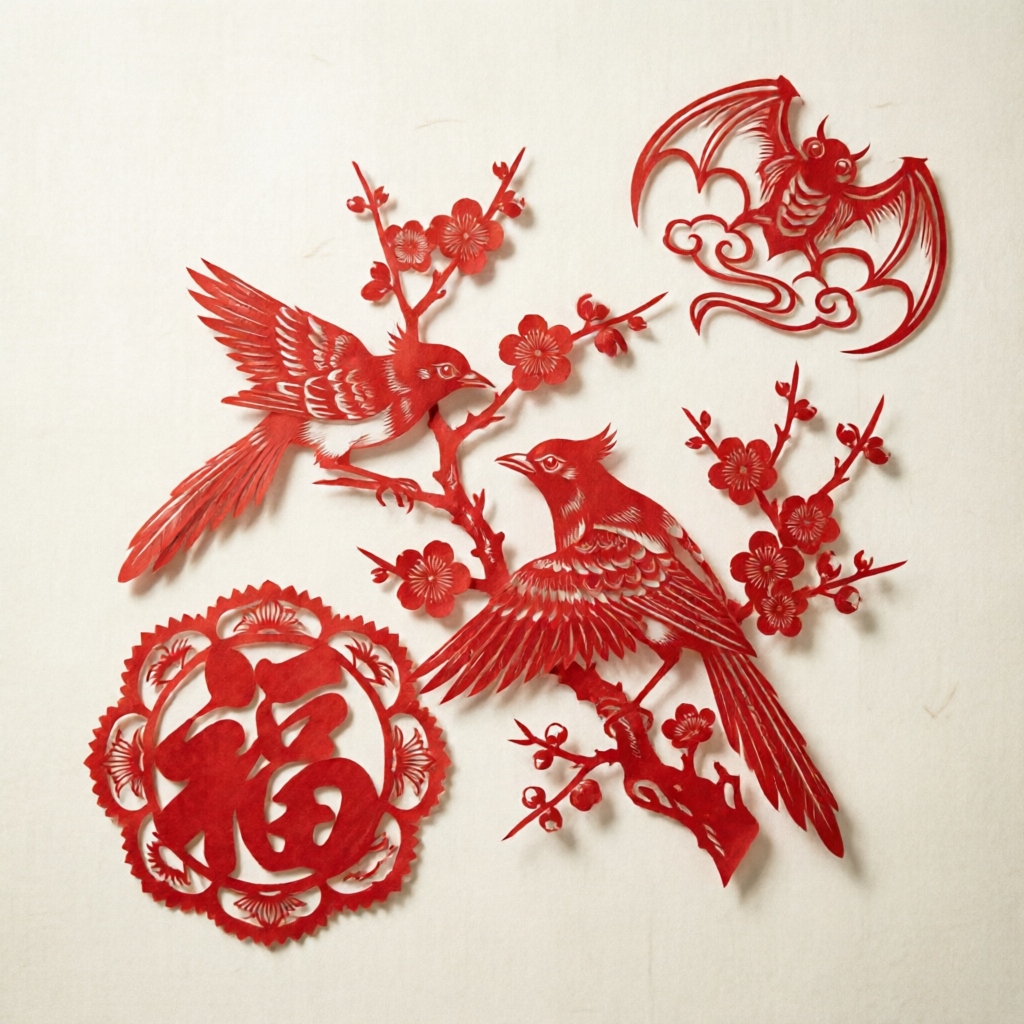
Overview
Chinese paper cutting (中国剪纸) is a traditional folk art form that involves cutting paper designs with scissors or knives. This art form has a history spanning over 1,500 years and has been recognized as an Intangible Cultural Heritage of Humanity by UNESCO since 2009. The art is characterized by its intricate designs, symbolic meanings, and diverse techniques, making it one of the most distinctive and widely practiced forms of paper art in China.
History
Pre-Tang Period
The invention of paper during the Western Han Dynasty (206 BCE-220 CE) laid the foundation for paper cutting. However, similar techniques using thin materials like gold foil, leather, silk, and even leaves were practiced earlier. The Shiji (Records of the Grand Historian) mentions King Cheng of Zhou using a "gui" (jade tablet) cut from a paulownia leaf to enfeoff his brother during the Western Zhou Dynasty (1046-771 BCE). Archaeological discoveries have revealed leather cutouts from the Warring States Period (475-221 BCE) in Hubei Province and silver foil cutouts in Henan Province, which demonstrate techniques similar to later paper cutting.
The earliest surviving paper cutting artifacts date back to the Northern and Southern Dynasties (386-581 CE). Five round flower paper cuttings were discovered near the Flaming Mountains in Turpan, Xinjiang. These works show the use of repetitive folding techniques and non-overlapping imagery.
Tang Dynasty
During the Tang Dynasty (618-907 CE), paper cutting flourished. Du Fu's poem "Pengya Xing" mentions "cutting paper to summon souls," indicating the practice of using paper cuttings in rituals. Tang paper cuttings preserved in the British Museum demonstrate advanced artistic skills with complete compositions depicting idealized scenes between heaven and earth. The period also saw the emergence of paper-cutting techniques used for stencil printing on fabrics, as evidenced by discoveries at the Mogao Caves in Dunhuang.
Song Dynasty
The Song Dynasty (960-1279 CE) saw the professionalization of paper cutting, with artisans specializing in "cutting various patterns" mentioned in Zhou Mi's "Wulin Jiushi". The development of the paper industry provided abundant materials for paper cutting, leading to its wider application in decorations for windows, lanterns, and tea sets. The Jizhou Kiln in Jiangxi incorporated paper-cutting designs into ceramics, while shadow puppets and blue printed fabrics also adopted paper-cutting techniques.
Ming and Qing Dynasties
During the Ming (1368-1644) and Qing (1644-1912) dynasties, paper cutting reached its peak of development and maturity. The art form was applied to various decorative elements including lanterns, fans, and embroidery. Paper cutting became a universal art form practiced by people from all social strata, including the imperial family. The Palace Museum in Beijing preserves paper cuttings from the Kunming Palace, the wedding chamber of Qing emperors, which show similar techniques to those used in common households.
Modern Era
The early 20th century saw renewed interest in paper cutting as part of the New Culture Movement. Intellectuals like Cai Yuanpei, Lu Xun, and Liu Banong collected folk art, including paper cuttings. In the 1930s, artist Chen Zhinong began researching and creating paper cuttings depicting Beijing's folk customs.
During the 1940s, paper cutting took on new themes reflecting contemporary life. Following Mao Zedong's "Talks at the Yan'an Forum on Literature and Art" in 1942, artists at the Lu-Yan Academy began creating paper cuttings that combined traditional techniques with revolutionary content. This period marked a significant transformation in paper cutting, connecting it with social and political themes.
After the founding of the People's Republic of China in 1949, paper cutting continued to evolve under the principle of "letting a hundred flowers bloom and weeding through the old to bring forth the new." Artists created works depicting socialist life, while traditional themes remained popular.
Key Information
| Aspect | Description |
|---|---|
| Chinese Name | 中国剪纸 (Zhongguo Jianzhi) |
| English Names | Chinese paper cutting, Chinese paper-cut |
| Origin | 6th century CE |
| Status | Intangible Cultural Heritage of Humanity (UNESCO, 2009) |
| Categories | Folk art form |
| Main Materials | Paper, scissors, knives |
| Key Techniques | Folding, cutting, piercing, layering |
| Cultural Significance | Used in festivals, weddings, religious ceremonies, and daily life |
Cultural Significance
Chinese paper cutting is deeply embedded in cultural practices and symbolism. Different designs carry specific meanings: lotus flowers symbolize purity, fish represent abundance, and dragons signify power and good fortune. The art form is particularly important during festivals like Chinese New Year, when paper cuttings are used to decorate homes and bring good luck.
Paper cutting also serves practical purposes beyond decoration. It is used as templates for embroidery, patterns for textiles, and designs for architectural elements. The art form's adaptability has allowed it to maintain relevance across different periods and social contexts.
Modern Status
Today, Chinese paper cutting continues to be practiced both traditionally and in contemporary forms. While traditional techniques are preserved and passed down through master-apprentice relationships, modern artists are experimenting with new materials, themes, and applications. Paper cutting has found expression in contemporary art, fashion design, and digital media.
The Chinese government has taken measures to protect and promote this cultural heritage, including establishing training programs, museums, and cultural festivals dedicated to paper cutting. Despite challenges from modernization and changing lifestyles, paper cutting remains a vibrant art form that connects contemporary Chinese people with their cultural traditions.
References
- Goethe, A. S., & Zhang, L. (2012). Chinese Folk Art: Traditions and Identities. Oxford University Press.
- Jing, Q. (2009). The Art of Chinese Paper Cutting. China Intercontinental Press.
- Andrew, L. (2015). Folk Arts and Crafts of China. China Architecture & Building Press.