Overview
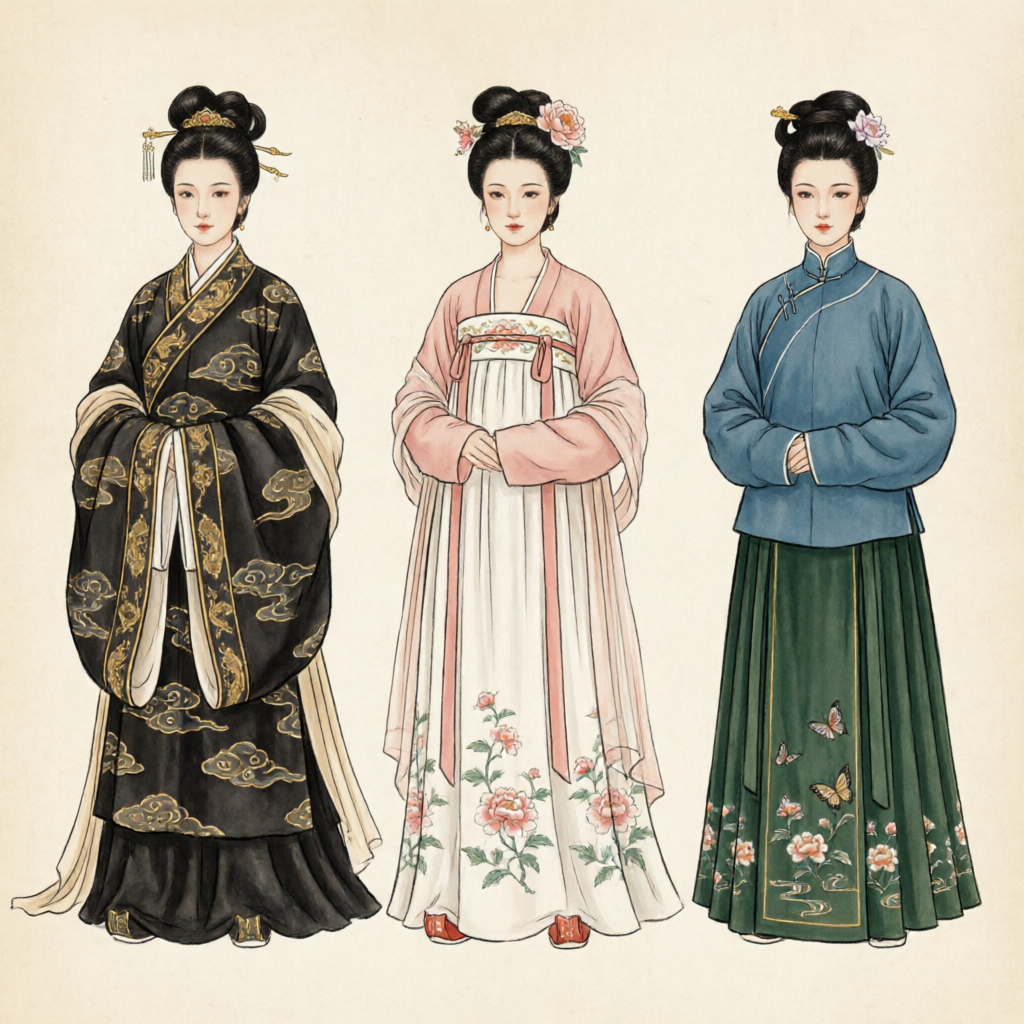
Hanfu (汉服) refers to the traditional clothing of the Han Chinese people, which has a rich history dating back over 3,000 years. The term "Hanfu" literally translates to "Han clothing" and encompasses a wide variety of styles and forms that evolved throughout Chinese history. Hanfu is characterized by its distinctive features such as the "jiao ling you ren" (交领右衽) collar system, wide sleeves, and the use of sashes and buttons rather than zippers. The clothing system represents not only aesthetic values but also cultural and philosophical concepts deeply rooted in Chinese tradition.
History
Origin and Formation
According to historical records, the basic form of Hanfu emerged during the time of the Yellow Emperor (黄帝), Yao (尧), and Shun (舜), with the complete system established during the Zhou Dynasty (1046-256 BCE). The clothing was passed down through the Qin and Han Dynasties and became popular among the common people. Through Confucianism and the Chinese legal system, Hanfu influenced the entire East Asian cultural sphere.
Archaeological evidence suggests that silk production began in China around 5000 BCE during the Yangshao culture period. The wife of the Yellow Emperor, Leizu (嫘祖), is traditionally credited with inventing sericulture and silk weaving. During the Shang Dynasty (1600-1046 BCE), people in the Central Plains commonly planted mulberry trees, raised silkworms, and wove silk, as evidenced by pictographic characters for silkworm, mulberry, and silk in oracle bone inscriptions.
After the Shang Dynasty, the冠服制度 (guanfu zhidu, or hat and robe system) was initially established. During the Western Zhou Dynasty (1046-771 BCE), the clothing system gradually developed into a complete "zhangfu zhidu" (章服制度, or ceremonial robe system) centered on the "mianfu" (冕服, or sacrificial robe). The phrase "cheng Yin zhi lu, fu Zhou zhi mian" (乘殷之辂,服周之冕) became a key principle of Confucian statecraft.
During the Spring and Autumn and Warring States periods (770-221 BCE), clothing styles became remarkably diverse. The "shen yi" (深衣, or deep robe) was created during this period, which became representative of the era's clothing. The "shen yi" was characterized by its connected upper and lower parts, distinguishing it from other garments where上衣 (shang yi, upper garment) and下裳 (xia chang, lower garment) were separate.
Later Development
After Qin Shi Huang unified China in 221 BCE, he established various systems including the clothing system. He abolished the core six-mianfu system of the Zhou Dynasty and created a new official attire system. Despite these changes, the overall clothing style still retained distinctive Han ethnic characteristics.
During the Western Han Dynasty (206 BCE-24 CE), the ceremonial system was formulated by 叔孙通 (Shusun Tong) based on the rituals of the Xia, Shang, and Zhou Dynasties. Men and women's clothing still followed the shen yi style. Typical women's shen yi during the Western Han included straight-lapel (zhi ju) and curved-lapel (qu ju) styles, with different tailoring from the Warring States period. Men's shen yi had wide collars extending to the shoulders, right-over-left lapels, and front panels hanging to the ground. For convenience of movement, the back panel was cut in a trapezoid shape below the knees, creating swallow-tail shaped sides.
Emperor Ming of the Eastern Han (r. 58-75 CE) restored the mianfu system that had been abandoned since the fall of the Zhou Dynasty. He established a Han Dynasty hat and robe system that distinguished rank primarily through帽冠 (mao guan, hats and caps), with an overall solemn and elegant style. This represented a cultural revival in the realm of clothing following Emperor Wu of Han's "disregard of the hundred schools of thought and sole respect for Confucianism".
During the Qin and Han Dynasties, men primarily wore wide-sleeved robe garments, mainly divided into qu ju (curved-lapel) and zhi ju (straight-lapel) robes, which could be worn on various occasions except for sacrificial ceremonies and court assemblies. Another characteristic of the Han Dynasty was the implementation of the "shou system" (绶制度), where different colored ribbons indicated rank.
The Shaving Hair and Changing Clothing Policy
After the Manchu-led Qing Dynasty established rule in China, it implemented the "剃发易服" (tifa yifu, or shaving hair and changing clothing) policy to weaken Han ethnic identity and maintain Manchu rule. Those who wore Han clothing and maintained their traditional hairstyle were subject to severe punishment.
After the Manchus entered the Shanhai Pass in 1644, they ordered Han Chinese to shave their hair and change their clothing, with the directive that "all clothing must follow our dynasty's system." In the second year of Shunzhi's reign (1645), the Qing government issued a nationwide order requiring hair shaving and clothing changes within ten days. Those who "still maintain the Ming system and do not follow our dynasty's system will be executed without mercy."
This policy was enforced brutally across China. Countless people were arrested and executed for wearing Han-style clothing. In Jiangyin, people resisted for three months before the city fell, with all residents fighting to the death rather than surrendering. Jiading residents also resisted for over two months, suffering a cruel massacre that became one of the most brutal atrocities in Chinese history.
In response to prolonged Han resistance, the Qing government proposed the "ten followings and ten non-followings" (十从十不从) policy, which allowed limited concessions in traditional Han clothing elements. However, overall, Hanfu gradually disappeared under the Qing government's violent suppression and massacres. For more than 200 years of Qing history, Han men's clothing was basically based on Manchu clothing, with qipao, long gowns, and mandarin jackets being developments and modifications of Manchu ethnic clothing rather than traditional Han ethnic clothing.
Survival and Revival
Although Hanfu disappeared under policies like the shaving hair and changing clothing policy, some of its elements never became extinct. They survived in the clothing of modern Chinese people who practice Taoism or Buddhism, in some remote mountain communities, and in the attire of many ethnic minorities in China. Elements of Hanfu can still be seen in important modern sacrificial ceremonies, commemorative activities, and folk festivals.
In the early 21st century, as China's national strength developed, people began to re-examine the excellent aspects of their traditional culture. Enthusiasts of traditional culture researched Hanfu, extracting its essence while discarding its drawbacks, and restored traditional Han clothing. They promoted Hanfu by wearing it during traditional festivals, advocating traditional teachings, and playing traditional musical instruments. This process became known as the "Hanfu movement" (汉服运动).
Key Information
| Feature | Description |
|---|---|
| Primary Materials | Silk, hemp, cotton, ramie (夏布, xiabu) |
| Construction Components | Collar (领), lapel (襟), right-over-left overlap (衽), garment panel (衿), hem (裾), sleeve (袖), sleeve cuff (袂), sash (带), knee-cover (韨) |
| Main Types | Deep robe (深衣), upper garment and lower skirt (上衣下裳) |
| Distinctive Features | Cross-collar right-over-left (交领右衽), wide sleeves (褒衣广袖), hidden buttons (系带隐扣) |
| Historical Periods | Shang Dynasty (1600-1046 BCE), Zhou Dynasty (1046-256 BCE), Han Dynasty (206 BCE-220 CE), Tang Dynasty (618-907 CE), Song Dynasty (960-1279 CE), Ming Dynasty (1368-1644 CE) |
Cultural Significance
Hanfu represents more than just clothing; it embodies cultural and philosophical concepts deeply rooted in Chinese tradition. The "jiao ling you ren" (交领右衽) collar system, with the left lapel crossing over the right, symbolizes symmetry and the Confucian concept of "not leaning to either side" (不偏不倚). The round sleeves represent "heaven" in the "heaven-round earth-square" (天圆地方) cosmological concept.
The system of three layers of clothing—undergarment (小衣), middle garment (中衣), and outer garment (大衣)—reflects the hierarchical structure of traditional Chinese society. Different styles of Hanfu were appropriate for various occasions, from formal court ceremonies to everyday life, reflecting the importance of ritual propriety (礼) in Confucian thought.
Modern Status
Since the early 21st century, Hanfu has experienced a revival in mainland China, particularly among young people interested in traditional culture. The Hanfu movement has grown into a significant cultural phenomenon, with enthusiasts organizing public events, creating online communities, and establishing businesses specializing in traditional Chinese clothing.
Modern Hanfu enthusiasts focus on historical accuracy while adapting traditional styles for contemporary wear. The movement has sparked academic research into historical clothing, textile production techniques, and cultural preservation. Despite challenges in defining authenticity and addressing commercialization, Hanfu continues to serve as a means of cultural identity and heritage expression for many Chinese people.
References
- Yang, B. (2004). The History of Chinese Clothing. Yale University Press.
- Feng, Q. (2010). Traditional Chinese Costumes: From Hanfu to Cheongsam. Cambridge University Press.
- Li, W. (2015). Cultural Identity and Costume Revival: The Hanfu Movement in Contemporary China. Journal of Asian Studies, 74(3), 657-678.
- Zhao, M. (2018). Silk, Symbols, and Power: The Cultural Significance of Traditional Chinese Dress. University of Hawaii Press.
- Chen, X. (2020). From Historical Garments to Modern Identity: The Revival of Hanfu in 21st Century China. Fashion Theory, 24(5), 623-645.