Hot Pot
Overview
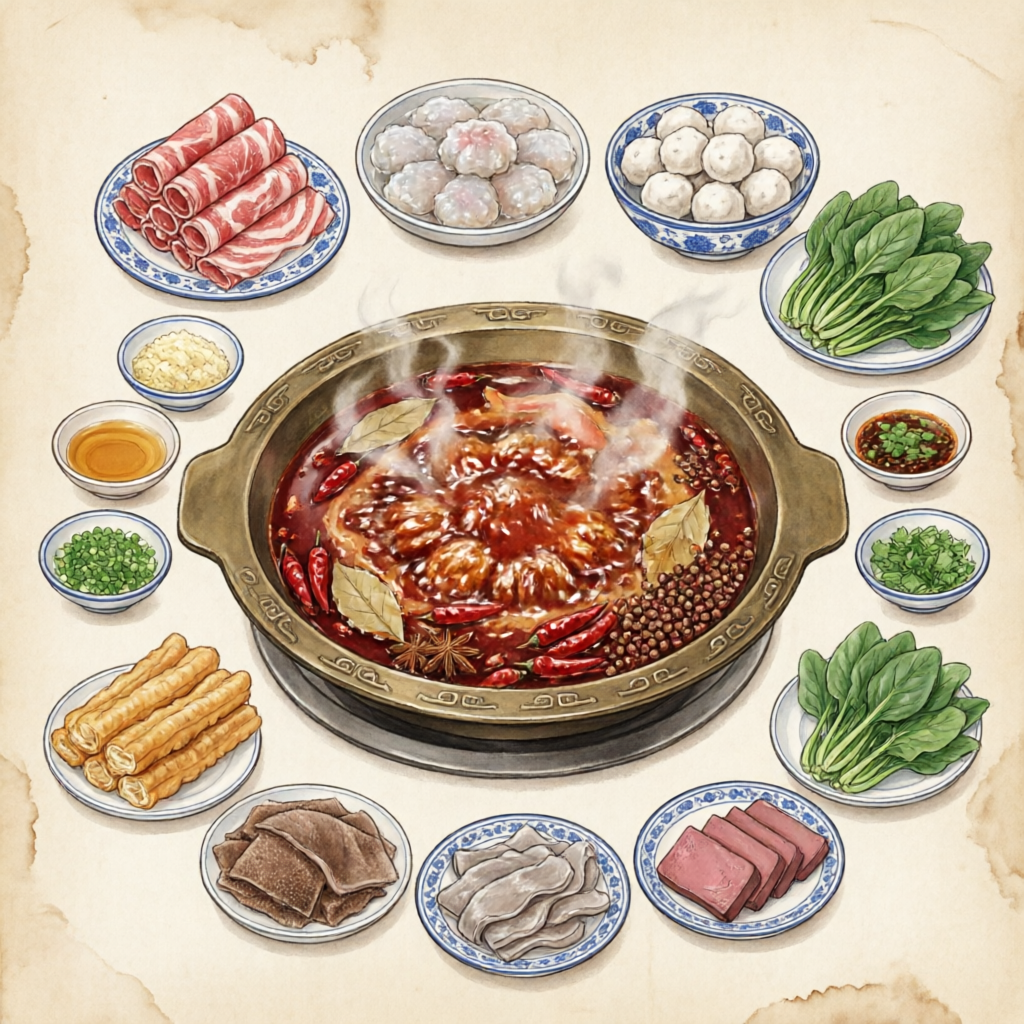
Hot pot is a cooking method that involves a simmering pot of soup stock at the center of the dining table, where ingredients are cooked and shared among diners. This culinary tradition, which has evolved over thousands of years in China and spread across Asia and beyond, represents more than just a meal—it embodies a social custom that brings people together around shared warmth and conviviality. The practice involves a wide variety of broths, ingredients, and dipping sauces, with regional variations reflecting local tastes and ingredients. Hot pot can be enjoyed year-round but is particularly popular during colder months in many cultures.
History
The origins of hot pot are debated among historians, with two primary theories regarding its inception. One theory suggests that hot pot existed as early as the Warring States period (475-221 BCE), when people used earthenware pots for cooking. Another theory posits that hot pot began in the Han Dynasty (206 BCE-220 CE), with the "dou" (a type of vessel) being considered an early form of hot pot. Archaeological evidence supporting the latter theory was unearthed from the tomb of the Marquis of Haihun, a Western Han Dynasty noble, which contained actual hot pot artifacts.
Historical records from the Three Kingdoms period (220-280 CE) mention copper hot pots used to boil various meats including pork, beef, lamb, chicken, and fish. However, hot pot was not yet popular at that time. During the Northern Song Dynasty (960-1127 CE), hot pot had become common in restaurants in Bianjing (modern-day Kaifeng), with establishments serving hot pot during winter months.
The Southern Song Dynasty (1127-1279 CE) saw further development of hot pot culture, as documented in Lin Hong's cookbook "Shan Jia Qing Gong" ("Mountain Home's Simple Delights"), which described a hot pot meal with friends. During the Yuan Dynasty (1271-1368 CE), hot pot spread to Mongolia, and by the Ming and Qing dynasties (1368-1912 CE), it had become not only popular among common people but also a famous "court dish" featuring ingredients like pheasant and other game.
By the late Qing Dynasty and early Republican period, dozens of distinct regional hot pot styles had emerged throughout China, each with its own characteristics. Hot pot was introduced to Japan during the Muromachi period (1338-1573 CE), where it became known as "sukiyaki" (also called "susuki"). Today, hot pot has spread to countries including the United States, France, and the United Kingdom.
Key Information
| Aspect | Description |
|---|---|
| Chinese Name | 火锅 (Huǒguō) |
| Alternative Names | Various regional names including "打边炉" (Dǎ biān lú) in Guangdong |
| Classification | Numerous varieties including copper pot lamb hot pot, yin-yang hot pot, mala (numbing-spicy) hot pot, Chaoshan beef hot pot, clear broth hot pot, sour soup hot pot, lamb hot pot, pig's knuckle hot pot, tomato hot pot, and pepper-ma hot pot |
| Taste Profiles | Light, numbing-spicy, sour, fresh and sweet, or customized according to diner preferences |
| Main Ingredients | Meats, egg products, vegetables, bean products, mushrooms, noodles and vermicelli, bones, meat oil, seafood, etc. |
| Cuisine Category | Highly diverse with no single classification |
| Seasonality | Suitable for all seasons, particularly popular in winter |
| Regions of Origin | Primarily Sichuan and Chongqing regions |
| Distribution | Throughout China and internationally |
| Cooking Method | Simmering over charcoal or other heat source |
Cultural Significance
Hot pot transcends mere culinary function in many cultures, serving as a social ritual that embodies community and togetherness. In China, the circular arrangement of diners around a central pot reflects traditional values of harmony and reunion (tuán yuán). This communal dining experience is particularly significant during family gatherings and festive occasions.
Regional customs associated with hot pot vary across China. In Northeast China, ingredients are arranged in the hot pot according to specific rules: "qian fei hou zou, zuo you you xia, si zhou qing sa cai hua" (flying birds in front, walking beasts behind, fish on the left, shrimp on the right, with vegetables sprinkled around like "stars surrounding the moon"). This arrangement shows respect to guests. In Chongqing, China's "hot pot capital," diners typically use basic seasonings like scallions, ginger, garlic, and sesame oil to appreciate the original flavors of the broth. Vegetables like bean sprouts and mushrooms are added first, followed by meats like tripe and duck intestine, which are cooked with a specific "seven up, eight down" method for optimal tenderness.
In Taiwan, hot pot is traditionally eaten on the seventh day of the Lunar New Year with seven specific ingredients: celery, garlic, scallions, coriander, chives, fish, and meat. These symbolize "diligence, calculation, intelligence, good relationships, lasting happiness, abundance, and prosperity" respectively.
Modern Status
Today, hot pot has evolved into a global culinary phenomenon with countless regional variations and innovations. In China, the hot pot market continues to expand and diversify, particularly in northern regions where cold, dry weather creates favorable conditions for its popularity. The industry has seen continuous innovation in both variety and business models, with distinct schools including the "south school" represented by Chongqing hot pot known for its "ma, la, tang" (numbing, spicy, hot) characteristics, and the "north school" represented by lamb hot pot.
Recent market trends show significant growth in specific regional styles. As of 2023, the number of new Chaoshan beef hot pot establishments exceeded 10,000, making it one of the major schools of hot pot consumption alongside Sichuan-Chongqing style hot pot. Modern hot pot restaurants offer diverse options based on cooking fuel (charcoal, gas, electric, alcohol), pot material (tin, aluminum, stainless steel, enamel), structure (integrated, separate, yin-yang), and cooking style (broth, clear stew, boiled).
Internationally, hot pot has been adapted to local tastes and ingredients. In India, "curry hot pot" features local curry leaves, coconut powder, and spices with ingredients like fish heads, shrimp, chicken, and beef. Korean hot pot typically features "kimchi and pork belly" in a broth made with sea cucumber. Swiss cheese hot pot involves melting cheese in wine and dipping French bread, while chocolate hot pot involves dipping fruits in melted chocolate. Italian hot pot features beef slices, ham, pork chops, and shrimp with spinach and onions.
References
-
Anderson, E. N. (2014). The Food of China. Yale University Press.
-
Huang, H. T. (2016). Fermented Foods in China: History, Culture, and Nutrition. Springer.
-
Jing, L., & Liu, W. (2020). "Regional Diversity and Evolution of Hot Pot Cuisine in China." Journal of Ethnic Foods, 7(1), 1-15.
-
Kwok, C. (2018). Chinese Culinary History: From the Stone Age to the Present. Routledge.
-
Zhang, Y. (2022). "Social Dimensions of Hot Pot Consumption in Contemporary China." Food, Culture and Society, 25(3), 345-362.