Overview
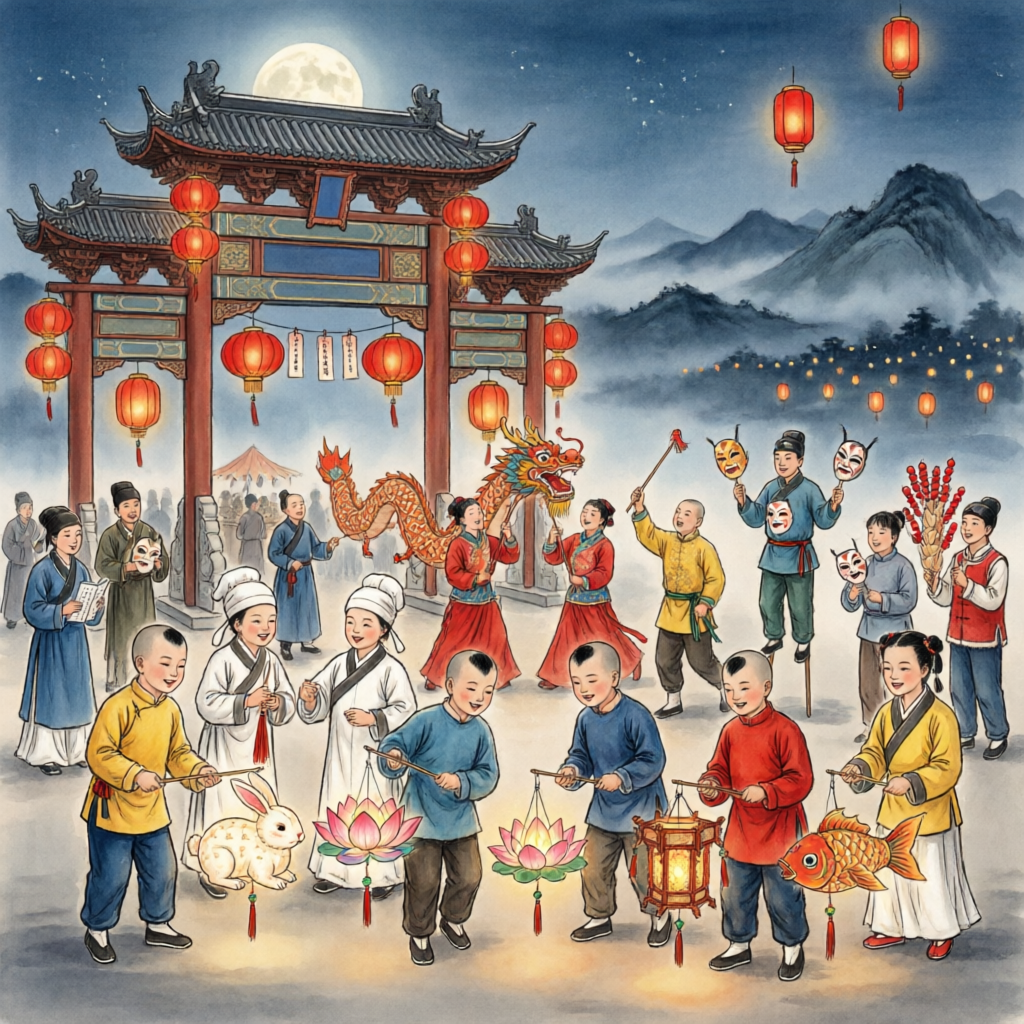
The Lantern Festival, also known as Shangyuan Festival (上元节), is a traditional Chinese festival celebrated on the 15th day of the first lunar month in the Chinese calendar. As one of the most important traditional festivals in China, it marks the first full moon of the new lunar year and symbolizes family reunion and the coming of spring. The festival is characterized by colorful lantern displays, eating tangyuan (元宵) or yuanxiao (汤圆), solving riddles, and various folk performances. It has a history spanning over 2,000 years and is celebrated not only in China but also in other countries with significant Chinese populations.
History
Origins
Several theories exist regarding the origins of the Lantern Festival:
-
Emperor Wen of Han Theory: According to historical records, after the death of Emperor Hui of Han (Liu Ying), his mother Empress Lü seized power. After Empress Lü's death in 180 BCE, Zhou Bo and others eliminated the Lü clan and installed Liu Heng as Emperor Wen of Han. The day of this victory coincided with the 15th day of the first lunar month. To celebrate, Emperor Wen ordered that night to be spent outside the palace enjoying festivities with the common people. As "yuan" (元) means "first" and "xiao" (宵) means "night" in classical Chinese, Emperor Wen designated this day as the Lantern Festival.
-
Worship of Taiyi God: This theory comes from the Records of the Grand Historian·Book of Music, which states: "The Han dynasty often offered sacrifices to Taiyi at Ganquan on the first day of the first lunar month, with ceremonies continuing from dusk until dawn, often with meteors passing over the altar." This account shares many similarities with the Lantern Festival customs. Song dynasty scholar Hong Mai and Zhu Bian both supported this theory, which was later adopted by Wang Sanping in his Ancient and Modern Textual Research. It is said that when Sima Qiang created the "Taichu calendar," he already designated the Lantern Festival as a major festival.
-
Daoist Theory: Daoist cosmology divides the universe into three realms (heaven, earth, and water) governed by three officials (Tian Guan, Di Guan, Shui Guan). By the Northern Wei Dynasty, these officials were associated with the Three Yuan Festivals. The 15th day of the first lunar month was designated as the birthday of Tian Guan (the Heavenly Official), known as Shangyuan Festival. The 15th day of the seventh lunar month was Zhongyuan Festival (birthday of Di Guan), and the 15th day of the tenth lunar month was Xiayuan Festival (birthday of Shui Guan). This "Three Realms and Three Officials" concept first appeared in the late Eastern Jin and early Liu Song dynasty text Taishang Dongxuan Lingbao San Yuan Pin Jing.
-
Buddhist Theory: This theory suggests that the Lantern Festival originated from Buddhism. The Sishi Guangji cites the Monk History·Han Daben Zhuan, stating: "On the 30th day of the 12th lunar month in the Western Regions, which corresponds to the 15th day of the first lunar month in China, it is called the 'Great God Transformation Month.' Emperor Ming of Han ordered lamps to be lit to represent the great brilliance of Buddhism." The earliest document directly linking lantern lighting with Buddhism is Emperor Jianwen of Liang's poem "Lighting Lanterns on the Eighth Day of the First Lunar Month." During the Northern and Southern Dynasties, lighting lanterns during the Lantern Festival gradually became popular, and by the Sui and Tang dynasties, it had formally become a folk custom.
Historical Development
The Eastern Han Dynasty's introduction of Buddhist culture played a significant role in shaping Lantern Festival customs. During the Eastern Han period, court gatherings on New Year's Day already included both bonfires and lantern lighting. Fu Xuan's "Court Assembly Ode" from the Jin Dynasty describes the lanterns of the New Year court assembly: "On the eve of the three court assemblies, torches illuminated the courtyard. Ornate lanterns resembled trees of fire, with hundreds of branches shining brightly."
During the Northern and Southern Dynasties, lantern lighting during the Lantern Festival gradually became fashionable. Emperor Wu of Liang, a devout Buddhist, had grand lantern displays in his palace on the 15th day of the first lunar month. During the Liang Dynasty of the Southern Dynasties, Wu Jun's poem "Ode to Lanterns" mentions "comparing to the fifteenth night, cassia trees grow in the moon." The "fifteenth" refers to "three-five-fifteen," i.e., Shangyuan (the first full moon). This historical period marked the formation stage of the Shangyuan Festival.
During the Sui Dynasty, the Lantern Festival on the 15th day of the first lunar month was already spectacular. The Book of Sui·Biography of Liu Yu records: "Every full moon night of the first lunar month, streets and alleys were filled with people gathering for entertainment. Drums deafened the sky, torches illuminated the earth." This account, from Liu Yu's memorial in the third year of the Kaihuang era (583), shows that the Lantern Festival in Sui Dynasty's capital Chang'an was a large-scale entertainment-focused festival.
In the Tang Dynasty, lighting lanterns during the Lantern Festival became legally stipulated. Cultural exchange between China and foreign countries was more intimate, and Buddhism flourished. Officials and common people普遍 "lit lamps to worship Buddha" on the 15th day of the first lunar month. The Tang Dynasty Lantern Festival was even more lively than that of the Sui Dynasty. In the fourth year of the Jinglong era (710), Emperor Ruizong and his queen went incognito to view the lanterns that night. Thousands of palace maids were allowed to view the lanterns. The next day, they again went incognito to view the lanterns. It was believed that on Shangyuan night, deities descended to earth, so lanterns were lit for three nights (from the 14th to the 16th), later extended to five nights.
In the Song Dynasty, the most lively and grand festival was not the Spring Festival but the Lantern Festival. During the lantern festival period, not only were the lanterns brilliant, but also songs, dances, and various performances filled the streets and alleys. "Every household had lanterns, and everywhere was filled with music." "The varieties of lanterns were numerous," "exquisitely beautiful," and "ingeniously diverse, renewing people's senses daily." In addition to the carnival where "women went out to the streets, from night till dawn, men and women mixing," there was another custom: the emperor celebrated with the people to show closeness to the populace. A Song Dynasty poem states: "Playing music of Shun, offering cups of Yao, the emperor announces on horseback to go to the heavenly street. The emperor is pleased to celebrate with the people, and cheers come from all directions." This describes the scene of the Song emperor viewing the Lantern Festival with the people at Xuanmen Gate.
During the Yuan Dynasty, most holidays were canceled, and folk lantern lighting was prohibited. "Every time during the Lantern Festival, even in the markets and streets, lanterns were forbidden." The Yuan rulers believed that life lies in movement, and work is rest.
In the Ming Dynasty, fireworks and lanterns reached their peak, connecting with the Spring Festival. Daytime markets were bustling, while nighttime lantern displays were spectacular. The "Ming Xianzong Lantern Festival Celebration Painting" now housed in the National Museum of China vividly depicts the "Lantern Festival celebration" scene in the Forbidden City over 500 years ago. In 1485, Emperor Xianzong of Ming, Zhu Jianchen, ordered a grand celebration in the palace. Lanterns and colored decorations were hung inside and outside the palace, creating a lively and festive atmosphere. Everyone wore festive clothing, and joy was evident on their faces. Court painters followed Emperor Xianzong from morning till night, faithfully recording the lively scenes they witnessed.
During the Qing Dynasty, with foreign rule over the Central Plains, the Da Qing Hui Dian records show that from the first year of Chongde (1636), the Qing court's Shangyuan Festival was set for three days (14th to 16th of the first lunar month). During these three days, officials had to wear court robes, not handle criminal cases, and not conduct business, except for urgent matters. If activities were held, they had to be accompanied by ritual music. During the Lantern Festival, various types of lanterns were hung in the Forbidden City. According to the Qinding Gongzhong Xianxing Zeli, on the 24th day of the 12th lunar month each year, the Minister of the Imperial Household Department led officials and servants to set up "Heavenly Lanterns" and "Longevity Lanterns" in front of the Hall of Heavenly Purity. The Heavenly Lanterns were lit every evening from the day of their setup until the third day of the second lunar month. The Longevity Lanterns were connected daily from their setup until New Year's Eve, when the emperor held a banquet in the Hall of Preserving Harmony, the lantern connections were replaced with flower lanterns, and two corridor rail lanterns were set up at this time.
From the eleventh year of Kangxi (1672), the Qing court customarily banqueted foreign vassals on the 14th and 15th of the first lunar month. In the early Kangxi period, the banquet was held in the palace; in the late Kangxi period, it was moved to the Garden of Perfect Brightness; from the Yongzheng era onward, it was held at the Hall of Upright Brightness and the Hill and Water Longevity Pavilion in the Garden of Perfect Brightness. An important part of the banquet was lantern plays. Folk lantern festivals were magnificent, with brilliant and exquisite lanterns that remained very attractive.
Festival Period
There is still debate among scholars regarding the定型 period of the Lantern Festival. However, it is generally believed that during the Han, Wei, and Six Dynasties periods, Lantern Festival customs had already appeared. After the Tang and Song dynasties, Lantern Festival customs gradually flourished along with the development of urban life, and many customs have been passed down to this day. As time passed, the Lantern Festival became more and more grand, with stronger ethnic characteristics, and the lantern festival period also became longer. In the Han Dynasty it was one day, in the Tang Dynasty three days, in the Song Dynasty five days, in the Ming Dynasty extended to ten full days (from the 8th to the 18th), the longest lantern festival in Chinese history, and in the Qing Dynasty shortened to four to five days.
Due to different lantern periods, the first day of lantern lighting was called "trial lanterns," the 15th day "main lanterns," and the last day "remaining lanterns" or "late lanterns." They were also called "divine lanterns," "human lanterns," and "ghost lanterns." The night of the 14th was called "divine lanterns," placed in front of home altars and ancestral halls to worship deities and ancestors; the 15th night was called "human lanterns," placed at doors, windows, beds, and tables to avoid scorpions; the night of the 16th was called "ghost lanterns," placed in tombs and wild fields to help wandering souls escape the ghost realm. It prayed for heaven's will and protected all living beings, leaving nothing out for gods, humans, ghosts, and livestock.
After the founding of New China, the Lantern Festival was never included as a legal holiday. At that time, New China was being rebuilt from scratch, and the common people who were in power for the first time in thousands of years enthusiastically devoted themselves to the cause of socialist construction. After 1979, the Spring Festival holiday was extended to three days. In 2000, the "Golden Weeks" of Spring Festival, May Day, and National Day were historically established; in 2008, the three traditional festivals of Qingming Festival, Dragon Boat Festival, and Mid-Autumn Festival were designated as new legal festivals. The Lantern Festival was still not designated as a legal holiday, not because it was unimportant, but because its date was too close to the Spring Festival. The ancients had holidays for the Lantern Festival because there was no major Spring Festival holiday period at that time.
| Dynasty | Description | Festival Period |
|---|---|---|
| Han | Shangyuan Day | 1 day |
| Tang | One day before and after Shangyuan | 3 days |
| Song | One day before and three days after Shangyuan | 5 days |
| Ming | 8th to 18th day of first lunar month | 10 days |
| Qing | Northern China | 3 days |
| Southern China | 5-6 days |
Folk Legends
According to folk legends, lantern appreciation began in ancient times when people in the countryside held torches to drive away insects and beasts, hoping to reduce pests and pray for a good harvest. To this day, people in some regions of southwestern China still make torches from reeds or branches on the 15th day of the first lunar month, dancing in groups in fields or threshing grounds while holding torches.
Dongfang Shuo, a favorite minister of Emperor Wu of Han, was witty and kind. One winter day, while appreciating plum blossoms in the imperial garden, he encountered a palace maid who wanted to jump into a well. After rescuing her, Dongfang Shuo learned her name was Yuanxiao. She had been in the palace for a long time and couldn't see her family, leading her to consider suicide. Dongfang Shuo sympathized and promised to help. Dongfang Shuo set up a fortune-telling stall, and everyone who asked for a fortune got the result "fire will burn you on the 16th day of the first lunar month," causing panic in Chang'an. Emperor Wu consulted Dongfang Shuo, who explained: "Chang'an is in danger, fire will burn the imperial palace, on the 15th day, fire will illuminate the night." He suggested that on the evening of the 15th, every household would hang lanterns and eat yuanxiao, and people from outside the city would enter to view the lanterns, making it look like the whole city was on fire to deceive the Jade Emperor. That evening, Yuanxiao's parents entered the city to view the lanterns. With Dongfang Shuo's help, the family was finally reunited.
Another legend tells of Yuan Shikai renaming "yuanxiao" to "tangyuan." It is said that after Yuan Shikai usurped the fruits of the Xinhai Revolution and wanted to restore the monarchy and become emperor, he was worried about public opposition and lived in fear. One day, he heard a street vendor shouting "yuan—xiao" with an elongated voice. He felt that "yuanxiao" sounded like "Yuan xiao" (Yuan Shikai being eliminated), which reminded him of his own fate. Therefore, in 1913 before the Lantern Festival, he ordered that "yuanxiao" could only be called "tangyuan" or "fruit balls." However, the term "yuanxiao" was not eliminated because of his will, and the common people ignored his order and continued to use it.
Festival Customs
Folk Activities
In the Tang and Song dynasties, eating "miancan" (face silkworm) became popular. Wang Renyu's "Kaizhi Tianbao Yishi" records: "Every year during Shangyuan, people in the Tang capital made miancan." This custom continued in the Song Dynasty, but the seasonal foods were more abundant than in the Tang Dynasty. "Shi Za Ji" detailedly reflects the custom of eating "mianjian" (face cocoon) in Bianjing (modern Kaifeng) during the Shangyuan Festival. It is known that mianjian was a steamed bun with meat or vegetable filling. Paper slips or wooden pieces with official ranks were placed in the filling to predict future official positions. Or auspicious phrases from ancient and modern famous sayings that could predict one's future were selected.
The earliest record of eating yuanxiao during the Lantern Festival appears in the Song Dynasty. At that time, yuanxiao was called "fuyuanzi," "yuanzi," "rutang yuanzi," and "tangyuan." According to historical records such as "Pingyuan Xugao," "Shiguang Ji," and "Daming Yitong Fu," yuanxiao as a seasonal food for celebrating the Lantern Festival began in the Song Dynasty. Because "yuanzi" must be eaten during the Lantern Festival, people named it "yuanxiao." Song dynasty scholar Zhou Bi's poem "Yuanxiao Zhu Fuyuanzi Qianbei Siwei Weichang Ci Ci Siyun" mentions: "Stars shine in the dark clouds, pearls float in turbid water." "Fuyuanzi" is "tangyuan." Eating tangyuan during the Lantern Festival symbolizes reunion of family members and happiness and well-being. Poet Jiang Baishi wrote in his poem "Ode to Yuanxiao": "Noble guests open the curtain to view the imperial street, rare products in the market arrive at once." This "rare product in the market" refers to yuanxiao.
Zheng Wangzhi's "Shenfu Lu" from the Song Dynasty records: "Bianzhong seasonal food, Shangyuan youchui." The method of making youchui, according to a "Shangshi Ling" record cited in "Taiping Guangji," was made by soft bread with jujube filling, fried until "its taste is crisp and delicious," which is today's fried yuanxiao. Some people called it "oil painting bright pearl." By the Southern Song Dynasty, so-called "rutang yuanzi" appeared, which should be the predecessor of today's tangyuan.
In the Ming Dynasty, the names "tangyuan" and "yuanxiao" also appeared. "Ming Gong Shi" from the late Ming Dynasty records Beijing's Shangyuan Festival "eating yuanxiao, its method uses glutinous rice flour, with walnut kernels and brown sugar as filling, boiled into walnut-sized balls, which are what is called tangyuan in Jiangnan." The name tangyuan is still popular in the south today. The name yuanxiao is not only popular in the north but also widespread in the south.
During the Kangxi period of the Qing Dynasty, the imperial kitchen specially made "Babao Yuanxiao," a famous delicacy known throughout the court. Ma Siyuan was a master yuanxiao maker in Beijing at that time. His "difen yuanxiao" (dipped powder yuanxiao) was famous far and wide. Fu Zeng (born 1688) wrote in his "Shangyuan Zhuzhi Ci": "Osmanthus fragrance wraps walnuts, glutinous rice like pearls washed in well water. I hear Ma's dipped powder is good, selling yuanxiao in the trial wind." The poem describes the famous Ma's yuanxiao.
In modern times, the production of yuanxiao has become more and more exquisite. In terms of dough, there are glutinous rice flour, sticky sorghum flour, millet flour, and corn flour. The fillings are sweet, salty, meat, and vegetable, with different production methods in the north and south. Yuanxiao can be as large as walnuts or as small as soybeans. Cooking methods include boiling, stir-frying, deep-frying, and steaming. In addition to being eaten by themselves, yuanxiao are also given as gifts to each other and are sacrificial items for worshipping gods and ancestors.
"Yuanxiao" and "tangyuan" look similar, but they are made differently and have slightly different textures. After the Ming Dynasty, the round seasonal foods called "yuanzi" in the Song Dynasty were again called tangyuan or yuanxiao. The term "yuanxiao" is mainly popular in northern China, while "tangyuan" is more commonly used in southern China. In the north, "roll" yuanxiao; in the south, "wrap" tangyuan. One uses dry flour, the other uses wet flour. The fillings are also somewhat different; yuanxiao is mostly sweet filling, while tangyuan has sweet, salty, meat, and vegetable fillings. Sweet fillings include osmanthus brown sugar, hawthorn brown sugar, assorted, bean paste, sesame, peanut, etc. The salty filling is pork filling. There are also "five-spice" yuanxiao made with mustard, garlic, leek, and ginger, symbolizing diligence, longevity, and upward progress. They can be cooked by boiling, frying, steaming, or deep-frying.
The Spring Festival, as the traditional major festival of the Chinese nation, includes two parts: busy New Year (welcoming the New Year) and bidding farewell to the old year (bidding farewell to the old year). In time, it generally starts from the eighth day of the twelfth lunar month and ends on the fifteenth day of the first lunar month. The Lantern Festival is the finale of Chinese New Year customs activities. From ancient times to the present, it embodies the word "lively" (闹), and it's lively at night. On this night when the bright moon hangs high, people light thousands of colorful lanterns to celebrate. Going out to admire the moon, lighting lanterns and setting off fireworks, happily guessing lantern riddles, eating yuanxiao together, family reunion, and celebrating the festival together, all bring joy and harmony.
During the Sui, Tang, and Song dynasties, the Lantern Festival was extremely popular. The number of people participating in songs and dances reached tens of thousands, continuing from dusk till dawn until the end of the month. In the Ming and Qing dynasties, the common people celebrated the Lantern Festival very lively, with various musical instruments, songs, and dances performing competitively. Gu Lu's "Qing Ji Lu" records that in Suzhou during the Qing Dynasty, "before and after the Lantern Festival, every household used gongs, drums, cymbals, and gongs to beat rhythms, called 'nao Lantern Festival' (making lively Lantern Festival)." Qing Yongzheng "Shuozhou Zhi" records that the common people "set up Aoshan, burn旺火, hang lanterns and set off fireworks, and feast together," called "nao Lantern Festival." Even today, people in some southwestern regions of China still make torches from reeds or branches on the 15th day of the first lunar month, dancing in groups in fields or threshing grounds while holding torches.
In ancient China, the Lantern Festival was a full of romantic color festival. During the Lantern Festival period, it was an opportunity for young men and women to meet with their lovers. Therefore, the Lantern Festival can be said to be a genuine Chinese Valentine's Day. Folklore expert Fang Xiao explained that this name comes from the fact that the Lantern Festival was a rare time in ancient China when men and women could have contact.
The ancient Chinese implemented a curfew system, and women were constrained by etiquette. The carnival of the Lantern Festival gave women in deep boudoirs the opportunity to go out at night. It also provided an opportunity for unmarried men and women to meet, can go out together, and appreciating lanterns during the Lantern Festival was exactly an opportunity for socializing. Those who were originally lovers could date during the Lantern Festival. An ancient painting "Shangyuan Dengcai Tu" from the Ming Dynasty depicts a large-scale ancient social gathering. "Men and women playing together" is a special cultural landscape of the Lantern Festival. According to the "Book of Sui·Biography of Liu Yu," "Every full moon night of the first lunar month, streets and alleys were filled with people gathering for entertainment. Drums deafened the sky, torches illuminated the earth. People wore animal masks, men dressed as women, and actors and acrobats performed in strange shapes." The scene was comparable to a masquerade ball. In the TV series "The Legend of the Palace of the Tang Dynasty," Princess Taiping and Xue Shao first met on the street market during the Lantern Festival. Xue Shao wearing a Kunlun slave mask has become a "classic Lantern Festival story" in many people's hearts. Many classic poems were born during the Lantern Festival.
Lantern Displays
Lanterns are said to have originated in the Han Dynasty and flourished in the Tang and Song dynasties. Their widespread popularity was helped by China's traditional festivals—the Lantern Festival. Emperor Ming of Han promoted Buddhism. After learning that Buddhism had the practice of monks viewing Buddha's relics and lighting lamps to worship Buddha on the 15th day of the first lunar month, he ordered that night to light lamps in the imperial palace and temples, and for the aristocracy and common people to hang lanterns in the private sector, which gradually evolved into the custom of appreciating lanterns during the Lantern Festival. The Lantern Festival has become a grand festival for displaying and viewing lanterns from ancient times to the present.
Because the Lantern Festival is also an auspicious time for praying for children, it became a reason for ancient women to go out to appreciate lanterns. Song dynasty Chen Yuanjing's "Shiguang Ji" volume twelve "Tou Deng Zhan" explains why people stole lanterns during the Lantern Festival at that time: "One theory is that stealing lanterns is a sign of giving birth to a son." Here "lantern" (灯) is a homophone for "male offspring" (丁). In this way, stealing lanterns symbolizes giving birth to a son, and stealing lanterns is praying for descendants. According to the same logic, appreciating lanterns also has the meaning of praying for children. Thus, ancient women going out to view and appreciate lanterns had this reason, making it legitimate.
Lantern Riddles
Riddles have always been a traditional intellectual game in China. By the Song Dynasty, the Lantern Festival had taken on the meaning of an "intellectual festival," one sign of which was the emergence of "lantern riddles." In the Southern Song Dynasty, "lantern riddles" became an essential part of the Lantern Festival. Lantern riddles are riddles posted on Lantern Festival lanterns for people to guess, also known as "yuci" or "yinyu." Liu Xie of the Southern Liang Dynasty's "Wenxin Diaolong·Xie Yan" states: "Since the Wei Dynasty, this has been criticized as not for jesters, but scholars' teasing and hiding has evolved into riddles." According to Wu Zimu's "Meng Li Lu": "Those who guess riddles first beat a drum to announce, then gather people to guess poetry riddles, character riddles, li riddles, she riddles, which are originally hidden sayings. There are dao riddles, where guests recite thoughts to mock, also called da mi." Zhou Mi's "Wulin Old Matters" "Lantern Types" also has similar records: "Some use silk lanterns to cut and write poems, sometimes containing satire, and paint characters with hidden beginnings, and old Beijing slang to tease passersby."
Lantern riddles matured during the Ming and Qing dynasties. Qing Gu Lu's "Qing Ji Lu" records the scene of guessing lantern riddles in Suzhou during the Lantern Festival at that time: "Well-meaning people cleverly made hidden sayings and posted them on lanterns. One side of the lantern was against the wall, and the other three sides were posted with riddles for people to guess, called 'da deng mi' (guessing lantern riddles). The riddles came from classics, poems, various schools of thought, legendary novels, proverbs, objects, birds and scales, insects and shells, flowers, grasses, vegetables, and medicines, and were given out at will." Those who guessed correctly received prizes such as towels, fans, sachets, fruits, food, etc., called "mi zeng" (riddle gifts).
There is a legend that one year during the Lantern Festival, Emperor Qianlong took a group of civil and military officials to view the lanterns. When he was happy, Emperor Qianlong also came up with a riddle couplet for his ministers to guess. The accompanying scholar Ji Xiaolan thought for a moment, then wrote a couplet on a palace lantern: "Black is not, white is not, red and yellow are not. Similar to foxes, wolves, cats, and dogs, neither domestic animals nor wild beasts. Poems have, ci have, Confucius Analects has. Vague to east, west, south, and north, although short, it is also wonderful." Emperor Qianlong pondered, and the civil and military officials scratched their heads, unable to guess. Finally, Ji Xiaolan revealed the answer: guessing riddles.
Other Customs
In ancient China, there were "seven sacrifices," of which these were two. The method of sacrifice was to insert a poplar branch above the door, insert a pair of chopsticks in a bowl of bean porridge, or directly place wine and meat in front of the door.
"Song Deng" (sending lanterns), also known as "Song Hua Deng Deng" (sending flower lanterns), etc., refers to the custom of the wife's family sending flower lanterns to the daughter's family before the Lantern Festival, or general relatives sending to newly married childless families, to pray for the good omen of adding a son, because "lantern" (灯) is a homophone for "male offspring" (丁). This custom exists in many places. In Xi'an, Shaanxi, lanterns are sent from the eighth to the fifteenth day of the first lunar month. In the first year, a pair of large palace lanterns and a pair of painted glass lanterns are sent, hoping that the daughter will have good luck after marriage and give birth to a son soon. If the daughter is pregnant, in addition to the large palace lanterns, one or two pairs of small lanterns are also sent, wishing the daughter a safe pregnancy.
Zong Lin of the Southern Liang Dynasty's "Jing Chu Sui Ji" says: "On the evening of the Lantern Festival, welcome Zigu to predict future silkworm breeding and to predict various matters." Every Lantern Festival, some places have the custom of worshiping Zigu. Zigu is the "girl" god that ancient women worshiped. The custom of welcoming Zigu has existed since the Northern and Southern Dynasties.
Zigu is also called Qi Gu, and in northern China is often called Ce Gu (toilet goddess) or Kang San Gu (pit third goddess). The ancient folk custom was to worship the toilet goddess Zigu on the 15th day of the first lunar month, to predict silkworm breeding, and to predict various matters. Legend has it that Zigu was originally a concubine in a family, hated by the main wife, and killed in the toilet on the 15th day of the first lunar month, becoming the toilet goddess. On the night of welcoming Zigu, people use straw, cloth, and other materials to make a life-sized portrait of Zigu, and worship it in the toilet or pigsty at night. In the Ming and Qing dynasties, the belief in Zigu divination during Shangyuan was still common, and Zigu divination was mainly used for good or bad fortune, disaster or blessing, and abundant or poor harvest.
"Zhu Shu" (chasing mice) is a traditional folk activity during the Lantern Festival, starting from the Wei and Jin dynasties. This was mainly for sericulture families. Because mice often eat large quantities of silkworms at night, legend has it that on the 15th day of the first lunar month, feeding mice with glutinous porridge can prevent them from eating silkworms. Later this became a custom. Sericulture families would cook a large pot of sticky porridge on the 15th day of the first lunar month, some with a layer of meat on top. The porridge was served in bowls and placed in places where mice appeared, such as ceilings, corners, while muttering curses.
Modern Status
Today, the Lantern Festival remains an important traditional festival in China and among Chinese communities worldwide. While it is no longer a legal holiday in mainland China due to its proximity to the Spring Festival, it is still widely celebrated. Major cities organize lantern exhibitions and cultural activities, with some of the most famous being held in cities like Beijing, Nanjing, and Hong Kong.
The festival has also spread to other countries, particularly those with significant Chinese populations such as Singapore, Malaysia, and Indonesia. In recent years, digital lantern displays have become increasingly popular, combining traditional elements with modern technology.
Despite modernization, many traditional customs continue to be practiced, including eating tangyuan/yuanxiao, solving lantern riddles, and lion and dragon dances. The festival serves as an important cultural link connecting Chinese people around the world to their heritage.
Cultural Significance
The Lantern Festival carries rich cultural significance in Chinese society. It symbolizes family reunion and completeness, as the round shape of the tangyuan/yuanxiao represents family togetherness. The festival also marks the end of the Chinese New Year celebration period and the beginning of spring agricultural activities.
Historically, the Lantern Festival provided rare opportunities for social interaction between men and women in traditional Chinese society, earning it the reputation of "Chinese Valentine's Day." The bright lanterns symbolize hope and good fortune for the coming year.
The festival's various customs and activities reflect traditional Chinese values such as filial piety, respect for ancestors, and prayers for good harvests and prosperity. It also showcases Chinese artistic achievements in lantern making, poetry, and folk performances.
References
-
Zhang, J. (2010). Chinese Festivals: Their Origin and Symbolism. Cambridge University Press.
-
Jones, R., & Liu, W. (2015). The Lantern Festival: Tradition and Transformation in Modern China. Routledge.
-
Chao, K. (2018). Festivals and Food in Chinese Culture. University of Hawaii Press.
-
Li, Y. (2009). Traditional Chinese Festivals: Lantern Festival. China Intercontinental Press.
-
Wang, L. (2017). Chinese Cultural Heritage: The Lantern Festival. Springer.