Cantonese
Overview
Cantonese, also known as Yue Chinese, is a major variety of Chinese spoken by approximately 70 million people worldwide. It is the traditional prestige dialect of the Guangdong and Guangxi provinces, as well as the official language of Hong Kong and Macau. Cantonese is one of the most widely spoken Chinese dialects outside mainland China, serving as a lingua franca for many overseas Chinese communities, particularly in Southeast Asia, North America, and Europe. What distinguishes Cantonese is its tonal system, archaic vocabulary elements, and grammatical structures that preserve features of Middle Chinese, particularly its preserved final stops (-p, -t, -k) and tonal contrasts.
History
Pre-Qin Period
The linguistic ancestors of Cantonese began developing in the Lingnan region south of the Nanling Mountains approximately 129,000 years ago, evidenced by early human remains such as those of the Maba people. During the pre-Qin period, this area was inhabited by various Baiyue tribes, including the Xi'ou, Luoyue, and Nan'yue, who are ancestors of today's Zhuang, Dong, Li, Bouyei, Dai, Maonan, Mulao, Shui, and She peoples. During the Spring and Autumn and Warring States periods, the Lingnan region maintained close relations with the states of Wu, Yue, and Chu. Around this time, the population in Guangdong was sparse, and political entities were relatively loose, making the region a place where multiple cultures merged and coexisted.
Historical records indicate that before the Qin and Han dynasties, the Lingnan region was still in the late stage of primitive society, with relatively backward productivity and production relations compared to the Central Plains. After the Qin and Han dynasties, Zhao Tuo implemented the "policy of harmonizing the Baiyue" (和辑百越), introducing agricultural techniques and maritime culture from the Central Plains, which transformed the Lingnan region from a slash-and-burn agricultural society to a farming civilization, initiating a millennium of cultural prosperity for the region.
Qin and Han Dynasties
In 222 BCE, after Qin Shi Huang unified the six states, he ordered Tu Sui to lead 500,000 troops in five divisions to conquer the Lingnan region. One division attacked Dong'ou and Min'yue (modern Zhejiang and Fujian), two divisions attacked Nan'yue (modern Guangdong), and the remaining two divisions attacked Xi'ou (modern Guangxi). The first phase quickly conquered the Guangdong region with little resistance, but it took six years to subdue Guangxi and Vietnam at the cost of "hundreds of thousands of dead bodies and flowing blood." By 214 BCE, the Qin army had basically occupied the Lingnan region. Subsequently, Emperor Qin Shi Huang established three commanderies: Guilin, Xiang, and Nanhai.
Emperor Qin Shi Huang dug the Lingqu Canal to conquer the Lingnan region. After the war, most remaining soldiers stayed in Lingnan. To consolidate control, the central government relocated 500,000 people from the Central Plains. Besides officials who had been demoted, most were "merchants" (贾人), who were targets of the court's policy of "agriculture first, commerce second" (重农抑商). The court considered this a way to both punish merchants and penetrate the Lingnan region. According to records, there were roughly five batches of immigrants during the Qin Dynasty. To stabilize the military and solve the issue of spouses for stationed soldiers, the Nanhai Commandery applied to the court to send 30,000 single women to the Lingnan region, with the euphemistic reason: "to sew clothes for soldiers from the north." The Qin court approved the application but reduced the number to 15,000 widows and unmarried women from the Central Plains who joined the "support the frontier" campaign.
Since the Qin conquest of Lingnan 2,200 years ago, there have been at least six major immigration waves in the region. At that time, the Guangdong region had a sparse population, and the large-scale migration of people from the Central Plains promoted its development. By 2 CE, the population of Guangdong reached 375,200. During the Qin and Han dynasties, Guangzhou had become an important city and foreign trade port in southern China, but the economic and population center of Guangdong was still in northern Guangdong and the Xijiang River basin. This population distribution was related to the two routes of migration from the Central Plains to Guangdong: one was down the Xijiang River through the Xianggui Corridor, settling in places like Gaoyao and Luoding, with some reaching as far as the Leizhou Peninsula; the other was through mountain passes along the Zhejiang Ridge, descending along the Lianjiang River to reach northern Guangdong areas like Lianxian and Yangshan. This formed a population distribution in Han Dynasty Guangdong with the highest population in the northern mountain areas, followed by the Xijiang River basin. The Pearl River Delta and Chaoshan Plain remained sparsely populated and undeveloped until the Tang Dynasty, only developing rapidly during the Song Dynasty due to large-scale immigration.
After the fall of the Qin Dynasty, Zhao Tuo, the Nanhai Commandant, annexed Guilin and Xiang commanderies and declared himself king, establishing the short-lived Nanyue Kingdom. In 196 BCE, Emperor Gaozu of Han sent Lu Jia as an envoy to Nanyue. Zhao Tuo accepted the King of Nanyue seal from Emperor Gaozu and submitted to the Han Dynasty, making Nanyue a vassal state of Han.
Wei, Jin, Northern and Southern Dynasties
During the Wei, Jin, Northern and Southern Dynasties, the Central Plains region was again in a state of prolonged civil war. The "Yongjia Disturbance" (永嘉之乱) triggered the first major wave of migration from the Central Plains to Guangdong. A large number of scholars and commoners from the Central Plains moved to the Lingnan region, and the language of the Central Plains continuously influenced the local language. The gentry from the Central Plains gradually came to dominate the political, economic, and cultural development of the Lingnan region, promoting the development of Cantonese.
Tang and Song Dynasties
During the prosperous Tang Dynasty, the population of the Lingnan region further increased. After the fall of the Northern Song and at the end of the Southern Song, there were two waves of migration of aristocratic families, common people, and anti-Yuan soldiers fleeing south. The scale of immigration during the Song Dynasty far exceeded that of the Jin Dynasty. During this period, Cantonese continued to be influenced by the Central Plains language, becoming a language that both corresponded to Middle Chinese pronunciation and had some independent vocabulary. The Cantonese dialect of the Song Dynasty was probably similar to modern Cantonese, and its phonology and vocabulary may have laid the foundation for modern Cantonese. Therefore, the Tang and Song dynasties can be considered the formative period of Cantonese. As a result, modern Cantonese still corresponds to the pronunciation of the Guangyun dictionary from the Song Dynasty, but it is difficult to correspond to the pronunciation of ancient Chinese from the Yuan Dynasty or later.
Yuan, Ming and Early Qing Dynasties
During the Yuan Dynasty, the Mongols moved their capital to Dadu (modern Beijing) in the Yan Yun Sixteen Prefectures, using the local language as the official language. The Central Plains language at that time continuously diverged from Middle Chinese and Cantonese: the Central Plains language rapidly developed toward Beijing Mandarin, with the entering tones (入声) quickly disappearing (that is, the -p/-t/-k finals were lost, as the characters "入", "日", "北" all had different entering tone finals in Middle Chinese and modern Cantonese), and light tones appeared that were not part of the traditional four tones of "level-rising-falling-entering". The already established Cantonese, however, developed independently without influence from the Yuan Dynasty.
At the end of the Ming Dynasty, there was another wave of migration from the Central Plains to the Lingnan region. From the Ming Dynasty to the mid-Qing Dynasty, the finals of official Mandarin further disappeared (modern Mandarin only retains -n/-ng finals, with the -m final merging with the -n final). Also, the g/k/h initials before i/u vowels were completely palatalized into j/q/x initials (as the characters "吉", "其", "兮" all had g/k/h initials in Middle Chinese and modern Cantonese, but were completely palatalized into j/q/x initials in modern Mandarin). Between the 18th and 20th centuries (from the early Qing to the early Republic of China), a book called "Fen Yin Cuo Yao" (分韵撮要) was published, recording the phonology of Cantonese.
Modern Period
In modern times, although there was a trend of replacing classical Chinese with modern vernacular Chinese in formal writing, the actual use of Cantonese was not significantly restricted. However, after the founding of the People's Republic of China, the state standardized Mandarin as the national common language, and Cantonese has been increasingly influenced by Mandarin. This has led to many younger generations in Cantonese-speaking areas of mainland China not knowing the Cantonese pronunciation of certain specialized terms. This situation has caused many native Cantonese speakers to begin experiencing a sense of linguistic crisis.
Key Information
| Feature | Description |
|---|---|
| Language Family | Sino-Tibetan, Chinese branch |
| Geographic Distribution | Guangdong, Guangxi, Hong Kong, Macau, overseas Chinese communities |
| Official Status | Official language in Hong Kong and Macau |
| Speakers | Approximately 70 million worldwide |
| Writing System | Chinese characters with Cantonese-specific usage |
| Tonal System | Nine tones (six distinct tone contours with three entering tones) |
| Preservation of Features | Retains Middle Chinese phonological features, particularly entering tones |
| Linguistic Influence | Significant influence on other southern Chinese dialects |
Cultural Significance
Cantonese holds significant cultural importance, particularly in the Pearl River Delta region and among overseas Chinese communities. It is the language of Cantonese opera (粤剧), a traditional art form recognized by UNESCO as part of the Intangible Cultural Heritage of Humanity. Cantonese cinema, particularly Hong Kong films, has had a global influence since the mid-20th century.
The preservation of Middle Chinese features in Cantonese makes it particularly valuable for classical Chinese literature and poetry. Unlike Mandarin, which lacks entering tones, Cantonese can properly recite classical Chinese poetry with correct tonal patterns and rhymes. This has led to Cantonese being considered more "authentic" for traditional Chinese literary arts.
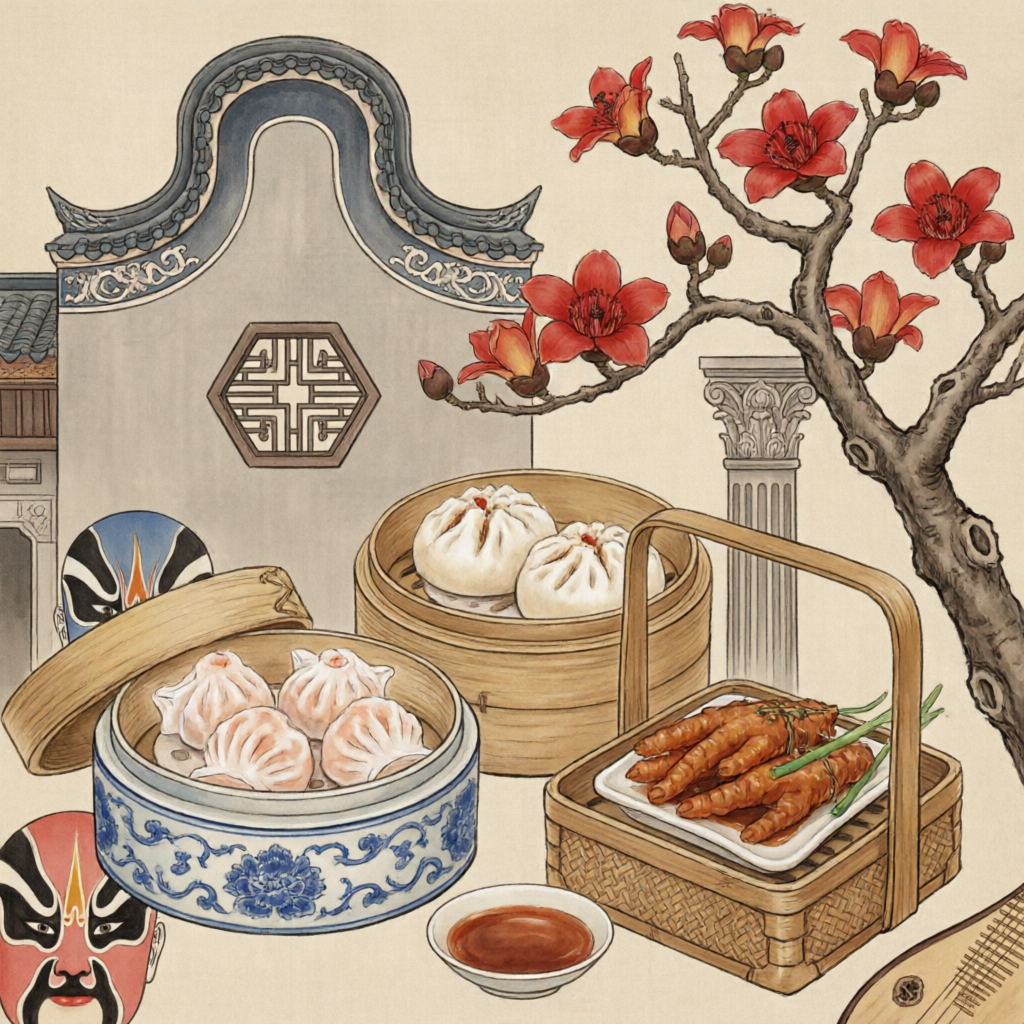
Cantonese cuisine, often referred to as "dim sum" (点心) culture, has become internationally famous and represents one of China's most influential culinary traditions. The language itself has contributed to the spread of Cantonese culinary terms worldwide, such as "dim sum," "wonton," "chow mein," and "yum cha" (饮茶).
Modern Status
Today, Cantonese faces challenges in mainland China due to the promotion of Mandarin as the official language. In Guangdong and Guangxi, while Cantonese remains widely spoken in informal settings, Mandarin dominates education, media, and official contexts. This has led to concerns about language preservation and a "mother language crisis" among younger generations.
In contrast, Cantonese maintains strong vitality in Hong Kong and Macau, where it is an official language and the primary medium of instruction, media, and daily communication. Hong Kong Cantonese has developed its own distinctive characteristics and has been influential in popular culture throughout East Asia.
Globally, Cantonese remains one of the most widely spoken Chinese dialects among overseas Chinese communities. It is the third most spoken Chinese dialect in the United States and Canada, and the fourth most spoken language in Australia. Cantonese media, particularly television programs and music from Hong Kong, continue to have significant influence in Chinese communities worldwide.
References
-
Ramsey, S. Robert. (2015). The Languages of China. Princeton University Press.
-
Chao, Yuen Ren. (1947). Cantonese Primer: Grammar and Character Text in Written Vernacular. Harvard University Press.
-
Li, Charles N., & Sandra A. Thompson. (1981). Mandarin Chinese: A Functional Reference Grammar. University of California Press.
-
Bauer, Robert S., & Paul K. Benedict. (1997). Modern Cantonese Phonology. Walter de Gruyter.
-
Norman, Jerry. (1988). Chinese. Cambridge University Press.