Shadow Puppetry
Overview
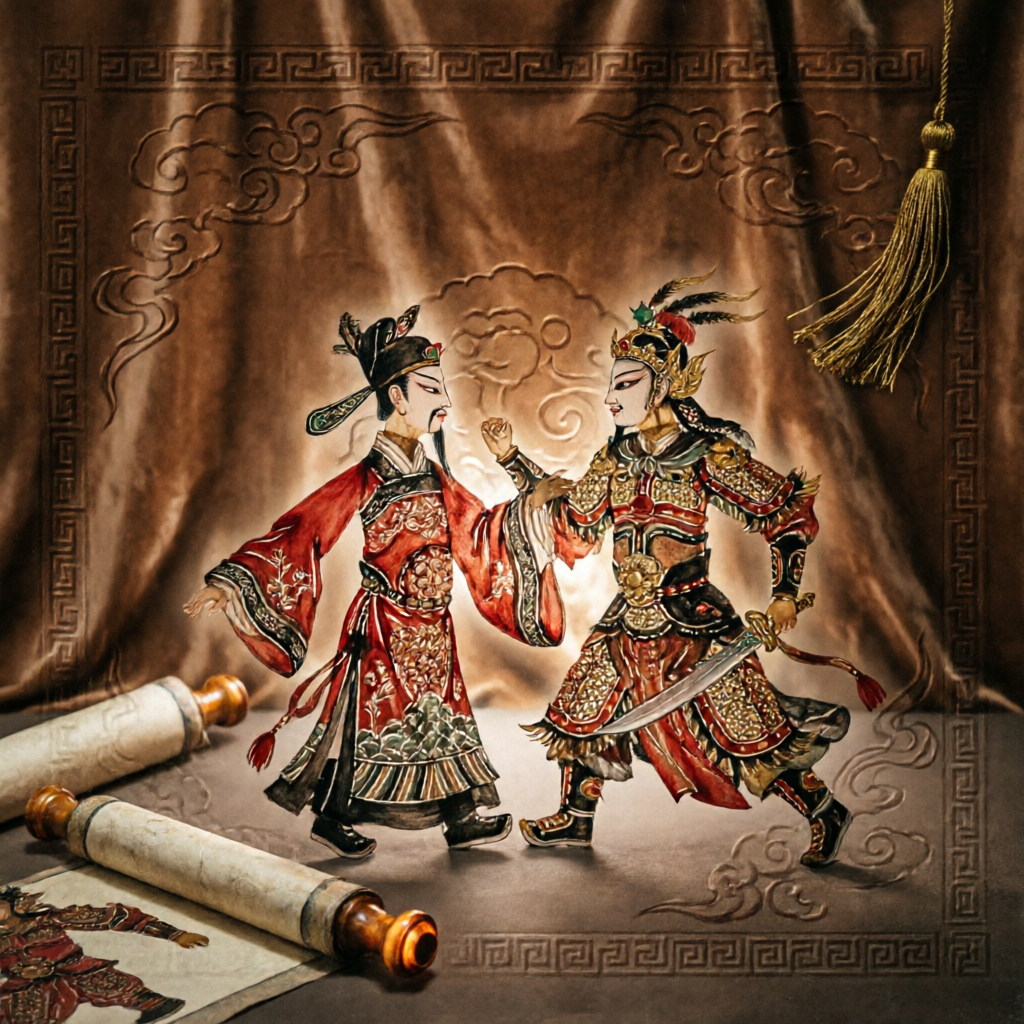
Shadow puppetry, formerly known as "shadow play" or "lamp shadow play" (灯影戏), is a form of folk theater that involves manipulating cut-out figures made from animal hide or cardboard to tell stories, illuminated by light sources such as candles or burning alcohol. Performers stand behind a white screen, manipulating the puppet figures while narrating stories to local musical tunes (sometimes in regional dialects), accompanied by percussion and string instruments. This art form, with its strong local flavor, has been particularly popular in rural areas of Henan, Shanxi, Shaanxi, and Tianshui in Gansu province.
The term "shadow puppet" (皮影) refers to both the theatrical form and the crafted figures, including scenery and props. These figures are typically hand-carved and painted by folk artisans from animal leather, hence the name. In the era before cinema and television, shadow puppetry was one of the most popular forms of folk entertainment.
History
Shadow puppetry has a documented history of over 2,000 years. According to historical accounts in the Book of Han, the art form originated during the Western Han Dynasty when Emperor Wu of Han was mourning the death of his favorite consort, Lady Li. The emperor was so distraught that he neglected state affairs. One day, his minister Li Shaoweng saw children playing with cloth dolls whose shadows were vividly cast on the ground. Inspired, Li created a figure of Lady Li from silk cloth, painted it, and attached wooden rods to its limbs. At night, he set up a screen and candles, inviting the emperor to watch. The emperor was delighted and became fond of this art form.
From the 13th century during the Yuan Dynasty, Chinese shadow puppetry spread to various countries through military expeditions and cultural exchanges, reaching Persia (Iran), Arabia, Turkey, Siam (Thailand), Burma, the Malay Archipelago, Japan, and European nations including England, France, Germany, Italy, and Russia.
During the Ming Dynasty, shadow puppetry flourished. In 1508, a grand theatrical performance was held in Beijing where shadow puppetry participated. It is also recorded that shadow puppetry spread from Lanzhou and Huating to Hebei's Zhuozhou, then to the western and northern rural areas of Beijing, eventually forming two distinct schools in the city's eastern and western districts.
From the Qing Dynasty to the early Republican era, Chinese shadow puppetry reached its peak of development. Wealthy families and nobles took pride in commissioning master artisans to create exquisite puppets, maintaining sophisticated puppet trunks, and keeping private troupes. In rural areas and towns, shadow puppet troupes were ubiquitous, with some regions hosting twenty to thirty such troupes. The art form was performed during festivals, harvest celebrations, religious ceremonies, weddings, birthdays, and other occasions. Continuous performances could last all night or even extend for ten days to half a month. During temple fairs, multiple troupes might compete, creating a lively atmosphere.
By the late Qing Dynasty, shadow puppetry had become popular in Beijing among both commoners and the imperial court. During the Kangxi era, the Prince Li's Palace maintained eight officials with fifth-rank salaries specifically to manage shadow puppet performances. During the Jiaqing era, shadow puppet troupes were invited to perform in noble residences during festivals. Many Beijing troupes performed puppetry during the day and shadow puppetry at night in private gatherings, with some Peking Opera actors participating in shadow puppet performances.
However, during the late Qing Dynasty, some local authorities banned shadow puppetry, fearing that nighttime gatherings might lead to unrest. Puppeteers were also implicated in the White Lotus Rebellion and persecuted under the accusation of "mysterious bandits." During the Japanese invasion and subsequent wars, social turmoil and continuous conflict devastated the once-thriving shadow puppet industry.
After 1949, surviving shadow puppet troupes and artists across China became active again. Starting from 1955, national and provincial shadow puppetry exchange performances were organized, with troupes frequently sent abroad for cultural exchange. Nevertheless, during the Cultural Revolution, shadow puppetry suffered another blow during the "Four Olds" campaign and never fully recovered.
Key Information
| Aspect | Description |
|---|---|
| Origin | Western Han Dynasty (over 2,000 years ago) |
| Materials | Donkey, cow, sheep, or pig leather |
| Key Process | Eight main steps: skin selection, preparation, drawing, transferring, carving, coloring, steaming and flattening, assembly |
| Regional Variations | Sichuan, Hubei, Hunan, Beijing, Tangshan, Shandong, Shanxi, Qinghai, Ningxia, Shaanxi styles |
| Performance | Behind a white screen, accompanied by music and narration |
| Cultural Status | Intangible Cultural Heritage of China |
Cultural Significance
Shadow puppetry reflects the aesthetic values and cultural characteristics of different regions in China. Each local style incorporates elements of local operas, folk songs, and musical traditions, creating diverse artistic expressions. For example, Haining shadow puppetry in Zhejiang Province, dating back to the Southern Song Dynasty, blends with local "sea worker tunes" and "Haining minor tunes," absorbing classical singing styles like "Yiyang腔" and "Haiyan腔" to form a distinctive musical tradition with high-pitched, passionate melodies accompanied by Jiangnan silk and bamboo instruments.
In Guangdong's Lufeng, shadow puppetry represents one of China's three major shadow puppet systems, preserving ancient Minnan linguistic features while developing rich local musical characteristics. Similarly, Mianyang shadow puppetry in Hubei Province integrates traditional painting, carving, and art, combining techniques from film and animation with strong national characteristics.
Modern Status
Today, shadow puppetry faces challenges in the modern entertainment landscape but continues to be preserved and revitalized through various efforts. In 2011, Chinese shadow puppetry was inscribed on the UNESCO Representative List of the Intangible Cultural Heritage of Humanity, recognizing its cultural significance.
Contemporary practitioners are adapting traditional techniques to modern contexts. For instance, Taishan shadow puppetry, represented by master Fan Zheng'an, has developed the unique "Shi Bu Xian" (Ten Idles) technique and has been incorporated into primary school education since 2008. The art form has also gained national exposure through television documentaries and special performances at prestigious venues like the National Centre for the Performing Arts.
In some regions, the traditional performance scene is being revived. In Xiantao (formerly Mianyang), Hubei Province, over 20 shadow puppet troupes with nearly 300 artists remain active, bringing back the vibrant atmosphere of "five li, three stages performing flower drums, every village and hamlet staging shadow plays."
Despite these preservation efforts, shadow puppetry still struggles with issues of aging artisans, limited transmission to younger generations, and competition with modern entertainment forms. However, its unique cultural value and artistic continue to attract interest from both scholars and the general public.
References
-
"Chinese Shadow Theatre: History, Popular Religion, and Women Warriors" by Marc Manganaro (Columbia University Press, 2012)
-
"Shadow Puppets and Shadow Play in China" by Yuan Xin (China Intercontinental Press, 2008)
-
"The Art of Chinese Shadow Puppetry" by Stephen Little (Los Angeles County Museum of Art, 2011)
-
"Intangible Cultural Heritage in China: Traditional Shadow Puppetry" by Zhang Guangyuan (Social Sciences Academic Press, 2015)