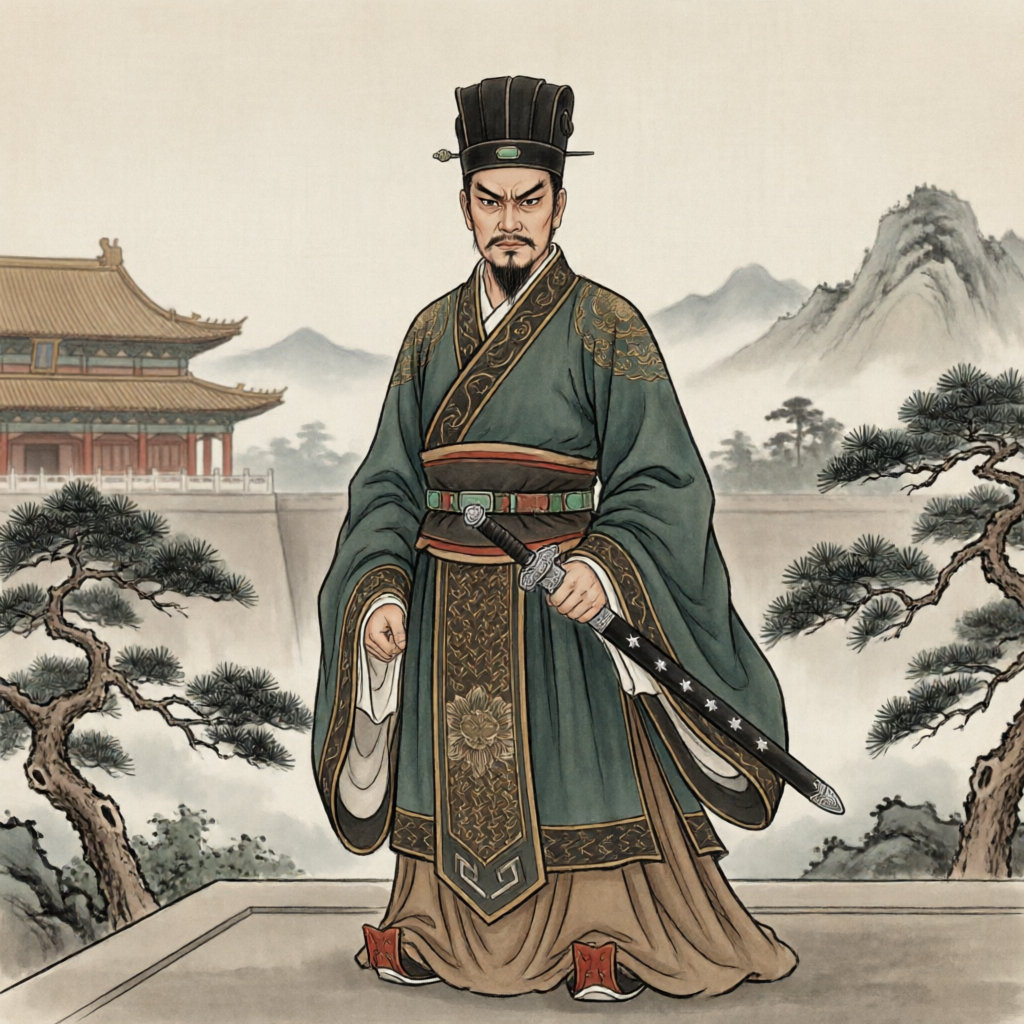
Cao Cao
Overview
Cao Cao (155-220 CE), courtesy name Mengde, was a warlord who lived during the late Eastern Han dynasty and the Three Kingdoms period of China. He rose to prominence in the chaotic years following the Yellow Turban Rebellion and gradually centralized power in northern China, eventually becoming the King of Wei. Although he never formally declared himself emperor, his son Cao Pi would establish the state of Cao Wei, posthumously honoring Cao Cao as Emperor Wu of Wei. Cao Cao is remembered as a brilliant military strategist, administrator, and poet, whose life and career have been immortalized in the historical novel Romance of the Three Kingdoms.
History
Early Life
Cao Cao came from an official family. The Records of the Three Kingdoms claims he was a descendant of Cao Shen, who served as Chancellor during the Western Han dynasty. The Book of Wei traces his ancestry back to the Yellow Emperor. His father, Cao Song, was adopted by the eunuch Cao Teng, who had served four emperors and was ennobled as the Marquis of Feiting. Cao Song inherited this title and later served as Grand Tutor during the reign of Emperor Ling.
In his youth, Cao Cao was known for his quick wit and adaptability. He was unconventional and did not focus on formal studies, leading many to underestimate his abilities. However, Qiao玄 of Liang and He Yong of Nanyang recognized his exceptional qualities. Qiao玄 told him: "The world is about to fall into chaos, and only a man of extraordinary talent can save it. Could that man be you?" Xu Shao of Runan, known for his ability to judge character, evaluated Cao Cao as "a villain in peaceful times, a hero in chaotic times."
Cao Cao showed early interest in military strategy, studying various classical texts on warfare and even annotating The Art of War. These studies laid the foundation for his later military career.
Rise to Prominence
In 174 CE, Cao Cao was recommended as a Xiaolian (filial and incorruptible) and entered the capital Luoyang as an official. He was appointed as Commandant of the Northern District of Luoyang. In this position, he strictly enforced the law, even executing the uncle of the powerful eunuch Jian Shuo for violating curfew. This action earned him enemies among the court elite, who eventually had him transferred to become the magistrate of Dunqiu County.
Cao Cao's career experienced several ups and downs during the increasingly corrupt late Han dynasty. He served in various positions, including as an Imperial Counselor, but grew disillusioned with the court's inability to address corruption. In 184 CE, the Yellow Turban Rebellion broke out, and Cao Cao was appointed as Cavalry Commandant to suppress the rebels in Yingchuan. He achieved significant success in this campaign, which marked the beginning of his military career.
Establishing Power
In 189 CE, Emperor Ling died, and a power struggle ensued between the eunuch faction and the court officials led by General He Jin. He Jin summoned the warlord Dong Zhuo to the capital to help him eliminate the eunuchs, but this move backfired when Dong Zhuo took control of the government and deposed the young emperor. Cao Cao, unwilling to serve Dong Zhuo, fled Luoyang and changed his name.
In Chenliu, Cao Cao "distributed his family wealth and raised righteous troops," becoming one of the first warlords to oppose Dong Zhuo. In 190 CE, he joined the coalition of eastern lords led by Yuan Shao that formed to eliminate Dong Zhuo. While the coalition ultimately failed due to internal divisions and lack of resolve, Cao Cao distinguished himself by advocating for decisive action.
In 192 CE, Cao Cao was appointed as Governor of Dong Commandery and later became Governor of Yan Province after suppressing the Yellow Turban forces there. He incorporated the surrendered rebels into a new army known as the Qingzhou Army, which became a significant military force. Over the next several years, Cao Cao consolidated his power in Yan Province, defeating rivals such as Lü Bu and Tao Qian.
Controlling the Han Court
In 196 CE, following the advice of his advisor Mao Jie, Cao Cao welcomed Emperor Xian to his capital at Xuchang. This "welcoming the emperor to control the warlords" strategy gave Cao Cao legitimate authority over other regional lords. That same year, he implemented the Tuntian system (military agricultural colonies), which helped solve the problem of food supply for his armies.
Cao Cao continued to expand his territory and influence over the next decade. He defeated Zhang Xiu in Wancheng (197 CE), conquered Lü Bu in Xiapi (198 CE), and eliminated Yuan Shu's forces in Huainan (197-199 CE). By 199 CE, Cao Cao controlled most of northern China and was poised to confront his most powerful rival, Yuan Shao.
The Battle of Guandu
In 200 CE, Cao Cao faced Yuan Shao at the Battle of Guandu. Despite being outnumbered (Cao Cao had approximately 20,000 troops compared to Yuan Shao's 100,000-120,000), Cao Cao employed brilliant tactics, including a surprise attack on Yuan Shao's supply depot at Wuchao. This decisive victory allowed Cao Cao to eliminate Yuan Shao as a rival and gain control of the northern plains.
After Guandu, Cao Cao continued his campaigns against other warlords. In 207 CE, he campaigned against the Wuhuan people in the northeast, securing his northern borders. In 208 CE, he began the southern campaign that would lead to the Battle of Red Cliffs, where his forces were defeated by the alliance of Sun Quan and Liu Bei.
Final Years
Despite the setback at Red Cliffs, Cao Cao remained the most powerful warlord in China. He was appointed as Chancellor and continued to administer the territories under his control. In 213 CE, he was ennobled as the Duke of Wei, and later as the King of Wei in 216 CE.
Cao Cao died in 220 CE at the age of 65. Shortly after his death, his son Cao Pi forced Emperor Xian to abdicate and established the state of Cao Wei, posthumously honoring Cao Cao as Emperor Wu.
Key Information
| Aspect | Details |
|---|---|
| Full Name | Cao Cao (曹操) |
| Courtesy Name | Mengde (孟德) |
| Posthumous Name | Emperor Wu of Wei (魏武帝) |
| Temple Name | Taizu (太祖) |
| Birth/Death | 155-220 CE |
| Major Titles | Duke of Wei (魏王), Chancellor (丞相) |
| Key Achievements | Unification of northern China, implementation of the Tuntian system, military innovations |
| Notable Works | Poetry collected in Cao Cao's Poems, military annotations on The Art of War |
| Family | Father: Cao Song; Mother: Lady Ding; Children: Cao Pi, Cao Zhang, Cao Zhi, etc. |
Cultural Significance
Cao Cao's life and career have had a profound impact on Chinese culture and historical memory. He is one of the central figures in the Romance of the Three Kingdoms, a historical novel that romanticizes the events of the Three Kingdoms period. In this novel, Cao Cao is often portrayed as a cunning and ruthless villain, though this portrayal has been debated by historians who argue it may reflect later biases.
Beyond literature, Cao Cao is remembered for his administrative innovations, particularly the Tuntian system, which helped address food shortages during times of war. His approach to governance emphasized meritocracy and efficiency, and he was known for recruiting talented individuals regardless of their background.
Cao Cao is also celebrated as a poet. His works, often written in the yuefu style, reflect his experiences as a military leader and his philosophical outlook. His poetry is characterized by its directness, vigor, and sense of historical consciousness.
Modern Status
Today, Cao Cao is regarded as one of the most important figures in Chinese history. Historians generally view him as a pragmatic and capable leader who brought stability to northern China during a time of chaos. His administrative and military innovations had a lasting impact on Chinese governance and military strategy.
In popular culture, Cao Cao remains a compelling figure. He has been portrayed in numerous films, television series, video games, and other media. The debate over whether he should be viewed as a hero or a villain continues to fascinate audiences and scholars alike.
Academic interest in Cao Cao has grown significantly in recent decades, with scholars re-examining historical sources to develop a more nuanced understanding of his life and career. Archaeological discoveries, including his tomb (discovered in 2009 in Anyang, Henan), have provided new insights into his life and the material culture of his time.
References
-
de Crespigny, Rafe. The Three Kingdoms and Chinese Culture. Melbourne University Press, 2010.
-
Chen, Shou. Records of the Three Kingdoms (Sanguozhi). Translated by Pei Songzhi, annotated by Robert Joe Cutter. Columbia University Press, 2012.
-
Knechtges, David R., and Taiping Chang. Ancient and Early Medieval Chinese Literature: A Reference Guide. Brill, 2014.
-
Lewis, Mark Edward. China Between Empires: The Northern and Southern Dynasties. Harvard University Press, 2009.
-
Twitchett, Denis, and Michael Loewe, eds. The Cambridge History of China, Volume 1: The Ch'in and Han Empires, 221 B.C.-A.D. 220. Cambridge University Press, 1986.