Overview
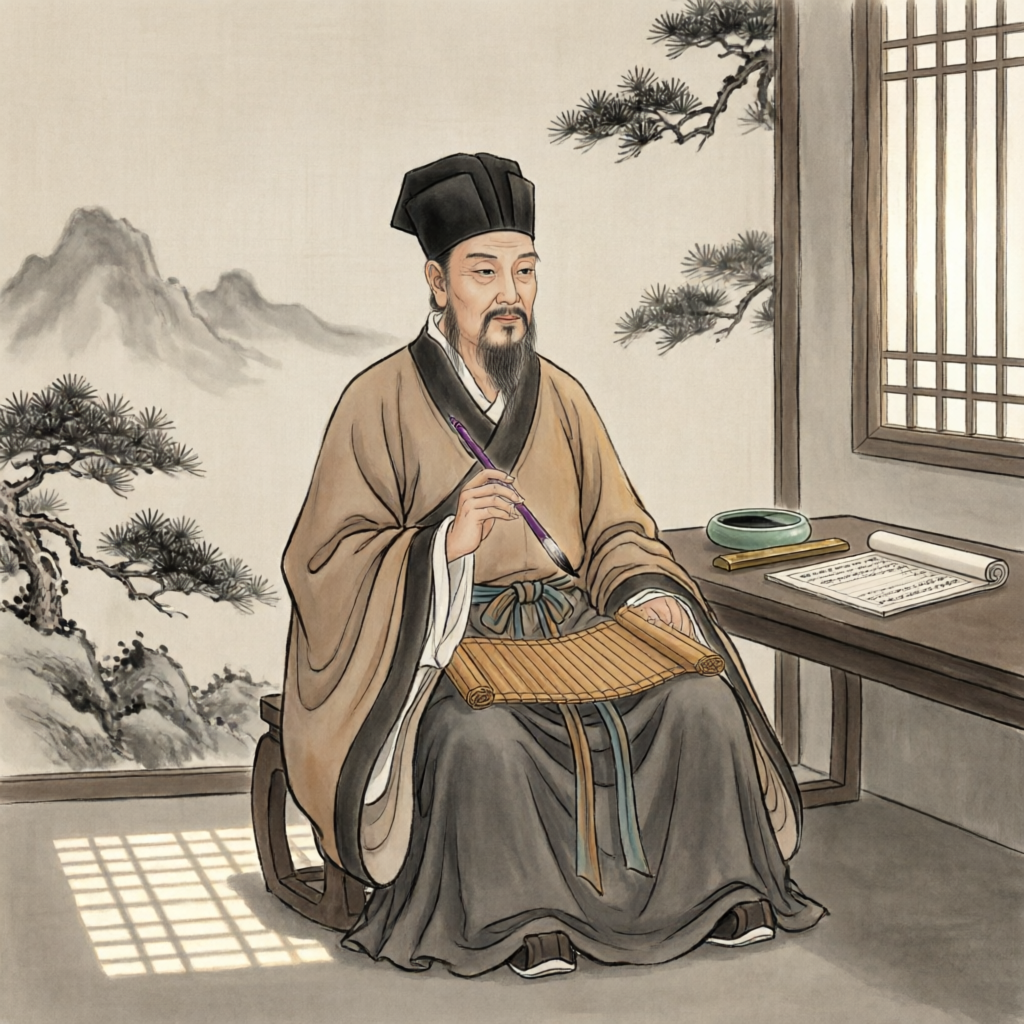
Cheng Yi (1033-1107), courtesy name Zhengshu, also known as Yichuan Xiansheng, was a prominent philosopher, educator, and one of the most influential figures of the Northern Song dynasty. Along with his elder brother Cheng Hao, he is collectively known as the "Two Chengs" (Er Cheng), who laid the foundation for Neo-Confucianism (also known as Lixue or "School of Principle"). Cheng Yi's philosophical system centered on the concept of "Li" (Principle), which he considered the fundamental cosmic and moral order. His ideas profoundly shaped Chinese intellectual thought for centuries and influenced later Confucian scholars, particularly Zhu Xi, who developed the systematic school known as Cheng-Zhu Neo-Confucianism.
History
Cheng Yi was born on September 11, 1033, in Huangpi County, Huangzhou (present-day Huangpi District, Wuhan), to a family with a long tradition of official service. His ancestor Cheng Yu had served as the Minister of Revenue during the reign of Emperor Taizong of Song and was granted the title "Grand Tutor to the Crown Prince." His father, Cheng Xiang, served as a county magistrate in several locations.
From a young age, Cheng Yi showed exceptional intellectual ability. At around fifteen years old, he and his brother Cheng Hao studied under Zhou Dunyi, who is recognized as the founder of Neo-Confucianism. In 1050, at the age of eighteen, Cheng Yi submitted a memorial to the imperial court, pointing out social crises in the Song dynasty and proposing solutions based on the "Kingly Way" (Wang Dao), though his suggestions were not adopted by Emperor Renzong.
In 1056, Cheng Yi studied at the Imperial Academy in Kaifeng. There, he wrote an essay "What Was Yan Hui fond of Learning?" in response to an examination question posed by the renowned educator Hu Yuan. The essay impressed Hu Yuan so much that he granted Cheng Yi the status of a scholar (Chushi) without official position.
Despite failing the imperial examination in 1059, Cheng Yi devoted himself to Confucian studies and teaching. In 1072, he and his brother established a school at Songyang. In 1078, while serving as the magistrate of Fugou County, he established schools to educate local children. Although his family was entitled to official positions through hereditary privilege (yin), Cheng Yi consistently declined these positions in favor of his relatives, choosing instead to focus on scholarship and teaching.
In 1082, the high official Yan Shuo provided land in Minggao Town, Luoyang, for the establishment of the Yigao Academy, where Cheng Yi taught for nearly twenty years. After Emperor Zhezong ascended the throne in 1085, Cheng Yi was recommended by Sima Guang and others for official positions, including Reader in the Chongzheng Palace. However, he initially declined the appointment. The following year, he accepted the position of Reader in the Chongzheng Palace, with the duty of teaching the young emperor.
Cheng Yi's tenure as the emperor's tutor was marked by his insistence on moral education and his proposal that lecturers should be allowed to sit while teaching the emperor, as a sign of respect for Confucian teachings. His direct criticism of political affairs and his uncompromising stance on moral principles eventually led to conflicts with other officials, resulting in his resignation in 1088.
During the political struggles between the conservative and reform factions, Cheng Yi was exiled to Fuzhou (modern-day Chongqing) in 1096. With the help of his disciple Qiao Ding, he continued teaching in Fuzhou. After Emperor Huizong came to power in 1100, Cheng Yi was briefly restored to official positions but was again dismissed when the reform faction regained power in 1102. His works were ordered to be destroyed, though they were preserved through the efforts of his disciples.
Cheng Yi died on October 5, 1107, in Yichuan, Luoyang, at the age of 75. Due to the political climate, only a few close disciples attended his funeral.
Key Information
| Category | Details |
|---|---|
| Alternative Name | Yichuan Xiansheng (Master of Yi River) |
| Courtesy Name | Zhengshu |
| Era | Northern Song Dynasty (960-1127) |
| Ethnicity | Han Chinese |
| Birthplace | Huangpi County, Huangzhou (modern Wuhan) |
| Birth Date | September 11, 1033 |
| Death Date | October 5, 1107 |
| Posthumous Title | Duke Zheng (Duke of Integrity) |
| Noble Title | Earl of Yi River |
| Major Achievements | Founded "Lixue" (School of Principle), laid the foundation for Neo-Confucianism |
| Major Works | "Cheng Yi Wenji" (Collected Works of Cheng Yi), "Yizhuan" (Commentary on the I Ching), "Jingshuo" (Commentaries on Classics) |
Cultural Significance
Cheng Yi's philosophical contributions represent a significant development in Confucian thought. He and his brother Cheng Hao systematized the concept of "Li" (Principle) as the fundamental cosmic and moral order, which became the cornerstone of Neo-Confucianism. Cheng Yi's interpretation of "Li" encompassed three dimensions: as the ultimate origin of the universe, as the embodiment of feudal moral principles and social hierarchy, and as the inherent characteristics and laws governing the development of things.
In his philosophy, Cheng Yi emphasized the unity of heaven and human affairs, arguing that both natural phenomena and human society are governed by the same "Li." This represented a departure from earlier Confucian thinkers who had largely avoided cosmological speculation. Cheng Yi's concept of "Li" effectively replaced the earlier Confucian notion of "Tian" (Heaven) as the ultimate cosmic principle, marking a significant philosophical innovation.
Cheng Yi also made important contributions to Confucian ethics and educational theory. He proposed that education's purpose should be the cultivation of sagehood, emphasizing moral self-cultivation through "ge wu" (investigation of things) and "zhi zhi" (extension of knowledge). His educational philosophy stressed the importance of understanding the fundamental principles behind texts rather than mere memorization.
Modern Status
Today, Cheng Yi is recognized as one of the most important figures in the history of Chinese philosophy. His ideas, developed along with his brother as the "Two Chengs," form the foundation of what later became known as the "Cheng-Zhu school" of Neo-Confucianism, which was systematized by Zhu Xi and became the official state ideology of imperial China.
Cheng Yi's concept of "Li" has been subject to various interpretations throughout Chinese intellectual history. While some scholars have criticized his philosophy for potentially justifying existing social hierarchies, others have emphasized its humanistic elements and its emphasis on moral self-cultivation. His works continue to be studied by scholars of Chinese philosophy, and his influence extends beyond China to other East Asian countries where Confucianism has historically been influential.
The "Chengmen Lixue" (School of Principle of the Cheng Brothers) established by Cheng Yi and his disciples represents one of the major intellectual movements of the Northern Song dynasty. Through his teaching and writing, Cheng Yi trained numerous disciples who helped transmit and develop his philosophical ideas, ensuring their lasting impact on Chinese intellectual tradition.
References
-
Chan, Wing-tsit. A Source Book in Chinese Philosophy. Princeton University Press, 1963.
-
de Bary, Wm. Theodore, and Bloom, Irene, eds. Sources of Chinese Tradition: Volume 1: From Earliest Times to 1600. Columbia University Press, 2000.
-
Gardner, Daniel K. Learning to Be a Sage: Selections from the Conversations of Cheng Yi (1033-1107). University of California Press, 1990.
-
Tu Wei-ming. Neo-Confucianism in History. Harvard University Asia Center, 2008.
-
Bol, Peter K. "This Culture of Ours": Intellectual Transitions in T'ao-hsüeh and the Southern Sung, 1130-1160*. Stanford University Press, 1992.