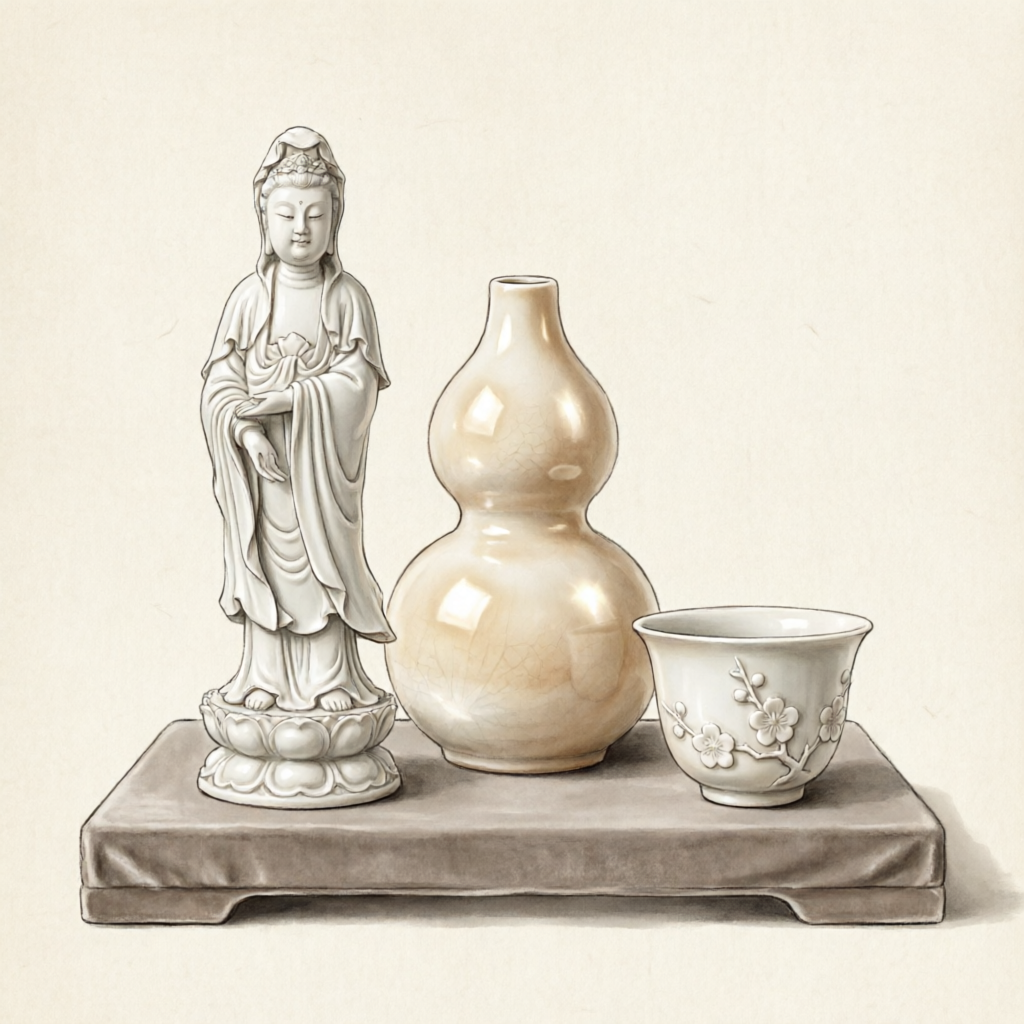
Overview
Dehua white porcelain (德化白瓷) is a distinguished type of Chinese ceramic ware originating from Dehua County in Fujian Province. Renowned for its exceptional quality, fine craftsmanship, and artistic value, this porcelain has been celebrated both domestically and internationally for centuries. The ceramic tradition in Dehua represents one of China's most significant contributions to the world of ceramics, characterized by its unique physical properties, distinctive aesthetic qualities, and cultural significance.
History
The history of Dehua white porcelain can be summarized in ten Chinese characters: "始于宋;盛于元、明;衰于清" (Started in Song Dynasty; flourished in Yuan and Ming Dynasties; declined in Qing Dynasty). As early as the Song and Yuan periods, Dehua's碗坪仑窑 (Wanpinglun Kiln) was producing both blue-white porcelain and white porcelain. However, Dehua white porcelain only became a representative variety in China's ceramic industry during the mid-Ming Dynasty.
During the Ming Dynasty, Dehua porcelain reached its zenith. Artisans developed a warm, milky white porcelain that resembled fat and jade, which was unique in China's ceramic industry at the time. The Quanzhou Prefecture Gazetteer from the Wanli era of the Ming Dynasty noted: "There is also white porcelain, produced from the mountains behind Cheng Temple in Dehua, which is pure white and delightful." During this period, the kilns primarily produced decorative items and sculptures.
The Ming and Qing periods marked a significant era for foreign trade in Chinese ceramics. The voyages of Zheng He in the early Ming Dynasty opened new sea routes between the Pacific and Indian Oceans, greatly promoting East-West trade. Dehua porcelain, benefiting from favorable international conditions, geographical advantages, and superior craftsmanship, became an important export commodity. It was shipped to over 50 countries and regions across East Asia, Southeast Asia, South Asia, West Asia, and the East African coast.
Key Information
| Feature | Description |
|---|---|
| Production Location | Dehua County, Fujian Province, China (117°55′–118°32′E, 25°33′–25°56′N) |
| Main Materials | Kaolin, porcelain stone, feldspar, quartz |
| Firing Temperature | 1250°C–1400°C for single firing; 800°C–900°C or 1250°C–1400°C for bisque firing, followed by 1250°C–1400°C for glaze firing in double firing |
| Key Characteristics | High whiteness (≥80), low water absorption (≤0.5%), excellent thermal stability, high density, good translucency |
| Chemical Composition | Low Fe₂O₃ and TiO₂ content; high SiO₂, K₂O, and Na₂O content |
| Primary Products | Sculptural white porcelain, daily-use white porcelain |
Cultural Significance
Dehua white porcelain holds profound cultural significance, particularly in Buddhist art. The region's excellent porcelain clay proved ideal for creating sacred white-clad Guanyin (Avalokiteshvara) statues. These ceramic sculptures fully exhibited the extraordinary, compassionate, and magnanimous spiritual temperament of Buddhism. When exported abroad, particularly to Japan and Southeast Asian Buddhist countries, they received enthusiastic reception.
Dehua porcelain was historically known as "China White" (中国白) and acclaimed as the "mother of world white porcelain." The artistic achievements of Dehua porcelain reflect the aesthetic values and technical innovations of Chinese ceramic art. The porcelain's influence extended beyond religious contexts to become a symbol of Chinese cultural exchange and artistic excellence.
Modern Status
After the founding of the People's Republic of China, Dehua's ceramic industry continued to develop. In 1986, Shangletaotao shifted to producing porcelain as foreign demand for ceramics revived. The development of purple sand pottery (紫砂陶) in 1979 opened new avenues for the local ceramic industry.
Today, Dehua white porcelain continues to be produced using both traditional and modern techniques. While traditional hand-forming methods are still employed for artistic pieces, mechanical forming, pressing, and injection molding are used for mass production. Modern electric kilns have largely replaced traditional wood-fired kilns, though traditional firing methods are preserved for high-end artistic pieces.
Dehua white porcelain has received numerous honors throughout its modern history. Notable awards include a gold medal at the 1915 Panama-Pacific Exposition in San Francisco for Su Xuejin's "Porcelain Plum Blossom" and multiple awards in national ceramic art competitions from 1977 to 1986. In April 2025, it was included in the first list of "China's Famous Consumer Products." On December 27, 2006, the General Administration of Quality Supervision, Inspection and Quarantine of China granted Dehua white porcelain geographical indication product protection.
References
-
Li, J. (2018). The Ceramic Art of Dehua: History, Technique, and Aesthetics. Fujian People's Publishing House.
-
Chen, W., & Zhang, H. (2020). Chinese Export Porcelain: Trade and Cultural Exchange. Cambridge University Press.
-
Wang, L. (2019). Traditional Crafts of Fujian Province: Dehua Ceramics. Cultural Relics Publishing House.
"Dehua white porcelain represents the pinnacle of Chinese ceramic art, combining technical excellence with profound cultural expression that has resonated across centuries and continents."
— Exhibition catalog, "The Beauty of Dehua: Ming and Qing Dehua White Porcelain Exhibition", Guangzhou Museum, 2022