Overview
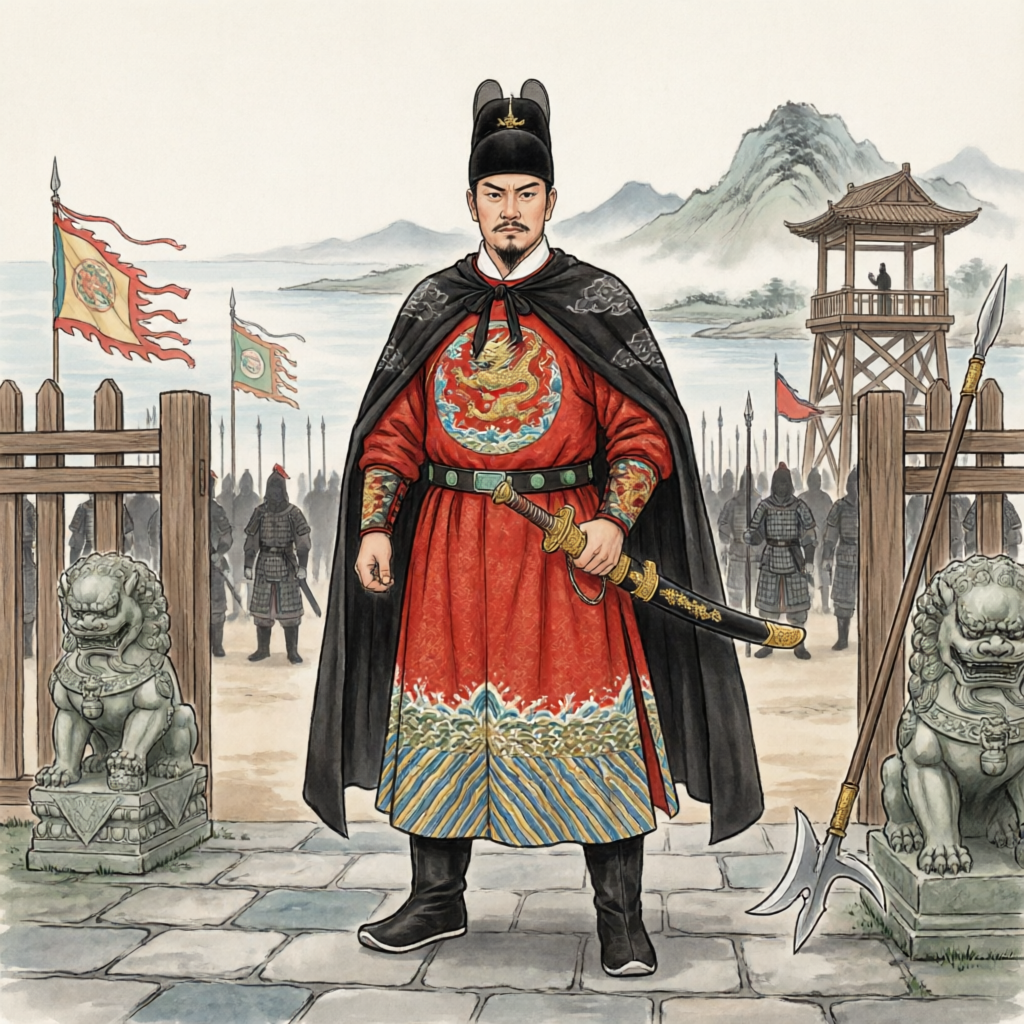
Qi Jiguang (1528-1588) was a prominent military general, strategist, and writer who lived during the Ming Dynasty in China. He is best known for his successful campaigns against the wokou (Japanese pirates) who ravaged China's southeastern coast in the 16th century. Qi Jiguang revolutionized military training and tactics, creating the highly effective "Qi Family Army" that became instrumental in defeating the pirates and restoring security to the coastal regions. His military treatises and innovative strategies continued to influence Chinese military thought for centuries after his death.
History
Early Life and Background
Qi Jiguang was born on November 12, 1528, in Luqiao, Jining Prefecture (present-day Weishan County, Shandong Province). His family originally came from Dongmou in Shandong (present-day Muping District, Yantai City), but his sixth-generation ancestor, Qi Xiang, had moved to Dingyuan in Anhui to escape warfare during the late Yuan Dynasty. Qi Xiang had followed Zhu Yuanzhang in his military campaigns and was posthumously honored for his service. As a result, his son was appointed as a military commander in Dengzhou Guard (present-day Penglai, Shandong), establishing a family tradition of military service.
Qi's father, Qi Jingtong, was a strict but dedicated military officer who served in various positions, including Commander-in-Chief of the Shandong coastal defense forces. He instilled in his son both scholarly knowledge and martial skills from an early age. Despite their prestigious military background, the family lived modestly. At the age of thirteen, Qi Jiguang studied under the famous scholar Liang Jie in Penglai, receiving a solid education in literature and military classics.
Early Military Career
In 1544, following his father's death, the seventeen-year-old Qi Jiguang inherited his father's position as Assistant Commissioner of Dengzhou Guard, marking the beginning of his forty-five-year military career. In 1546, at nineteen, he was put in charge of the garrison's farmland management, where he achieved notable success in reorganizing the system.
During this period, the coastal regions of Shandong suffered from wokou raids. Qi Jiguang expressed his determination to serve the country by writing a poem titled "Taoqian Shen Chu" on the blank pages of a military book, ending with the famous lines: "I seek not personal glory, but only that the seas may be calm." This reflected his lifelong commitment to protecting the nation's coastal security.
Between 1548 and 1552, Qi Jiguang led Dengzhou guard troops to the northern frontier for annual frontier service, gaining valuable military experience. In 1549, he passed the provincial military examination, and in 1550, during the Gengxu Incident when Mongol forces reached Beijing, he demonstrated his tactical acumen by proposing defense strategies to the court.
Initial Campaigns Against Pirates
In 1553, Qi Jiguang was promoted to Assistant Commissioner with responsibility for twenty-five guard posts along the Shandong coast. Finding the military forces in disarray with poor discipline and inadequate training, he immediately began reforms. His commitment to strict discipline was demonstrated when he publicly punished his own maternal uncle (who was also his subordinate) for insubordination, only to apologize later as a nephew, earning his uncle's respect and establishing his authority among the troops.
By 1555, the wokou problem had become particularly severe in Zhejiang and Fujian provinces. That year, Qi Jiguang was transferred to Zhejiang as Assistant Commissioner of the provincial military command, where he frequently advised Governor Hu Zongxian on anti-piracy strategies. The following year, he was promoted to Regional Commander with responsibility for defending the area east of the Qiantang River, including Ningbo, Shaoxing, and Taizhou.
Formation of the Qi Family Army
Qi Jiguang quickly realized that the existing Ming forces were inadequate to deal with the well-organized and fierce wokou pirates. After several failed campaigns, he submitted proposals to create a new, specially trained force. Initially met with resistance, his ideas were finally accepted in 1559 when he was authorized to recruit soldiers from Yiwu, where local miners had demonstrated exceptional fighting abilities in clan conflicts.
Qi Jiguang established strict recruitment criteria, preferring rural farmers over city dwellers and emphasizing physical strength, courage, and martial potential. He recruited 4,000 carefully selected soldiers and put them through rigorous training that emphasized:
-
Organization: He implemented a hierarchical structure with units of 12 men, organized into larger formations for coordinated action.
-
Discipline: Drawing inspiration from the famous Yue Family Army of the Song Dynasty, he demanded strict adherence to rules and fair application of rewards and punishments.
-
Tactical Training: He emphasized practical martial skills and battlefield tactics rather than mere formal exercises.
-
Motivation: He instilled in his soldiers a sense of purpose by reminding them they were fighting to protect their own families and communities.
Innovative Tactics: The Mandarin Duck Formation
Qi Jiguang's most significant tactical innovation was the "Mandarin Duck Formation" (Yuan Yang Zhen), designed specifically for the challenging terrain of coastal Zhejiang and Fujian with their mountains, marshes, and narrow paths. This formation consisted of 12 soldiers with specialized roles:
- Team leader
- Two shield bearers (one with a long shield, one with a rattan shield)
- Two wolf spear handlers (using long bamboo spears with sharp tips)
- Four pikemen
- Two swordsmen
- One supply soldier
This formation allowed for flexible deployment, combining long and short-range weapons to maximize effectiveness in close combat. It could be adapted to different situations, splitting into smaller formations as needed. The Mandarin Duck Formation proved devastatingly effective against the wokou, who excelled at close-quarters combat but were vulnerable to this coordinated approach.
Key Information
| Aspect | Details |
|---|---|
| Full Name | Qi Jiguang (戚继光) |
| Courtesy Name | Yuanjing (元敬) |
| Style Name | Nantang (南塘) |
| Birth Date | November 12, 1528 |
| Death Date | January 5, 1588 |
| Birthplace | Luqiao, Jining (present-day Weishan County, Shandong) |
| Ancestral Home | Dongmou, Shandong (present-day Muping District, Yantai) |
| Highest Position | Commander-in-Chief of Fujian Province |
| Major Achievements | Suppression of wokou piracy; development of innovative military tactics |
| Key Works | "Jixiao Xinshu" (New Book of Effective Discipline), "Lianbing Shiji" (Record of Military Training) |
Cultural Significance
Qi Jiguang's legacy extends far beyond his military accomplishments. His military treatises, particularly "Jixiao Xinshu" (New Book of Effective Discipline) and "Lianbing Shiji" (Record of Military Training), became foundational texts in Chinese military theory and were studied by generations of officers. His emphasis on practical training, strict discipline, and innovative tactics influenced Chinese military thinking for centuries.
Throughout southeastern China, numerous temples and shrines were dedicated to Qi Jiguang as a local deity and protector. In regions where he had served, particularly in Zhejiang and Fujian, he was revered as a "Military God" (Wushen) who could protect against disasters and ensure safety. The folk saying "When Qi Jiguang comes, the pirates flee" (戚继光来,倭寇逃) reflected the popular belief in his protective powers.
Qi Jiguang was also celebrated in popular culture, appearing in numerous folk tales, novels, and operas. The story of his recruitment of miners from Yiwu and their transformation into an elite fighting force became a popular theme in local folklore, symbolizing how ordinary people could achieve extraordinary things through proper training and leadership.
Modern Status
Today, Qi Jiguang is remembered as one of China's greatest military strategists and national heroes. His hometown in Shandong Province has been developed as a tourist site, featuring memorial halls and exhibits dedicated to his life and achievements. Several statues and monuments honoring Qi Jiguang can be found throughout China, particularly in coastal regions that he protected.
His military writings continue to be studied by historians and military strategists worldwide. The "Mandarin Duck Formation" he developed is still analyzed as an example of innovative tactical thinking that maximized limited resources against a superior enemy.
In contemporary China, Qi Jiguang is often cited as an exemplar of patriotism, military innovation, and ethical leadership. His emphasis on discipline, practical training, and the moral purpose of military service continues to resonate in modern military education.
References
-
Qi, Jiguang. (1560). Jixiao Xinshu (New Book of Effective Discipline). Ming Dynasty.
-
Wan, Ming. (2003). Qi Jiguang: Military General of the Ming Dynasty. Beijing: Chinese People's Liberation Army Press.
-
Spence, Jonathan D. (2012). The Search for Modern China. W. W. Norton & Company.
-
Turnbull, Stephen. (2002). Samurai Invasion: Japan's Korean War 1592-1598. Cassell & Co.
-
Lorge, Peter A. (2008). War, Politics and Society in Early Modern China, 900-1799. Routledge.