Simplified Chinese Characters
Overview
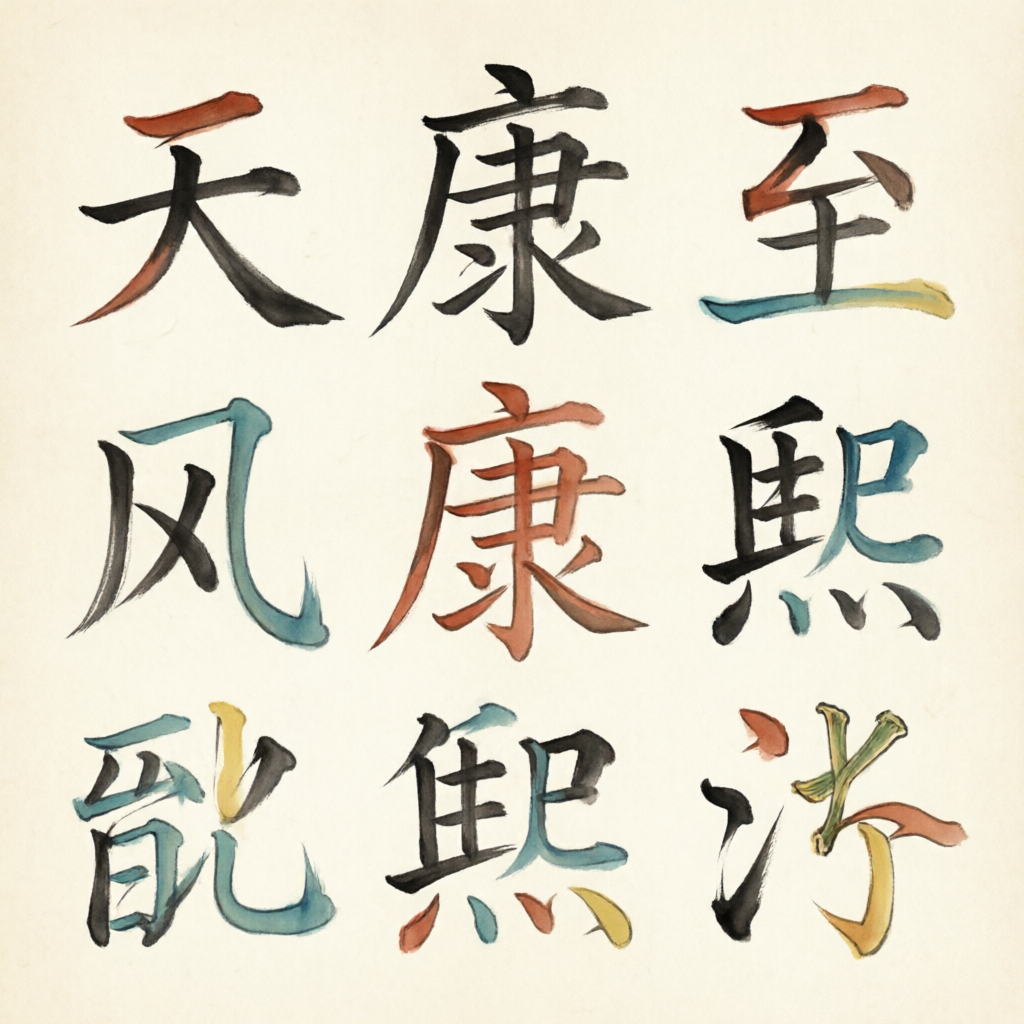
Simplified Chinese characters are standardized forms of Chinese characters used primarily in mainland China, Singapore, and Malaysia. These characters feature fewer strokes and simplified forms compared to their traditional counterparts, which are still used in Taiwan, Hong Kong, and Macau. The simplification process has a long historical development but was systematically implemented in the mid-20th century as part of language reform initiatives.
History
Evolution of Chinese Characters
The evolution of Chinese characters has been driven by their functional utility. Two opposing trends have influenced this development: the enhancement of phonetic and semantic functions through character complexification, and the practical need for easier writing through simplification. These sometimes contradictory requirements have been balanced through the natural evolution of characters, with scholars able to explain most changes through the traditional six categories of Chinese character creation (liushu).
During the Spring and Autumn and Warring States periods, regional variations of characters emerged alongside formal scripts. Popular vernacular forms (suti) appeared, including both simplified and complexified characters, though most could still be explained through traditional principles.
The Small Seal Script (xiaozhuan) developed from the Great Seal Script (dazhuan), gradually standardizing characters into more linear forms. The Clerk Script (lishu), which matured during the Han Dynasty, was described in historical records as "the abbreviated form of seal script" and established the foundation of square Chinese characters.
Following the Clerk Script, various script forms emerged including Regular Script (kaishu), Cursive Script (caoshu), and Semi-cursive Script (xingshu). While these were more convenient to write, some characters underwent complexification to enhance phonetic and semantic functions through added components or semantic differentiation.
Ancient Simplified Characters
Since ancient times, simplified characters have appeared in stone inscriptions and manuscripts, particularly during periods of political instability. During peaceful periods, these simplified forms were often collected and documented, such as in the "Popular Characters Since Song and Yuan Dynasties" (Song Yuan yilai zizipu).
After Qin Shi Huang unified China in 221 BCE, he implemented the "standardization of writing" (shu tongwen), creating the Small Seal Script by simplifying earlier forms and eliminating regional variations.
The Taiping Heavenly Kingdom (1851-1864) was the first historical regime to officially recognize simplified characters, using extensively in official documents and publications while creating new simplified forms. Many of these were later included in the modern "Scheme for Simplified Characters."
Key Information
| Aspect | Details |
|---|---|
| Primary Regions | Mainland China, Singapore, Malaysia |
| Traditional Character Regions | Taiwan, Hong Kong, Macau |
| Historical Origins | Ancient popular forms, formally standardized in 20th century |
| Major Implementation | 1956 in mainland China with the "Scheme for Simplified Characters" |
| Relationship to Traditional Characters | Generally one-to-one correspondence, though some simplified characters represent multiple traditional characters |
| Simplification Methods | Stroke reduction, component simplification, phonetic substitution, semantic association |
Cultural Significance
The simplification of Chinese characters has been deeply connected to broader cultural and political movements. In the early 20th century, as Western influence spread throughout East Asia, debates emerged about the future of Chinese writing. Some advocated abandoning Chinese characters entirely in favor of alphabetic writing systems, citing practical difficulties in printing, typing, and learning.
The "theory of Chinese character backwardness" identified several issues: the large number of characters, complex strokes, multiple readings, and difficulties in recognition, reading, memorization, writing, and usage. Some extreme views even suggested that Chinese characters contributed to China's decline.
In mainland China, the simplification movement gained momentum after the establishment of the People's Republic in 1949. Initially, some leaders advocated complete abandonment of Chinese characters in favor of alphabetic systems. However, as Sino-Soviet relations deteriorated, this approach was deemed impractical, and simplification combined with the pinyin romanization system became the preferred path.
Modern Status
Mainland China
The systematic simplification of Chinese characters in mainland China began in earnest in the 1950s. The process involved extensive research and consultation:
- 1950: Four principles for selecting simplified characters were established
- 1952: The Chinese Character Reform Research Committee was formed
- 1955: The "Draft Scheme for Simplified Characters" was circulated for public comment
- 1956: The "Scheme for Simplified Characters" was officially approved
- 1964: The "Complete Table of Simplified Characters" was published
- 1977: The "Second Scheme for Simplified Characters" ("Erjianzi") was introduced but later abandoned
- 1986: The "Complete Table of Simplified Characters" was reissued
- 2013: The "Table of General Standard Chinese Characters" was promulgated
In mainland China, simplified characters are the official standard used in education, publishing, and public life.
Taiwan
Taiwan has maintained the use of traditional characters in official contexts, education, and publishing. However, simplified characters are occasionally used in informal settings and have become more common with increased cross-strait exchanges. In recent years, some educational authorities have allowed the use of certain commonly simplified characters in examinations without penalty.
Hong Kong
Hong Kong has traditionally used traditional characters, though simplified characters have become more popular in informal contexts and signage since the handover in 1997. Official documents and education continue to use traditional characters, often with local modifications as specified in the "List of Commonly Used Characters."
Japan
Japan implemented its own simplification process with the "List of Characters for Daily Use" (Tōyō Kanji) in 1946, later replaced by the "List of Common Kanji" in 1981. Japanese simplified characters (shinjitai) differ from Chinese simplified characters, with only about 53 characters being identical. Japan continues to use both kanji and kana scripts.
Korean Peninsula
Korea developed its own alphabetic system (Hangul) in 1444 under King Sejong. North Korea completely abandoned Chinese characters in 1948, while South Korea reduced Chinese character education in the 1970s. Recently, there has been renewed interest in using both Hangul and Chinese characters in South Korea.
Vietnam
Vietnam abandoned Chinese characters during French colonial rule and later completely eliminated them after World War II. However, there has been some discussion about reintroducing Chinese characters in recent years.
Southeast Asia
Besides mainland China, simplified characters are used in Singapore and Malaysia. Singapore introduced its own simplified character list in 1969, though with some differences from the mainland standard.
References
- Chen, Ping. (1999). Chinese Writing Reform: History and Future. De Gruyter Mouton.
- DeFrancis, John. (1984). The Chinese Language: Fact and Fantasy. University of Hawaii Press.
- Ramsey, S. Robert. (1987). The Languages of China. Princeton University Press.
"Language reform is never accomplished in a day, yet the common people of China have not only made remarkable grammatical innovations, but they have also accomplished an equally remarkable reform: the great reform of Chinese character forms, the creation and promotion of 'broken characters.'"
— Hu Shih, 1923