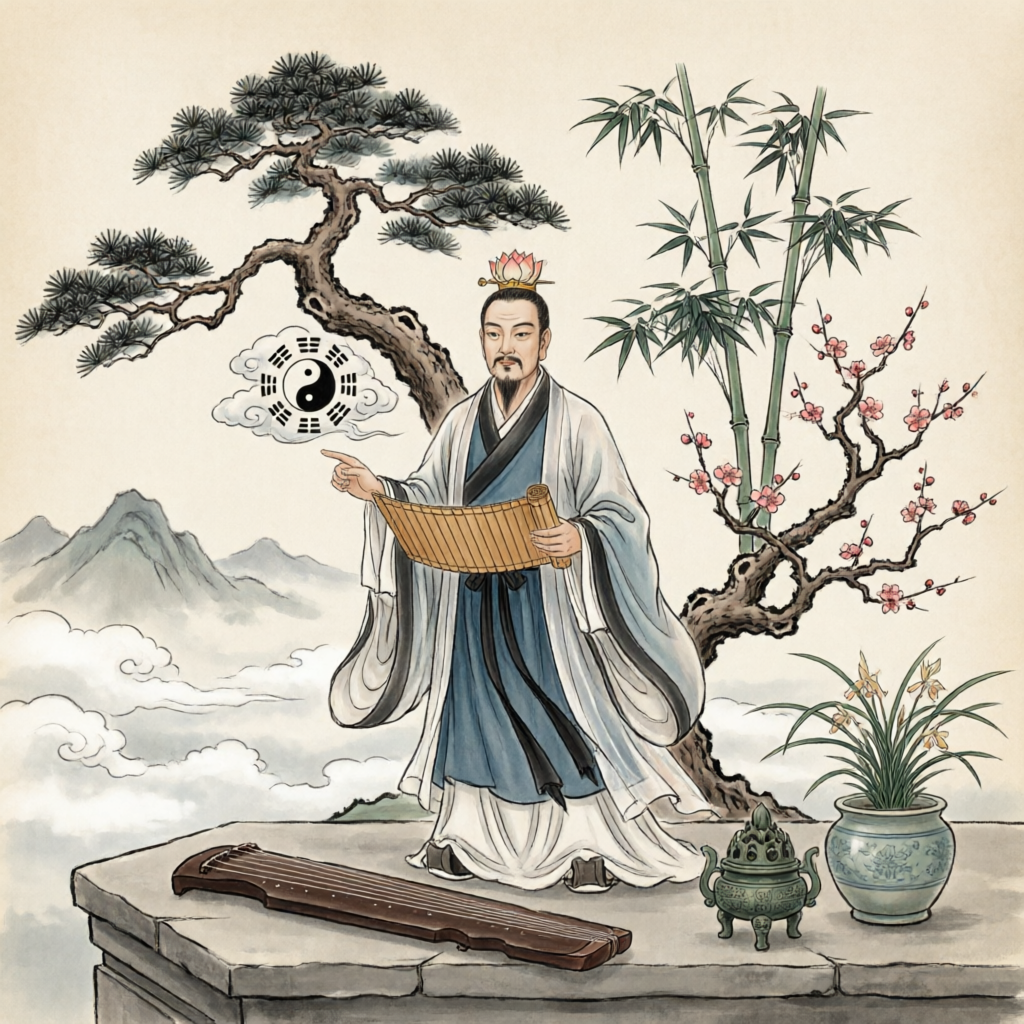
Overview
The Eclectic School (杂家, Zajia) represents a significant philosophical tradition in ancient China that emerged during the Warring States period (c. 475-221 BCE). This school of thought is characterized by its approach of "selecting the best of Confucianism and Mohism, and summarizing the essentials of the School of Names and Legalism" (采儒墨之善,撮名法之要). Rather than adhering strictly to a single philosophical tradition, the Eclectics synthesized elements from multiple schools to create comprehensive systems of thought that addressed practical political and philosophical questions. The school's most prominent representatives included Lü Buwei, Liu An, and She Jiao, who produced influential works that exemplify this syncretic approach.
History
The Eclectic School emerged during the Warring States period, an era characterized by intellectual ferment known as the "Hundred Schools of Thought" (百家争鸣). During this time, various philosophical schools developed distinct approaches to governance and social organization. As these schools competed for influence, they often incorporated elements from rival traditions to strengthen their own positions or address perceived weaknesses in their doctrines.
The Eclectics took this process of synthesis to its logical conclusion by deliberately combining insights from multiple traditions. This approach was particularly valuable in the political context of the Warring States period, when rulers sought practical solutions to the challenges of unification and governance. The school reached its zenith during the late Warring States period and early Han dynasty, producing works that attempted to create comprehensive systems of thought suitable for the emerging imperial state.
Key Information
| Aspect | Details |
|---|---|
| Chinese Name | 杂家 (Zajia) |
| English Name | Eclectics |
| Period of Origin | Warring States Period (c. 475-221 BCE) |
| Key Representatives | Lü Buwei, Liu An, She Jiao |
| Major Works | Lüshi Chunqiu (The Spring and Autumn Annals of Lü Buwei), Huainanzi (The Masters of Huainan), Shizi (fragments) |
| Main Tenets | Syncretism of philosophical traditions, practical governance, comprehensive systems of thought |
| Peak Period | Late Warring States to Early Han Dynasty |
Cultural Significance
The Eclectic School played a crucial role in the intellectual transition from the competitive pluralism of the Warring States period to the more unified imperial ideology of the Qin and Han dynasties. By synthesizing diverse philosophical traditions, the Eclectics helped create intellectual frameworks that could accommodate the needs of a large, centralized state.
The school's most significant contribution was its development of comprehensive systems of thought that attempted to address all aspects of human experience and governance. Works like Lüshi Chunqiu and Huainanzi represent ambitious attempts to "encompass all things of heaven, earth, and past and present" (备天地万物古今之事), creating intellectual systems that integrated cosmology, politics, ethics, and natural philosophy.
Modern Status
Today, the Eclectic School is recognized as an important part of China's intellectual heritage, though it is not typically studied as a distinct philosophical tradition in the same way as Confucianism, Daoism, or Legalism. Instead, it is understood as a transitional intellectual movement that contributed to the formation of imperial Chinese ideology.
Modern scholarship has renewed interest in the Eclectics, particularly in their role in synthesizing philosophical traditions and their approach to governance. The comprehensive nature of works like Lüshi Chunqiu and Huainanzi makes them valuable sources for understanding the intellectual landscape of the late Warring States period and early Han dynasty.
Major Works
Lüshi Chunqiu (The Spring and Autumn Annals of Lü Buwei)
Compiled around 239 BCE under the patronage of Lü Buwei, the chancellor of Qin, Lüshi Chunqiu represents one of the most ambitious syncretic works of ancient China. The text is organized into twelve chronological sections, eight topical treatises, and six discourses, totaling 160 chapters. It primarily draws from Daoist thought while incorporating elements from Confucian, Mohist, Legalist, and Military schools.
Lü Buwei's purpose in commissioning this work was to create a comprehensive guide for governance that could serve as a blueprint for Qin's unification of China. The text includes practical advice on politics, economics, philosophy, ethics, and military strategy, while also preserving numerous historical anecdotes and philosophical arguments. Notably, it introduces concepts like "following heaven and earth" (法天地) and "examining all reports" (传言必察), alongside practical health recommendations.
Huainanzi (The Masters of Huainan)
Compiled under the patronage of Liu An, Prince of Huainan (179-122 BCE), Huainanzi represents another major work of the Eclectic School. Also known as Huainan Honglie, the text is organized into twenty-one "inner" chapters and thirty-three "outer" chapters (though only the inner chapters survive). Primarily Daoist in orientation, it incorporates elements from Confucian, Legalist, and Yin-Yang schools of thought.
The text presents a cosmology based on the concepts of "Dao" and "qi" (vital energy), while preserving valuable materials on the history of natural science. Liu An, grandson of Emperor Gaozu of Han, gathered numerous scholars and experts to compile this work, which represents an attempt to create a comprehensive intellectual system suitable for governance.
Shizi (Fragments)
The Shizi, attributed to She Jiao (c. 390-330 BCE), survives only in fragmentary form. The original twenty-two chapters were lost, and modern versions are based on Qing dynasty reconstructions. Despite its incomplete nature, the text contains important philosophical contributions, particularly in cosmology.
She Jiao provided one of the earliest clear definitions of the Chinese concept of "cosmos" (宇宙), stating: "Heaven, earth, and the four directions constitute space; past and present constitute time." This definition established space (宇) and time (宙) as fundamental dimensions of the cosmos, influencing later Chinese philosophical thought.
Representative Figures
She Jiao
nShe Jiao (c. 390-330 BCE) was a native of Quwo in the state of Wei (modern Shanxi province). He served as an advisor to Shang Yang (also known as Wei Yang), helping implement legalist reforms in Qin that contributed to the state's eventual unification of China. After Shang Yang's execution in 338 BCE, She Jiao fled to the state of Shu, where he lived for nearly a decade before his death.
Though his original work is largely lost, She Jiao was considered an important thinker in antiquity, classified among the Hundred Schools of Thought. His philosophy represented the intellectual traditions of the "Three Jins" (三晋), referring to the states of Han, Zhao, and Wei that emerged from the partition of Jin.
Lü Buwei
nLü Buwei (c. 292-235 BCE) was a merchant from the state of Wei who became chancellor of Qin during the reign of King Zhuangxiang. Recognizing the potential profit in supporting Prince Zichu (later King Zhuangxiang), Lü Buwei provided financial support and political maneuvering that helped Zichu ascend to the throne.
As chancellor, Lü Buwei patronized the compilation of Lüshi Chunqiu, commissioning numerous scholars to create a comprehensive philosophical work. He also expanded Qin's territory through military campaigns, establishing commanderies that facilitated Qin's eventual unification. After the young King Zheng (later Qin Shi Huang) ascended the throne, Lü Buwei served as regent until he fell from power and was exiled to Shu, where he committed suicide.
Liu An
nLiu An (179-122 BCE) was a grandson of Emperor Gaozu of Han and the Prince of Huainan. A talented scholar and patron of learning, Liu An gathered numerous scholars and experts to compile Huainanzi. He was also credited with early experiments with hot air balloons and with the invention of tofu.
Liu An's intellectual interests were broad, encompassing philosophy, literature, and natural science. His court became a center of learning, attracting scholars from various traditions. Despite his contributions to culture and science, Liu An eventually became embroiled in political intrigue and was accused of treason, leading to his suicide and the abolition of his principality.
Thought Characteristics
Syncretism
nThe defining characteristic of the Eclectic School was its approach of "embracing Confucianism and Mohism, combining the School of Names and Legalism" (兼儒墨,合名法). This syncretic approach treated various philosophical traditions equally, incorporating elements from multiple schools without establishing clear hierarchies among them.
Different Eclectic works emphasized different traditions: Shizi incorporated Confucian, Legalist, Daoist, Mohist, and Mingjia (School of Names) thought; Guanzi drew from Legalist, Daoist, Confucian, Yin-Yang, Mingjia, and Nongjia (School of Agriculture) traditions; while Lüshi Chunqiu represented "a great synthesis of pre-Qin classics and the Hundred Schools of Thought," primarily incorporating Confucian, Military, Legalist, and Daoist elements.
Systematic Approach
nThe Eclectics attempted to build comprehensive philosophical systems by organizing knowledge around frameworks like Yin-Yang theory and the unity of "Heaven, Earth, and Humanity" (天、地、人). From Shizi to later works like Weiliaozi, they sought to "encompass all things of heaven, earth, and past and present" within unified systems.
This systematic approach is evident in the structure of Eclectic texts. Shizi developed a framework integrating heaven, earth, the four seasons, yin-yang, and the four directions with political theory and personal cultivation. Lüshi Chunqiu organized knowledge around "Heaven, Earth, and Humanity" and Yin-Yang concepts, while Huainanzi represented the culmination of this systematic approach, creating a comprehensive intellectual system.
Ideological Function
nEclectic thought served ideological functions by providing frameworks for governance in the late Warring States period and early imperial China. This ideological orientation manifested in three ways:
-
Integration of political theory with practical governance needs, offering different approaches to unification—ranging from "non-action" and "benevolence" to "righteous warfare" to end conflict.
-
Use of the "Heaven, Earth, and Humanity" framework to organize philosophical ideas, as seen in Guanzi, which systematically developed theories of Dao, governance, and health cultivation within this structure.
-
Combination of intellectual and political concerns, with works like Lüshi Chunqiu representing attempts to create a unified imperial ideology suitable for the emerging Qin state.
Huang-Lao Influence
nThe Eclectics showed significant influence from Huang-Lao Daoism, particularly in theoretical methods and content. Major works incorporated Huang-Lao concepts:
- Guanzi developed theories of "vital qi" and "names and methods" drawn from Huang-Lao thought.
- Heguanzi contained cosmological theories about qi and law, governance through following natural patterns, and rulers preserving their forms while cultivating their spirits.
- Lüshi Chunqiu incorporated Huang-Lao theories of "vital qi" combined with Yin-Yang cosmology, health cultivation through "nourishing qi" and "appropriate desires," and political theories of "following Heaven and Earth" with rulers practicing non-action while officials took specific actions.
Regional Characteristics
nThe Eclectic School developed distinct regional variations:
-
Works associated with Qin (Shizi, Lüshi Chunqiu, Weiliaozi) reflected Qin's political context. After Lü Buwei introduced diverse philosophical traditions to Qin, the state developed a distinctive cultural centered on Xianyang.
-
Works associated with Qi (Yinwenzi, Guanzi) emerged from Jixia Academy, where scholars attempted to integrate various regional traditions—including Chu, Three Jins, and Zoulu cultures—creating a major cultural center that produced one major branch of Eclecticism.
-
Heguanzi, associated with Zhao and Chu, reflected the author's experiences in the "Three Jins" region and later in the mountains of Chu, showing influences from both Legalist and Daoist traditions.
References
[1] Knoblock, John. "Xunzi: A Translation and Study of the Complete Works, Volume 1." Stanford University Press, 1988.
[2] Major, John S. "The Huai-nan Tzu: A Guide to the Tao and Its Attributes." Columbia University Press, 1993.
[3] Graham, A.C. "Disputers of the Tao: Philosophical Argument in Ancient China." Open Court, 1989.
[4] Puett, Michael J. "To Become a God: Cosmology, Sacrifice, and Self-Divinization in Early China." Harvard University Asia Center, 2002.
[5] Lewis, Mark Edward. "The Construction of Space in Early China." State University of New York Press, 2006.