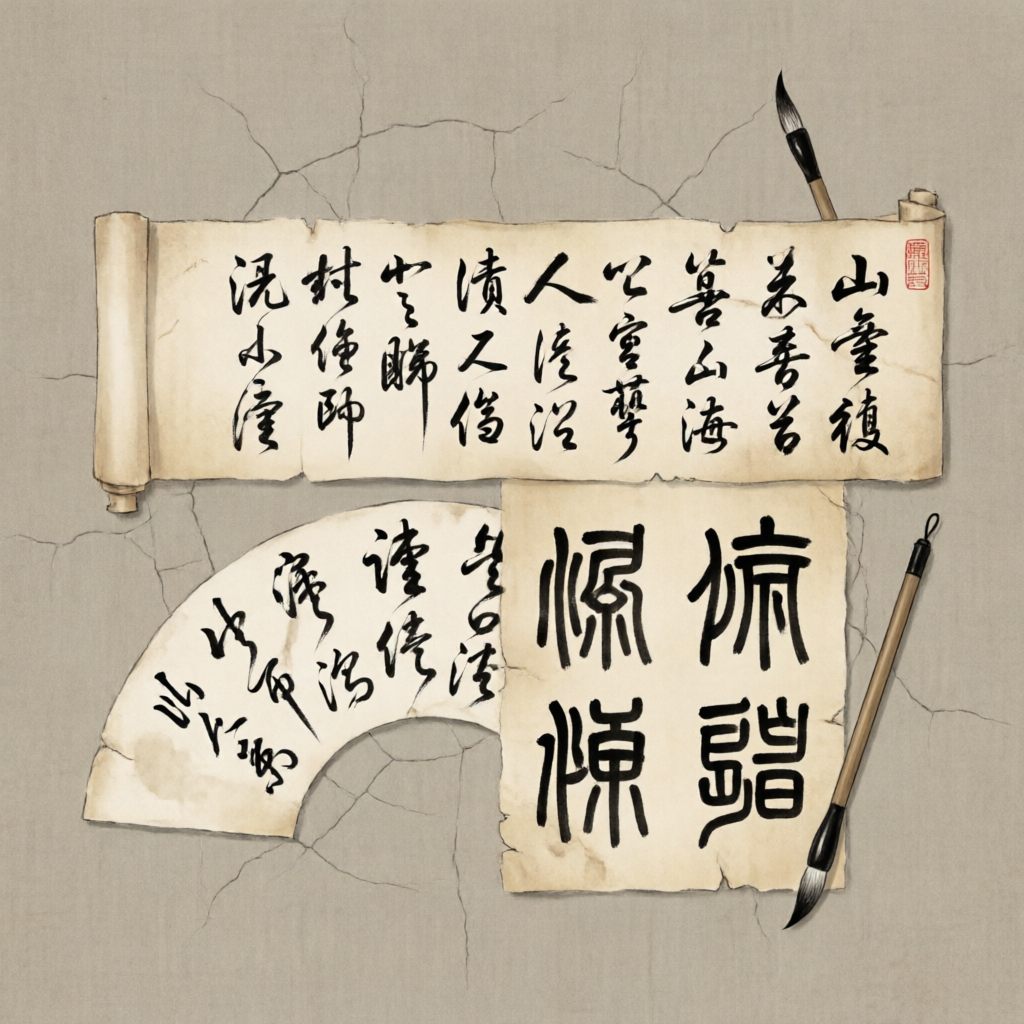
Chinese Calligraphy
Overview
Chinese calligraphy (书法, shū fǎ) is a traditional art form that originated in China and has spread throughout East Asia. It is considered one of the highest forms of visual art in Chinese culture, emphasizing the beauty of brushstrokes, composition, and the expressive qualities of written characters. The practice involves using specialized tools known as the "Four Treasures of the Study" (文房四宝, wén fáng sì bǎo): brush, ink, paper, and inkstone. Chinese calligraphy is not merely about writing characters legibly but is an art form that expresses the writer's emotions, personality, and spiritual cultivation.
History
Origins
The origins of Chinese calligraphy can be traced back to the earliest forms of Chinese writing. Archaeological evidence suggests that as early as 8,000 years ago, during the Cishan and Peiligang cultures in the Yellow River basin, pottery with proto-characters appeared. These early symbols represented a combination of communication, record-keeping, and decorative functions.
The most significant early developments occurred during the Shang Dynasty (c. 1600-1046 BCE) with the emergence of oracle bone script (甲骨文, jiǎ gǔ wén) on turtle shells and animal bones. This was followed by bronze script (金文, jīn wén) during the Zhou Dynasty (1046-256 BCE), which was cast on bronze vessels. These early scripts were primarily pictographic, with characters resembling the objects they represented.
Development Through Dynasties
Qin and Han Dynasties (221 BCE-220 CE)
The Qin Dynasty (221-206 BCE) marked a crucial period in the development of Chinese calligraphy. Emperor Qin Shi Huang unified the script across his empire, creating the small seal script (小篆, xiǎo zhuàn) under the direction of Chancellor Li Si. This standardization facilitated administrative efficiency and cultural exchange.
During the Han Dynasty (206 BCE-220 CE), clerical script (隶书, lì shū) emerged as a more practical writing form. This script featured horizontal strokes with distinctive "wavy" endings (波磔, bō zhé), making it easier to write and read. The Han period also saw the development of early cursive script (草书, cǎo shū), which prioritized speed and expressiveness over legibility.
Wei, Jin, and Northern and Southern Dynasties (220-589 CE)
The Wei-Jin period (220-420 CE) witnessed significant innovation in calligraphy. The emergence of regular script (楷书, kǎi shù) provided a standardized form that balanced legibility with aesthetic appeal. This period also saw the rise of running script (行书, xíng shū), which bridged the gap between regular and cursive scripts.
The most celebrated figure from this era is Wang Xizhi (王羲之, 303-361 CE), often referred to as the "Sage of Calligraphy" (书圣, shū shèng). His "Preface to the Orchid Pavilion Collection" (兰亭序, Lán Tíng Xù) is considered a masterpiece of running script and has been revered for centuries.
Sui, Tang, and Five Dynasties (581-960 CE)
The Sui Dynasty (581-618 CE) reunified China and synthesized various calligraphic styles, laying the foundation for the Tang Dynasty's achievements. The Tang period (618-907 CE) is often regarded as the golden age of Chinese calligraphy. This era produced many master calligraphers who specialized in different scripts:
- Regular script: Ouyang Xun (欧阳询, 557-641 CE), Yan Zhenqing (颜真卿, 709-785 CE), Liu Gongquan (柳公权, 778-865 CE)
- Cursive script: Zhang Xu (张旭, fl. 8th century CE), Huai Su (怀素, 737-799 CE)
The Tang Dynasty established formal calligraphy education through the "Imperial Academy" (国子监, guó zǐ jiàn), which included a specialized "Calligraphy School" (书学, shū xué).
Song, Yuan, Ming, and Qing Dynasties (960-1912 CE)
The Song Dynasty (960-1279 CE) emphasized "meaning" (意, yì) over strict formality. Calligraphers like Su Shi (苏轼, 1037-1101 CE), Huang Tingjian (黄庭坚, 1045-1105 CE), Mi Fu (米芾, 1051-1107 CE), and Cai Xiang (蔡襄, 1012-1067 CE) became known as the "Four Song Masters" (宋四家, Sòng Sì Jiā).
During the Yuan Dynasty (1271-1368 CE), Zhao Mengfu (赵孟頫, 1254-1322 CE) emerged as the most influential calligrapher, advocating for a return to classical traditions. His "Zhao style" (赵体, zhào tǐ) became one of the four major regular script styles.
The Ming Dynasty (1368-1644 CE) saw the rise of individualistic styles, particularly during the late Ming period when calligraphers like Zhang Ruitu (张瑞图, 1570-1641 CE) and Huang Daozhou (黄道周, 1585-1646 CE) challenged conventional aesthetics.
The Qing Dynasty (1644-1912 CE) witnessed a significant shift toward "stele studies" (碑学, bēi xué), focusing on ancient inscriptions and epigraphy. This movement was led by scholars like Ruan Yuan (阮元, 1764-1849 CE), Bao Shichen (包世臣, 1775-1855 CE), and Kang Youwei (康有为, 1858-1927 CE).
Key Information
| Aspect | Description |
|---|---|
| Chinese Name | 书法 (shū fǎ) |
| Tools | Four Treasures of the Study: brush (笔, bǐ), ink (墨, mò), paper (纸, zhǐ), inkstone (砚, yàn) |
| Major Scripts | Seal script (篆书, zhuàn shū), Clerical script (隶书, lì shū), Regular script (楷书, kǎi shū), Running script (行书, xíng shū), Cursive script (草书, cǎo shū) |
| Key Masters | Wang Xizhi, Yan Zhenqing, Su Shi, Zhao Mengfu |
| Cultural Significance | Integral to Chinese literati culture, associated with moral cultivation and self-cultivation (修身, xiū shēn) |
| Modern Status | Recognized as UNESCO Intangible Cultural Heritage, practiced worldwide as both art and discipline |
Cultural Significance
Chinese calligraphy holds profound cultural significance beyond its aesthetic value. Traditionally, it has been considered one of the "Four Arts" (四艺, sì yì) of the Chinese scholar, along with painting, stringed instruments, and board games.
The practice of calligraphy is closely linked to Confucian ideals of self-cultivation (修身, xiū shēn) and moral development. Through disciplined practice, calligraphers aim to achieve not only technical mastery but also spiritual refinement. The famous calligrapher Wang Xizhi was said to have practiced so much that he wore out the pond where he washed his brushes.
In Chinese aesthetics, calligraphy is valued for its ability to convey both form and spirit (形神兼备, xíng shén jiān bèi). The famous scholar Su Shi wrote: "The quality of calligraphy depends on the writer's character and spirit." This reflects the belief that a person's true nature is revealed through their brushwork.
Calligraphy also plays a significant role in Chinese religious and philosophical traditions. Buddhist monks often practice calligraphy as a form of meditation, while Taoist writings frequently incorporate calligraphic elements to express philosophical concepts.
Modern Status
In the contemporary era, Chinese calligraphy continues to thrive both in China and internationally. In 2009, Chinese calligraphy was inscribed on the UNESCO Representative List of the Intangible Cultural Heritage of Humanity, recognizing its cultural significance and the need for its preservation.
Modern calligraphers continue to explore both traditional and innovative approaches. While many practitioners maintain classical techniques, others experiment with contemporary materials, abstract compositions, and cross-cultural influences. Digital technology has also introduced new possibilities, with calligraphers using tablets and specialized software to create electronic works.
Educational institutions worldwide offer courses in Chinese calligraphy, and museums frequently feature exhibitions of historical and contemporary works. The practice has also gained popularity as a form of therapy and mindfulness practice, with many enthusiasts appreciating its meditative qualities.
Despite modernization, Chinese calligraphy remains deeply connected to cultural identity. During important festivals and celebrations, calligraphy is often displayed in homes and public spaces, continuing its role as a vital cultural expression.
References
-
Chiang, Y. (1977). Chinese Calligraphy: Its History and Aesthetic Development. Harvard University Press.
-
Barnhart, R. M., & Wong, S. (1996). Three Thousand Years of Chinese Painting. Yale University Press.
-
Mair, V. H. (Ed.). (2007). The Columbia History of Chinese Literature. Columbia University Press.
-
Tsien, T. H. (2004). Written on Water: Collected Papers from the Institute of East Asian Studies, University of California, Berkeley. University of California Press.
-
Ledderose, L. (2000). Ten Thousand Things: Module and Mass Production in Chinese Art. Princeton University Press.