Overview
The Dragon Boat Festival, also known as Duanwu Festival, is a traditional holiday celebrated primarily in China and other East Asian countries. It occurs on the 5th day of the 5th lunar month of the Chinese calendar and features various customs including dragon boat racing, eating zongzi (glutinous rice dumplings), hanging medicinal herbs, and wearing perfumed sachets. The festival has a history spanning over 2,000 years and incorporates elements of ancient beliefs, commemorative rituals, and seasonal customs.
History
The origins of the Dragon Boat Festival can be traced back to the pre-Qin period in China. Historical records indicate that as early as the Spring and Autumn Period (771-476 BCE), people in the central plains region observed customs related to the 5th day of the 5th lunar month. By the Han Dynasty (206 BCE-220 CE), the festival had taken more formal shape, with textual records describing activities aimed at avoiding plagues and warding off evil spirits.
Several theories exist regarding the festival's origins:
-
Commemorative Theory: The most popular theory associates the festival with the poet Qu Yuan (c. 340-278 BCE) of the Warring States Period. Legend holds that Qu drowned himself in the Miluo River on the 5th day of the 5th lunar month as an act of protest against corruption. Local people raced boats to try to save him and threw rice dumplings into the water to prevent fish from eating his body.
-
Dragon Worship Theory: Scholars like Wen Yiduo suggested that the festival originated from dragon worship rituals among the Baiyue people in ancient China. This theory points to the dragon boat racing and zongzi customs as evidence of totemic worship.
-
Solar Term Theory: Some researchers believe the festival originated as a celebration of the summer solstice, marking the midpoint of summer when natural forces were considered most potent.
The festival evolved through different dynasties. During the Han Dynasty, customs like eating zongzi and tying colored threads became popular. The Wei-Jin and Northern-Southern Dynasties (220-589 CE) saw the addition of "bìbīngzēng" (辟兵缯) charms to ward off military conflicts. By the Tang Dynasty (618-907 CE), the festival had become more entertainment-oriented, with imperial banquets and widespread dragon boat competitions.
Key Information
| Aspect | Details |
|---|---|
| Date | 5th day of the 5th lunar month in the Chinese calendar |
| Alternative Names | Loong Boat Festival, Double Fifth Festival, Duanwu Festival, Tianzhong Festival, Bathing Festival, Herb Medicine Festival |
| Primary Activities | Dragon boat racing, eating zongzi, hanging mugwort and calamus, wearing perfumed sachets, drinking realgar wine |
| Regional Variations | Different regions emphasize various customs, such as commemorating different historical figures or emphasizing particular rituals |
| UNESCO Recognition | Inscribed on the Representative List of the Intangible Cultural Heritage of Humanity in 2009 |
Cultural Significance
The Dragon Boat Festival carries profound cultural significance in Chinese tradition and beyond. Its customs reflect ancient Chinese beliefs about health, protection, and community.
Symbolism and Rituals
-
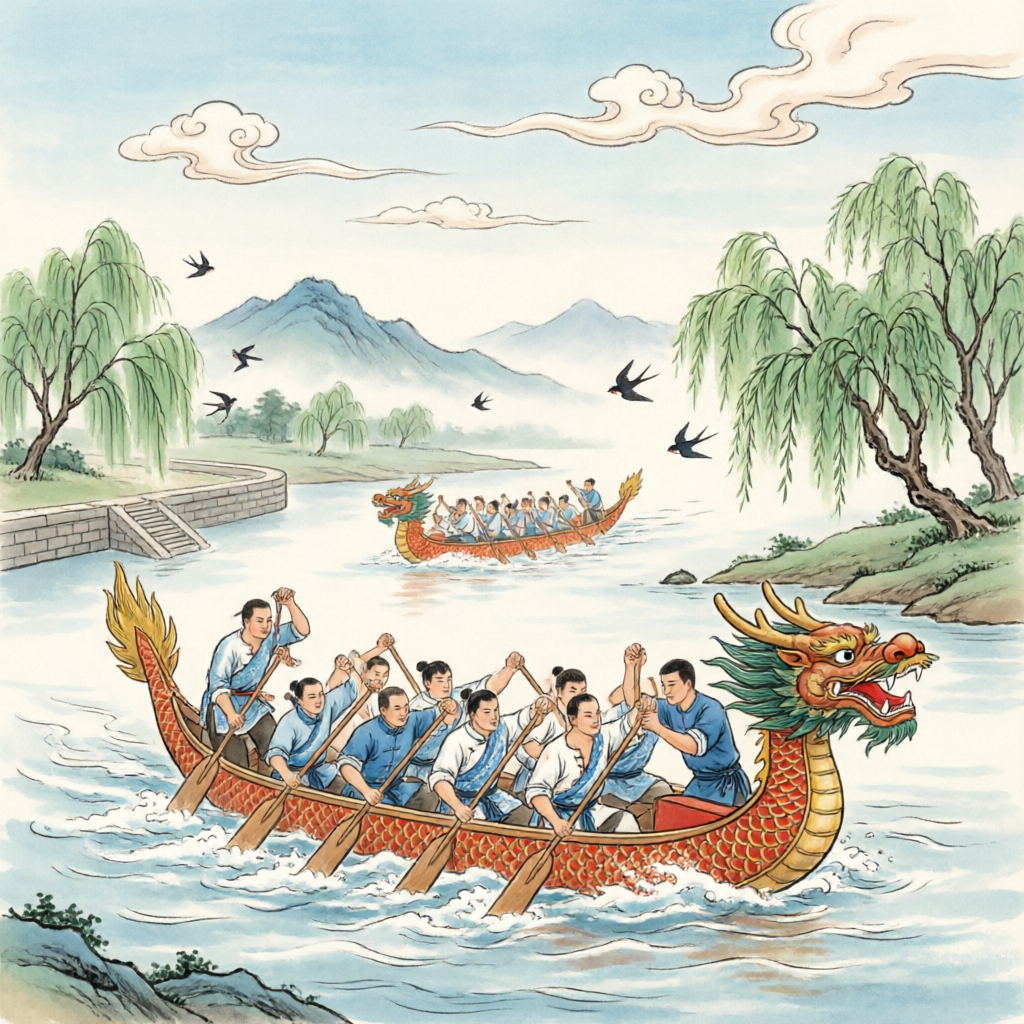
Dragon Boat Racing: The boats are typically decorated with dragon heads and tails, symbolizing the dragon totem. Racing represents the search for Qu Yuan's body and also demonstrates community strength and cooperation.
-
Zongzi: These pyramid-shaped rice dumplings wrapped in bamboo or reed leaves symbolize the offerings made to prevent fish from disturbing Qu Yuan's body. Different regions have varied fillings, reflecting local culinary traditions.
-
Medicinal Herbs: The practice of hanging mugwort and calamus or using herbs in bathing stems from the belief that the 5th day of the 5th lunar month had special medicinal properties. This reflects traditional Chinese medicine's emphasis on seasonal health practices.
-
Five-colored Threads: Wearing bracelets made of five colored threads represents the five elements in Chinese cosmology and is believed to offer protection.
Commemorative Figures
While Qu Yuan is the most widely commemorated figure associated with the festival, several other historical and legendary figures are honored in different regions:
- Qu Yuan: The patriotic poet of Chu state who drowned himself in protest.
- Wu Zixu: A general whose body was thrown into a river after being forced to suicide; honored in some regions of Jiangsu and Zhejiang.
- Cao E: A young girl who drowned while searching for her father's body; commemorated in eastern Zhejiang.
- Goujian: King of Yue who trained his navy on this day before defeating the state of Wu.
Modern Status
Today, the Dragon Boat Festival is celebrated both traditionally and in modernized forms across China and in Chinese communities worldwide. Since 2008, it has been a public holiday in mainland China.
Contemporary Celebrations
Modern celebrations often blend traditional elements with contemporary practices. Dragon boat racing has evolved into an international sport with standardized rules and competitions held worldwide. The festival has also become an occasion for promoting cultural exchange, with many cities organizing cultural events, exhibitions, and performances.
In recent years, there has been growing interest in the educational and cultural aspects of the festival. Schools and cultural institutions often organize activities to teach younger generations about the traditions and historical significance of Duanwu.
Global Recognition
In 2009, the Dragon Boat Festival was inscribed on UNESCO's Representative List of the Intangible Cultural Heritage of Humanity, recognizing its cultural significance and the need for its preservation. This international acknowledgment has helped promote awareness and appreciation of the festival beyond Chinese communities.
References
-
Loewe, Michael, and Edward L. Shaughnessy, eds. The Cambridge History of Ancient China: From the Origins of Civilization to 221 B.C. Cambridge University Press, 1999.
-
Kuhn, Philip A. Chinese Among Others: Emigration in Modern Times. Rowman & Littlefield, 2008.
-
Du, Lan. "The Dragon Boat Festival: Transformation and Continuity of a Chinese Tradition." Asian Folklore Studies, vol. 71, no. 1, 2012, pp. 1-28.
-
Yang, Mayfair Mei-hui. Gifts, Favors, and Banquets: The Art of Social Relationships in China. Cornell University Press, 1994.
-
Yau, Shuk-ting. "Ritual, Cultural Memory, and the Making of Heritage: The Dragon Boat Festival in Hong Kong." Journal of Ritual Studies, vol. 25, no. 2, 2011, pp. 1-20.