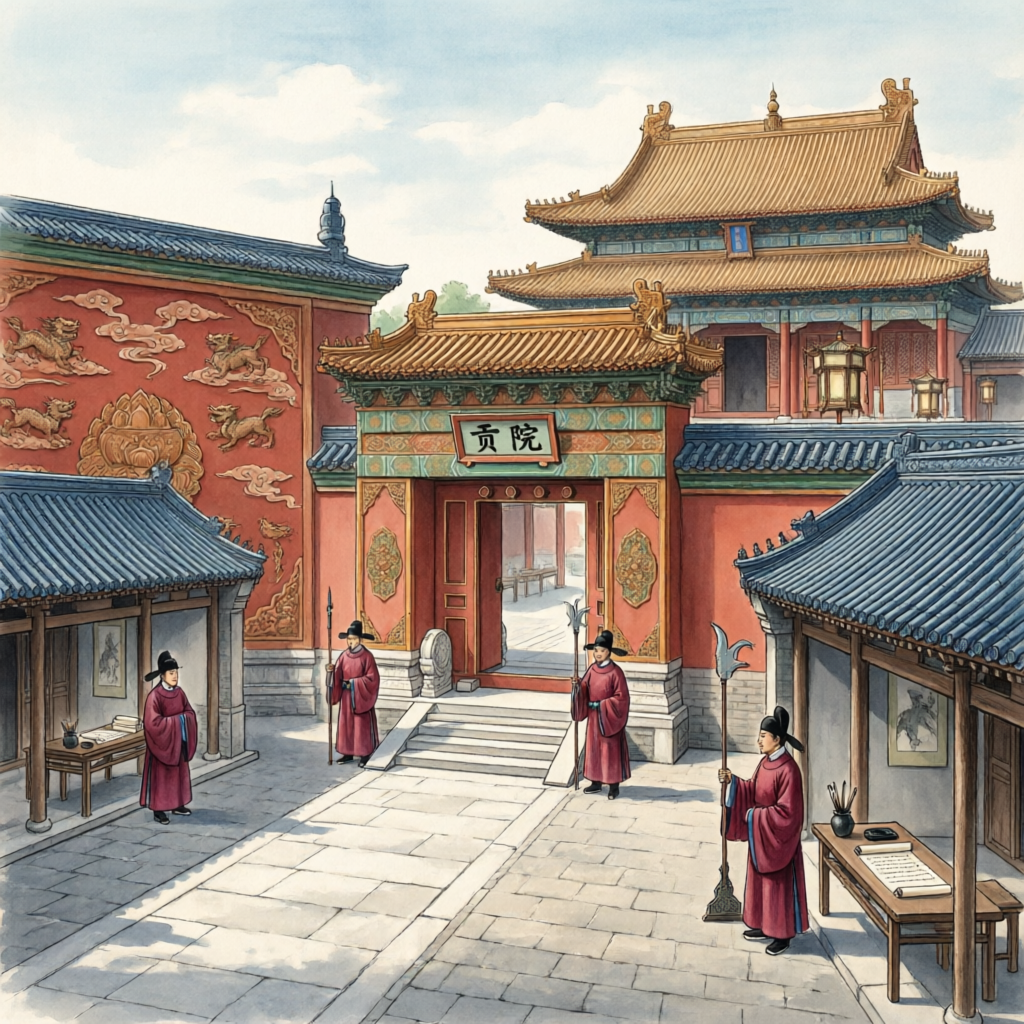
Imperial Examination System
Overview
The imperial examination system (科举制度, Kejú Zhìdù) was a civil service examination system in imperial China to select government officials through merit-based examinations rather than aristocratic or hereditary privilege. This system had profound influences on Chinese society, education, and governance for over thirteen centuries, from its establishment during the Han dynasty to its abolition in 1905 during the late Qing dynasty.
History
Origins and Development
The roots of the imperial examination system can be traced back to the Zhou dynasty (1046-256 BCE), where the "乡举里选" (xiāng jǔ lǐ xuǎn) method was employed. Under this system, local leaders known as "乡老" (xiāng lǎo, village elders) would recommend worthy individuals from their communities to higher authorities, who would then present them to the king for examination, primarily through archery tests.
During the Han dynasty (206 BCE-220 CE), the system evolved into the "察举制" (chájǔ zhì, recommendation system) and "征辟制" (zhěngbì zhì, recruitment system). Emperor Gaozu of Han issued edicts in 197 BCE ordering officials to recommend talented individuals, establishing the prototype of later examinations. Emperor Wen of Han further refined this system by ordering officials to recommend "贤良方正能直言极谏者" (xiánliáng fāngzhèng néng zhíyán jìjiàn zhě, upright and capable individuals who could speak truthfully to the throne) in 178 BCE and 165 BCE.
A significant reform occurred during Emperor Shun of Han's reign in 132 CE, when the imperial secretary Zuo Xiong recommended that the recommendation system be modified to include examinations. This reform, known as the "阳嘉新制" (Yángjiā Xīnzhì, Yangjia New System), established a specialized examination system where Confucian scholars were tested on classical texts and civil officials on administrative documents. This reform is considered the precursor to the imperial examination system.
Establishment in Sui and Tang Dynasties
Historians debate the exact origin of the imperial examination system, with some attributing it to the Han dynasty, others to the Sui dynasty (581-618 CE), and still others to the Tang dynasty (618-907 CE). During the Sui dynasty, the Nine-rank system (九品中正制, Jiǔpǐn Zhōngzhèng Zhì) was abolished, and a new system of selecting officials through specialized examinations was established.
However, most modern historians argue that the imperial examination system as we know it—with its distinctive features of allowing individuals to apply independently and the implementation of examination-based elimination—was formally established during the Tang dynasty. Emperor Gaozu of Tang issued an edict in 621 CE establishing regular examinations, and in 622 CE, he authorized individuals to apply independently, marking the birth of the imperial examination system.
Development in Song Dynasty
The Song dynasty (960-1279 CE) witnessed significant reforms to the examination system. Emperor Taizu of Song abolished the "公荐制度" (gōngjiàn zhìdù, public recommendation system) in 963 CE and established a re-examination system in 964 CE. To prevent cheating, he added a palace examination (殿试, diànshì) in 973 CE, which became a permanent feature.
Two crucial innovations were introduced during the Northern Song: "弥封" (mífēng, envelope sealing) and "誊录" (ténglù, transcription). The envelope sealing method, first implemented in 953 CE, concealed candidates' names on examination papers to prevent favoritism. The transcription system, established in 1015 CE, had clerks copy examination papers before grading to prevent recognition of candidates' handwriting.
Emperor Shenzong of Song and Wang Anshi implemented major reforms in 1071 CE, consolidating all examinations into a single category (进士科, jìnshì kē), abolishing poetry and literature tests in favor of classical studies, policy discussions, and policy proposals. These reforms aimed to unify thought and scholarship but were met with opposition from scholars like Su Shi and Sima Guang.
Key Information
| Feature | Han Dynasty | Sui Dynasty | Tang Dynasty | Song Dynasty |
|---|---|---|---|---|
| Primary Selection Method | 察举制 (Recommendation) | 分科举人 (Specialized examinations) | 常科与制科 (Regular and special examinations) | 三级考试 (Three-tier examination) |
| Key Examination Subjects | 孝廉 (Filial piety), 茂才 (Talented) | 十科举人 (Ten categories) | 进士 (Jinshi), 明经 (Mingjing) | 经义 (Classical studies), 策论 (Policy discussions) |
| Notable Reforms | 阳嘉新制 (Yangjia New System) | Abolition of Nine-rank system | Establishment of regular examinations | 弥封、誊录 (Envelope sealing, transcription) |
| Social Impact | Limited to elite families | Expanded recruitment | Open to commoners | Increased social mobility |
Cultural Significance
The imperial examination system profoundly influenced Chinese culture, education, and social structure. It created a merit-based pathway for social mobility, allowing talented individuals from humble backgrounds to enter the government bureaucracy. This system helped maintain Confucian values as the ideological foundation of imperial China and shaped the content of education for centuries.
The examination system also gave rise to a unique examination culture, including elaborate rituals, celebrations for successful candidates, and specialized examination literature. The "状元" (zhuàngyuán, top scholar) achieved special status and honor, becoming cultural icons celebrated in literature and art.
The system's emphasis on classical Chinese literature and philosophy influenced the development of Chinese literary forms and styles. The "八股文" (bāgǔ wén, eight-legged essay) that emerged during the Ming and Qing dynasties, though later criticized for its rigid structure, was a direct evolution of examination writing styles.
Modern Status
The imperial examination system was abolished in 1905 by the imperial edict of Empress Dowager Cixi as part of the late Qing reforms. Its demise marked the end of a thirteen-century tradition of selecting officials through examinations.
In modern China, the legacy of the examination system continues to influence the national college entrance examination (高考, gāokǎo), which remains a critical pathway for social mobility and educational advancement. The cultural significance of merit-based selection and the value placed on education continue to shape Chinese society.
Historically, scholars have debated the system's merits and drawbacks. Advocates praised it for promoting meritocracy and social mobility, while critics pointed to its emphasis on rote learning, potential for corruption, and eventual ossification. Despite these criticisms, the imperial examination system represents one of the most influential and long-lasting civil service examination systems in world history.
References
-
Elman, Benjamin A. A Cultural History of Civil Examinations in Late Imperial China. University of California Press, 2000.
-
Ho, Ping-ti. The Ladder of Success in Imperial China: Aspects of Social Mobility, 1368-1911. Columbia University Press, 1962.
-
Kracke, E.A. Civil Service in Early China: The Ch'in Dynasty. Harvard University Press, 1970.
"The imperial examination system was both a mechanism for selecting talent and a means of controlling thought, reflecting the complex relationship between education and power in imperial China." — Elman, 2000