Overview
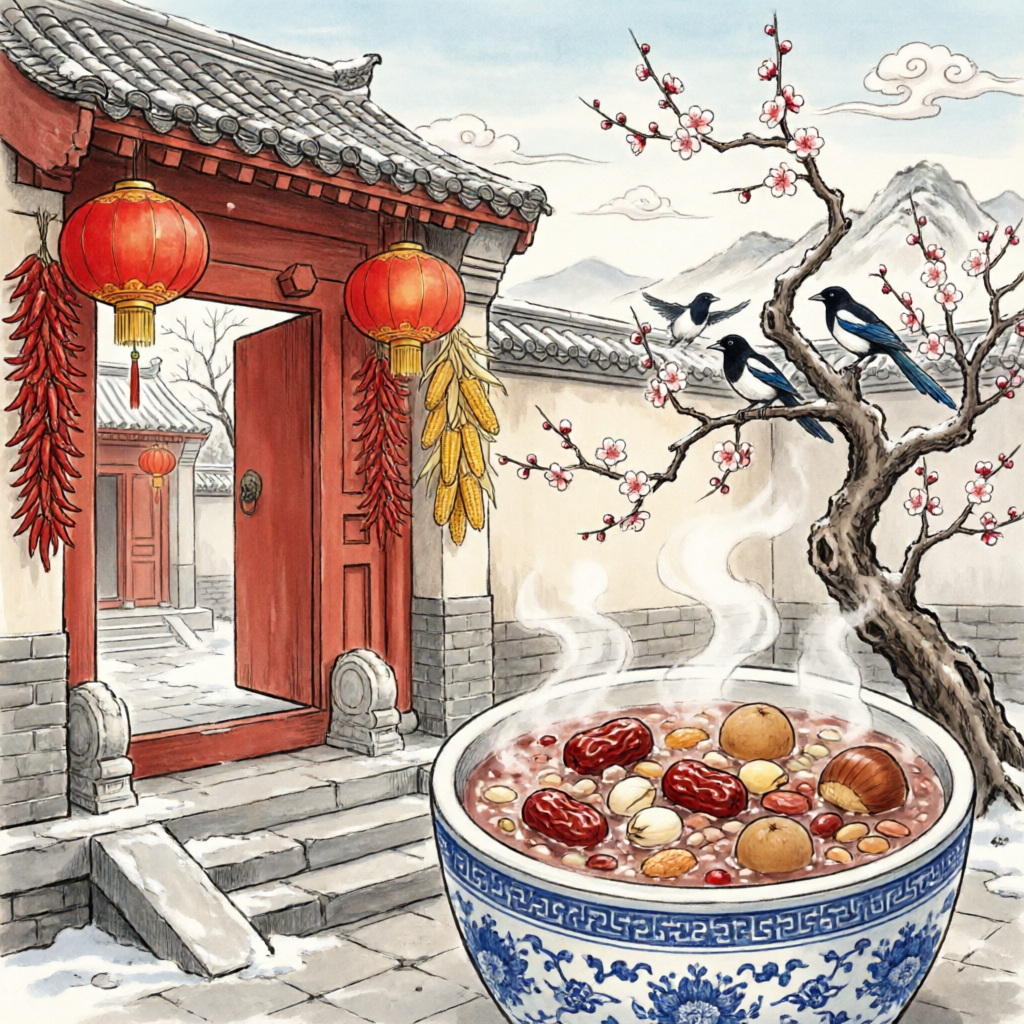
The Laba Festival, also known as the Laji Festival or Buddha Enlightenment Day, is a traditional Chinese holiday celebrated on the eighth day of the twelfth lunar month (腊月初八). This festival has ancient origins and has evolved over thousands of years, incorporating elements from ancient Chinese sacrificial rituals and Buddhist traditions. The festival is characterized by various customs, most notably the consumption of Laba porridge (腊八粥), which has different variations across different regions of China.
History
Origins
The Laba Festival originated from ancient Chinese "La sacrifices" (腊祭). In ancient China, "La" (腊) was originally a type of sacrificial ritual known as "Da La" (大腊). According to "Fengsu Tongyi" (《风俗通》), "La means hunting. It is called La because hunting animals are used to worship ancestors or because it marks the transition between the old and new year, with a grand hunt to repay the gods' blessings." This indicates that "La" and "hunting" were related, and "La sacrifice" involved using hunted animals for sacrifices to ancestors and various deities.
During the Shang Dynasty, people held four major sacrifices throughout the year using captured birds and beasts, worshiping ancestors and deities of heaven and earth. The winter sacrifice was the largest and most grandiose, which later became known as "La sacrifice," and the day of this winter sacrifice was called "La Day." According to the "Records of the Grand Historian: Basic Annals of Qin" (《史记·秦本纪》), "In the twelfth year, the first La sacrifice was held." This means that in the twelfth year of King Huiwen of Qin, located in the western region, imitated the customs of the central plains and held the La sacrifice for the first time.
Development
During the Han Dynasty, the specific date of La Day was not fixed. It was not until the Han Dynasty that the third "wu" day after the winter solstice was designated as "La Day." Emperor Wu of Han changed to the "Taichu Calendar" (《太初历》), making the first month of the lunar calendar the beginning of the year and the twelfth month the "La month," and fixed the eighth day of the twelfth lunar month as the day of the La sacrifice.
During the Wei, Jin, Northern and Southern Dynasties, the Laba Festival gradually separated from La Day Festival and became an independent holiday. After Buddhism was introduced to China, it received strong official support, and Buddhist activities flourished within the country. Legend has it that the day Buddha Shakyamuni achieved enlightenment was the eighth day of the twelfth lunar month. On this day, Buddhist monasteries would hold various commemorative activities. Thus, the imperial La sacrifice merged with Buddha's enlightenment day in Buddhism, expanding the Laba Festival's influence in official and society, ultimately forming its modern characteristics.
Golden Age
In the Tang Dynasty, the Laba Festival was initially closely related to Buddhism, commemorating Buddha's enlightenment with minimal participation from secular people. During this period, the main customs of the Laba Festival included bathing monks and Buddha, cooking "medicinal food," and lamp lighting customs. These customs were mainly held in monasteries, initially activities for monks and later gradually spread to the public, attracting active participation and evolving into folk traditions.
By the Song Dynasty, the Laba Festival had become as important as the La Day Festival. As the La Day Festival gradually declined, the Laba Festival eventually replaced it as the main festival of the La month. During this period, the Laba Festival continued to inherit previous customs, with the most notable development being the emergence of Laba porridge, which immediately became the main symbol of the Laba Festival and the most important identifier of its final formation. Additionally, new customs such as winter milling and sending medicinal herbs to eliminate epidemics also indicated the further development of the Laba Festival in the Song Dynasty.
During the Ming and Qing Dynasties, the development of the Laba Festival reached its peak stage, with the festive atmosphere becoming increasingly grand and new customs continuously emerging. In the Ming Dynasty, Laba Festival customs, while inheriting traditions from previous generations, also showed some new changes. For example, the custom of eating Laba porridge had been integrated into many fresh and characteristic ritual activities by the Ming Dynasty, not only expanding the richness of activities but also deepening the cultural connotation.
During the Qing Dynasty, with strengthened ethnic fusion, customs of various ethnic groups merged and permeated each other. The Laba Festival popular among the people not only inherited the characteristics of previous generations' customs but also incorporated many ethnic characteristics. During this period, Laba Festival customs became richer, and people endowed the Laba Festival with more auspicious meanings through historical evolution.
Gradual Decline
In the late Qing Dynasty, Chinese society entered a period of drastic turmoil and frequent changes in political power, with internal and external troubles and people living in misery. The call for reform to abolish old traditions and learn new ideas grew increasingly loud. Traditional culture became the primary target of suppression. As an important part of the traditional folk festival system, the Laba Festival naturally could not escape the fate of being reformed, showing signs of disintegration and decline.
As early as during the Taiping Heavenly Kingdom period, the official government had taken a repressive attitude toward the Laba Festival and other traditional festivals. For example, the promulgation of the "Heavenly Calendar" at the time clearly proposed six new festivals of the Heavenly Kingdom, none of which were traditional festivals.
In 1911, the Xinhai Revolution overthrew the old system, and the newly established Republic of China adopted a new calendar system (solar calendar) and established new festivals, attempting to align new festivals with Western customs. With the spread of Western ideas and tremendous changes in social forms, the agricultural culture that the Laba Festival relied on gradually retreated to the margins. Gradually, the Laba Festival became less grand, and some customs gradually disappeared. For example, popular customs such as ice storage and hair shaving had long disappeared, leaving only the eating of Laba porridge.
Key Information
| Aspect | Details |
|---|---|
| Chinese Name | 腊八节 (Laba Jie) |
| English Name | Laba Festival |
| Also Known As | Buddha Enlightenment Day, Laji Festival |
| Date | Eighth day of the twelfth lunar month |
| Type | Traditional Chinese festival |
| Regions | Primarily China, with variations in different regions |
| Main Activities | Eating Laba porridge, making Laba garlic, temple visits |
| Main Foods | Laba porridge, Laba garlic, Laba tofu, Laba noodles |
| Cultural Significance | Commemorates Buddha's enlightenment, celebrates harvest, wards off evil spirits |
Cultural Significance
The Laba Festival embodies rich cultural significance. It originates from ancient La sacrifice customs and is a legacy of "spring prayers and autumn thanks" - human worship and sacrificial activities of nature in later generations. It contains the ancient people's earnest expectations for the next year's agricultural harvest and gratitude and reverence for ancestral souls. After Buddhism was incorporated, its cultural connotation rich in benevolence and philanthropy was also absorbed into the Laba Festival.
In folk society, a series of Laba customs express people's desires for many children and grandchildren, good fortune, and health. The Laba Festival also reflects the Chinese nation's spirit of gratitude, remembrance, and hope for a better future. The various foods and activities of the Laba Festival carry people's wishes for auspiciousness, happiness, and prosperity.
Modern Status
Today, the Laba Festival is still celebrated in many parts of China, though its scale and significance have diminished compared to previous eras. The most enduring custom is eating Laba porridge, which has become a cultural symbol of the festival. In recent years, there has been a renewed interest in traditional festivals, including the Laba Festival, as part of cultural heritage preservation efforts.
Many Buddhist temples continue to hold ceremonies on this day, distributing Laba porridge to visitors and the needy. In some regions, local governments organize cultural activities to promote traditional customs. The Laba porridge, with its diverse ingredients representing abundance and harmony, has also gained popularity as a healthy food choice, extending beyond its traditional festival context.
References
-
Zhang, J. (2018). Traditional Chinese Festivals: History and Customs. Beijing: China Intercontinental Press.
-
Li, W. (2020). Buddhism and Chinese Folk Religion: A Historical Study. Shanghai: Shanghai People's Publishing House.
-
Wang, L., & Chen, H. (2019). Food and Culture in Traditional China. New York: Cambridge University Press.
-
Liu, Y. (2017). The Evolution of Chinese Festivals. Taipei: Taiwan Commercial Press.
-
Zhao, M. (2021). Buddhist Influence on Chinese Folk Customs. Hong Kong: Chinese University of Hong Kong Press.