Overview
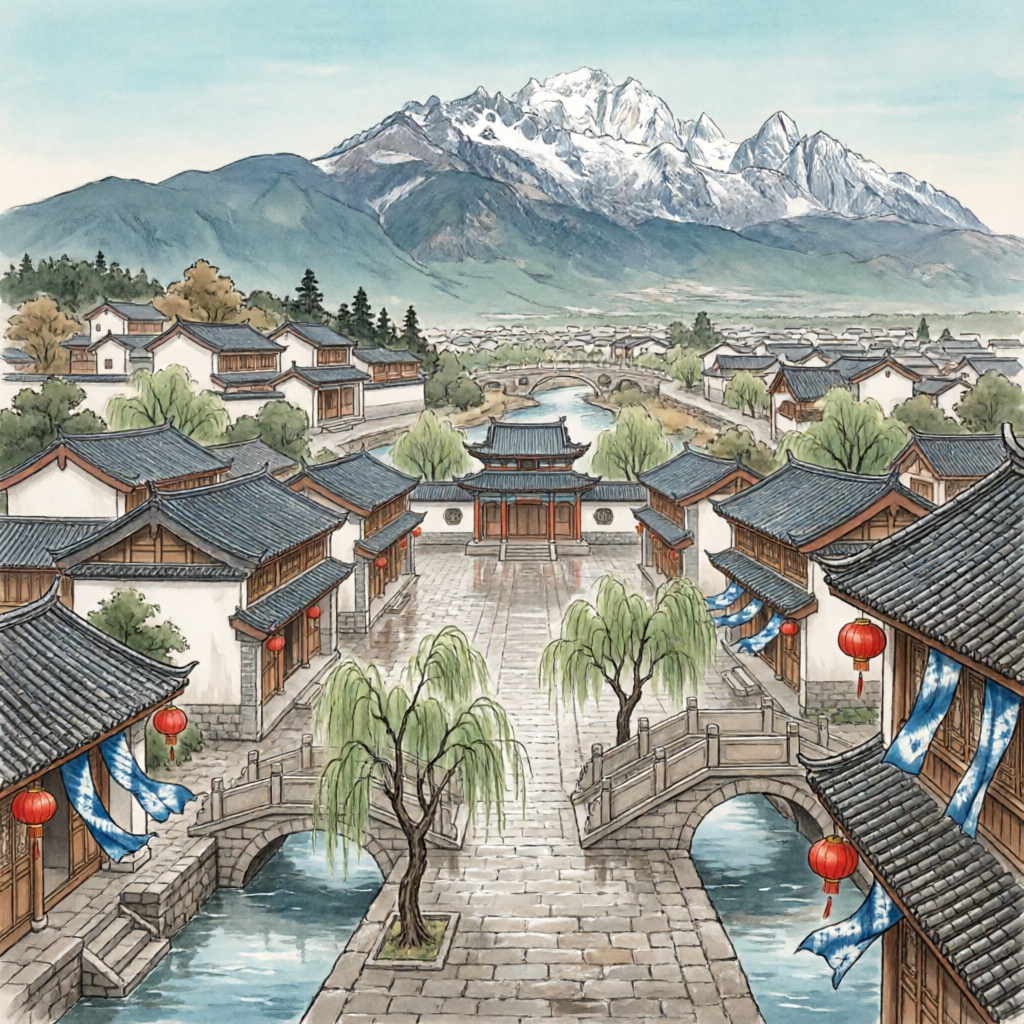
Lijiang Old Town is a historic cultural site located in Lijiang City, Yunnan Province, China. The town is renowned for its well-preserved ancient architecture, unique water systems, and rich cultural heritage of the Naxi people. In 1997, it was designated as a UNESCO World Heritage Site, recognizing its outstanding universal value in terms of cultural and historical significance. The Old Town encompasses three main areas: Dayan Ancient Town (including Black Dragon Pool), Shuhe Ancient Town, and Baisha Ancient Town, covering a total area of 7.279 square kilometers.
History
Formation in Tang and Song Dynasties
The origins of Lijiang Old Town date back to the Tang Dynasty (618-907 CE), when it was initially known as "Sancheng" (Three Tribute Cities). Historical records such as "Manshu" (Book of the Barbarians) from the Tang Dynasty and "Yi Tong Zhi" (Comprehensive Gazetteer) from the Yuan Dynasty mention Sancheng as an important administrative center. From 674 to 901 CE, Sancheng served as the central governance location for Lijiang. During this period, nearby Baisha and Shuhe were among the earliest settlements of the Naxi people, with Baisha Yuhu Village known as the "First Village of the Naxi People" and Shuhe serving as a hub on the ancient Tea Horse Road.
Development in the Yuan Dynasty
During the late Song and early Yuan dynasties (13th century), the Lijiang Old Town was formally established when the ancestors of the Mu family moved their administrative center from Baisha Ancient Town to the present-day Lion Mountain. This settlement was initially called "Dayechang" (Big Leaf Field). The Yuan Dynasty brought Lijiang under direct central governance when Kublai Khan appointed the Naxi leader Acong Aliang as "Chahan Zhang Guanmin Guan" (Administrator of Chahan Zhang), later promoting him to "Chahan Zhang Xuanweisi" (Commissioner of Chahan Zhang). This marked the beginning of the Tusi (hereditary chieftain) system in Lijiang. In 1276 CE, Lijiang Road was established, and in 1285 CE, it was reorganized into Lijiang Xuanfu Si (Pacification Commission), expanding its jurisdiction to include one prefecture, seven states, and one county. Sancheng from the Tang and Song dynasties began to appear in historical records as Tongan Prefecture City, becoming the political, economic, and cultural center of the Lijiang Tusi.
Flourishing in the Ming Dynasty
In 1382 CE, during the Ming Dynasty, Aja Ade (the seventh generation of the Mu family) surrendered to Ming forces, and Emperor Zhu Yuanzhang granted him the surname "Mu". The Mu Tusi subsequently entered a period of prosperity, with Lijiang Old Town experiencing its first golden age of development. During this period, the Old Town became the seat of the Lijiang Prefectural Government and the nerve center of the Mu regime, acquiring a new name: "Dayan Xiang" (Big Research Ward).
Changes in the Qing Dynasty
In the early Qing Dynasty, the influence of the Mu Tusi gradually declined. In 1723 CE, the Yongzheng Emperor implemented the "Tugui Liu" policy (replacing hereditary local rulers with centrally appointed officials), transforming Lijiang's political, economic, and cultural landscape. The Old Town was renamed "Dayan Li" (Dayan Subdistrict), and increased educational facilities established it as a cultural and educational center. Additionally, improvements in agricultural productivity and the development of handicrafts transformed the Old Town into a commercial center. However, during the Xianfeng and Tongzhi eras (1851-1874), the Du Wenxiu Muslim Rebellion in Yunnan Province severely damaged the Old Town.
Modern Development
After the founding of the People's Republic of China in 1949, Lijiang County was established in the Old Town. In 1986, it was listed as one of the second batch of National Famous Historical and Cultural Cities in China. On February 3, 1996, the Old Town was severely damaged by a magnitude 7.0 earthquake, with one-third of its residential buildings collapsing. However, the people of Lijiang reconstructed the town to its former appearance in less than two years. In December 1997, Lijiang Old Town was inscribed on the UNESCO World Heritage List, with its protected area including Dayan Ancient Town (including Black Dragon Pool), Baisha Residential Buildings, and Shuhe Residential Buildings. In 2003, Lijiang was restructured into Gucheng District and Yulong County, with the three ancient towns placed under different administrative jurisdictions.
Key Information
| Feature | Description |
|---|---|
| Location | Lijiang City, Yunnan Province, China |
| Coordinates | 26°52′50.43″N, 100°13′27.70″E |
| Area | 7.279 square kilometers |
| UNESCO Status | World Heritage Site (since 1997) |
| Altitude | 2,416 meters |
| Climate | Subtropical highland climate, distinct dry and wet seasons |
| Annual Rainfall | 950 mm |
| Main Features | Unique water system, Naxi architecture, cultural diversity |
| Protected Areas | Dayan Ancient Town, Shuhe Ancient Town, Baisha Ancient Town |
Cultural Significance
Lijiang Old Town represents a remarkable example of a traditional human settlement that has adapted harmoniously to the natural environment. The town's layout and architecture reflect the unique cultural traditions of the Naxi people while incorporating influences from Han, Tibetan, Bai, and Yi ethnic groups. The Old Town's distinctive water system, with its numerous canals and bridges, demonstrates sophisticated hydraulic engineering and urban planning.
The town serves as an important center for Naxi culture, preserving traditional customs, arts, and crafts. The Dongba script, one of the few remaining pictographic writing systems in the world, is still studied and preserved in Lijiang. The Old Town also hosts numerous festivals and cultural events that celebrate Naxi traditions, including the Sanduo Festival and the Naxi Ancient Music performances.
Modern Status
Today, Lijiang Old Town is a major tourist destination, attracting millions of visitors annually. The local economy has transitioned from traditional agriculture and handicrafts to tourism-related services. The town has implemented various conservation measures to balance tourism development with heritage preservation.
In recent years, Lijiang has faced challenges related to tourism pressure and maintaining the authenticity of the historic environment. The local government has implemented regulations to limit commercial development in the core preservation areas and to protect traditional residential buildings. In 2012, UNESCO approved a boundary adjustment for the World Heritage property, expanding its protected area to better manage tourism impacts and buffer zones.
The Old Town continues to evolve as a living community, with residents maintaining their traditional lifestyle while adapting to modern needs. Conservation efforts focus on preserving the town's unique architectural character, water systems, and cultural significance while ensuring it remains a vibrant place for local residents.
References
-
UNESCO World Heritage Centre. (1997). Lijiang Ancient City. Retrieved from https://whc.unesco.org/en/list/811
-
He, S., & Wang, Y. (2010). The Ancient Town of Lijiang: A World Heritage Site. Yunnan University Press.
-
Jiang, J. (2015). Water Systems and Urban Planning in Lijiang Old Town. Journal of Architectural Heritage, 9(3), 345-360.
-
Zhang, L. (2018). Cultural Identity and Tourism Development in Lijiang. Asian Ethnicity, 19(2), 234-252.