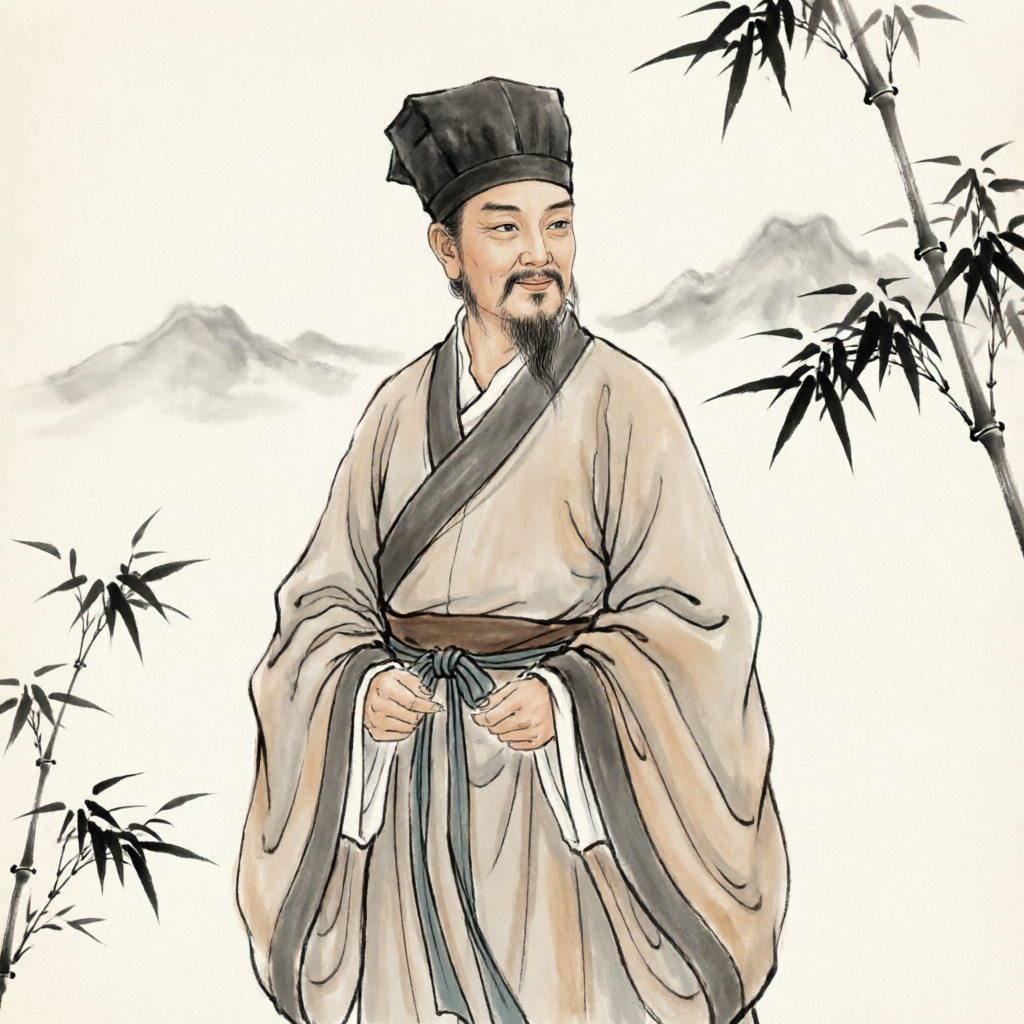
Su Shi
Overview
Su Shi (1037-1101), also known as Su Dongpo, was a preeminent writer, poet, calligrapher, statesman, and gourmet of the Song Dynasty. Born in Meishan, Sichuan province, he became one of the most significant literary figures in Chinese history, with profound influence on Chinese literature, particularly in poetry and ci poetry. Su Shi's life was marked by both political success and adversity, as he served in various official positions but also experienced multiple exiles due to his political conflicts. His literary works reflect his wide-ranging experiences and philosophical depth, blending personal emotions with social commentary.
History
Early Life
Su Shi was born on January 8, 1037, in Meishan, Meizhou (modern-day Sichuan province). He was a descendant of Su味道, a high official from the early Tang Dynasty. His name "Shi" refers to the handrail on ancient Chinese chariots, symbolizing something indispensable yet often overlooked. Su Shi received an excellent education at home, as his father Su Xun was a renowned classical essayist, and his mother, Madam Cheng, encouraged him to emulate Fan Pang, a famous scholar from the Eastern Han Dynasty known for his integrity.
In 1048, Su Xun, having observed a mourning period for his father, dedicated himself to teaching his sons, Su Shi and Su Che (Su Zhe), his knowledge and moral principles. Su Shi developed a free-spirited and straightforward personality, embodying the characteristics of Taoist philosophy. He enjoyed making friends, appreciating fine food, creating culinary masterpieces, savoring tea, and wandering through scenic mountains and forests.
Imperial Examination
In 1056, at the age of twenty-one, Su Shi left Sichuan for the first time to participate in the imperial examination in the capital, Bianjing (modern-day Kaifeng). Accompanied by his father and younger brother Su Zhe, he traveled along the Yangtze River and arrived in Bianjing in 1057.
The examination essay topic was "On the Ultimate Benevolence of Reward and Punishment." Su Shi's essay greatly impressed the chief examiner Ouyang Xiu and the secondary examiner Mei Yaochen. In his essay, Su Shi wrote: "When Gao Yao was about to execute someone, he said 'kill him' three times, while Emperor Yao said 'pardon him' three times." Ouyang Xiu and Mei Yaochen did not recognize this quote and initially placed Su Shi second, possibly because Ouyang Xiu mistakenly thought it was the work of his disciple Zeng Gong. After the results were announced, when asked about the source of the quote, Su Shi claimed it was from the annotations to the "Biography of Kong Rong" in the Records of the Three Kingdoms. When Ouyang Xiu checked and couldn't find it, Su Shi explained that he had taken creative liberty in the spirit of Kong Rong's "assuming so" approach. Ouyang Xiu was deeply impressed by Su Shi's boldness and predicted his future: "This man knows how to read books and use them well; his writings will surely be unparalleled in the world."
Rising Fame in the Capital
Through Ouyang Xiu's repeated praise, Su Shi quickly gained fame in the capital. Whenever he produced a new work, it would immediately circulate throughout the city. Just when the Su family was about to make their mark, news arrived that their mother had fallen ill and passed away. The two brothers returned home with their father to observe the mourning period.
After the mourning period ended in October 1059, the three Sus returned to Bianjing in February of the following year. Su Shi was appointed as the registrar of Fuchang County in Henan Prefecture, while Su Xun served as a collator in the Secretariat. In 1061, on Ouyang Xiu's recommendation, Su Shi and his brother participated in the special examination known as "Virtuous and Incorruptible Officials Who Can Speak Frankly." Su Shi's essay was rated third class (the first and second classes were nominally reserved, making the third class essentially first place). Only one other person in the Song Dynasty had previously achieved this third-class ranking, so Su Shi's accomplishment was hailed as "unseen in a century." He was subsequently appointed as an adjutant in the Court of Judicial Review and then as a judge in Fengyang Prefecture.
Self-Request to Leave the Capital
In 1071, Su Shi submitted a memorial criticizing the flaws in Wang Anshi's New Policies. Wang Anshi became enraged and sent the censor Xie Jingyong to accuse Su Shi before Emperor Shenzong. As a result, Su Shi requested a position outside the capital and was appointed as the vice-prefect of Hangzhou.
In autumn 1074, Su Shi was transferred to Mizhou (modern-day Zhucheng in Shandong) as prefect. From April 1077 to March 1080, he served as prefect of Xuzhou. During this time, the Yellow River breached its banks at Cao Village, causing the Liangshan Marsh to flood and the water of the South Qing River to overflow its channel. The floodwaters gathered around Xuzhou City, threatening to breach the city walls. Wealthy citizens tried to flee the city, but Su Shi declared: "If the wealthy leave, the morale of all citizens will collapse, and who will remain to defend the city? I am staying here, and the floodwaters will not breach these walls." He drove the wealthy citizens back into the city and went to the Wuwei Barracks, appealing to the military commander: "The river is about to breach the walls, and the situation is critical. Although you are imperial guards, I ask you to assist me." The commander replied: "If the prefect does not flee from the floodwaters, we common soldiers should certainly serve you." He led his soldiers with baskets and shovels to build a long dike from the Xima Terrace to the city walls. Despite continuous rain, which left only three "ban" (ancient measurement unit) of the wall above water, Su Shi built a small thatched hut on the city wall, refusing to return home even when passing it. He dispatched officials to plug gaps and protect the walls, ultimately saving Xuzhou City. He also requested conscripted laborers the following year to reinforce the old city walls and build wooden embankments to prevent future floods, a request approved by the imperial court.
Wutai Poem Case
In April 1079, Su Shi was transferred to Huzhou as prefect. After taking office, he submitted a Thank You Memorial to Emperor Shenzong, which was a routine procedure. However, as a poet, Su Shi could not resist adding personal touches, writing that he was "too foolish to adapt to the times" and "too old to cause trouble, perhaps capable of governing the common people." These remarks were used by the New Party to accuse him of "deceiving the court," "arrogance," "harboring resentment," "criticizing the emperor," and "having treacherous intentions." They selected lines from his extensive poetry collection that they claimed contained satirical references, leading to widespread anti-Su sentiment in the court. On July 28, just three months after taking office, Su Shi was arrested by officials from the Censorate and taken to the capital, with dozens of others implicated. This became the famous "Wutai Poem Case" of the Northern Song Dynasty (Wutai, or "Crow Terrace," was the nickname for the Censorate due to the crows that perched in the cypress trees there).
This enormous blow became a turning point in Su Shi's life. The New Party members insisted on putting Su Shi to death, while rescue efforts unfolded simultaneously in the court and among the common people. Not only did many veteran officials who shared Su Shi's political views submit memorials, but even some enlightened supporters of the New Policies advised Emperor Shenzong against executing Su Shi. Wang Anshi, then retired in Jinling, also wrote: "How can a sage dynasty execute a talented scholar?" Thanks to these efforts, largely decided by Wang Anshi with a single statement, Su Shi received a lighter sentence and was demoted to vice military commander of Huangzhou (modern-day Huanggang in Hubei), "placed under the jurisdiction of the local authorities" and under surveillance. Su Shi was imprisoned for 103 days and narrowly escaped execution. Fortunately, he was saved by the national policy established by Emperor Taizu of Song not to kill scholar-officials.
Exile in Huangzhou
Su Shi arrived at Dinghui Academy on February 1, 1080, and moved to Lin'ao Pavilion on May 29 of the same year. While living in Dinghui Academy, he wrote Bu Suan Zi: Written While Living in Dinghui Academy in Huangzhou. In July 1080, when the prefect of Huangzhou, Chen Shi, retired, Xu Junyou succeeded him. During Xu's tenure, he treated Su Shi "like family," developing a deep bond with him. In February 1081, when Su Shi's official stipends were exhausted and he had to "beg for rice," Xu Junyou allocated fifty acres of wasteland in the eastern part of the city to him. Su Shi began to personally cultivate the Eastern Slope (Dongpo), allowing his family of over twenty people to have enough to eat. He wrote Eight Poems on the Eastern Slope and Dongpo, built the "Dongpo Snow Hall," and adopted the pseudonym "Dongpo Jushi" (Resident of the Eastern Slope). On the Double Ninth Festival of 1081, Xu Junyou took Su Shi to climb high and enjoy the scenery of Huihui Tower, where Su Shi, after several cups of wine, was moved to write Nan Xiang Zi: Presented to Xu Junyou on the Double Ninth at Huihui Tower. On September 9, 1082, as Xu Junyou's term in Huangzhou was ending and he was about to be transferred to Hunan, he invited Su Shi to drink at Qixia Tower. Su Shi, feeling melancholy, wrote Zui Peng Lai: Presented to Junyou on the Double Ninth. In May 1083, when Xu Junyou left for Hunan and was replaced by Cai Yang as prefect, three large tile-roofed rooms were built for Su Shi south of Lin'ao Pavilion, which he named "South Hall" (Nantang).
The position of vice military commander of Huangzhou was quite low-ranking without real authority. By this time, Su Shi had become disheartened after his experience. After taking office, he frequently visited the Red Cliff Mountain outside Huangzhou City, writing famous works such as Red Cliff Rhapsody, Second Red Cliff Rhapsody, and Nian Nu Jiao: Remembering the Red Cliff to express his thoughts and feelings during his exile. In his spare time, he led his family to reclaim a slope east of the city, farming to supplement their livelihood. It was during this period that he adopted the nickname "Dongpo Jushi" (Resident of the Eastern Slope).
Return to Officialdom
In 1084, Su Shi left Huangzhou and was ordered to report to Ruzhou. Due to the long journey and exhaustion, his young son unfortunately died. As Ruzhou was far away, his travel funds were exhausted, and he was grieving for his son, Su Shi requested permission from the court to first settle in Changzhou before proceeding to Ruzhou, which was granted. Just as he was preparing to return south to Changzhou, Emperor Shenzong died. Changzhou, with its intricate water networks and beautiful scenery, offered Su Shi both freedom from political strife in the capital and the opportunity to enjoy natural beauty while living with his family and many friends. Su Shi thus chose Changzhou as his permanent residence.
In 1085, Emperor Zhezong ascended the throne, and Empress Dowager Gao assumed regency as Zhezong was young. Sima Guang was reappointed as chancellor, and the New Party led by Wang Anshi was suppressed. Su Shi was reinstated as an official in Dengzhou (modern-day Penglai). Four months later, he was recalled to the capital as a Gentleman of the Ministry of Rites. After half a month in the capital, he was promoted to Gentleman for Attending to the起居. Three months later, he was promoted to Gentleman of the Central Secretariat. Soon after, he was further promoted to Hanlin Academician and Drafter of Edicts, and then as Chief Examiner of the Ministry of Rites.
When Su Shi saw the emerging faction trying to suppress Wang Anshi's supporters and abolish all the New Policies, he believed they were no different from the so-called "Wang Party" and again proposed his views to the court. He criticized the corruption exposed after the Conservative Party took power, which aroused strong opposition from the conservative faction and led to false accusations against him. At this point, Su Shi was neither accepted by the New Party nor forgiven by the Conservative Party, so he again requested a transfer to a local post.
Second Term in Hangzhou
In 1089, Su Shi was appointed as an Academician of the Dragon Diagram Pavilion and Governor of Hangzhou. During his second term in Hangzhou, a severe drought occurred, followed by famine and epidemic diseases. Su Shi requested the court to reduce by one-third the tribute rice from the region and obtained monk ordination certificates (dudie), which he exchanged for rice to relieve the starving population.
In the spring of 1090, he sold government rice at reduced prices, prepared large quantities of thick congee and herbal medicines, and sent doctors to treat people in different neighborhoods, saving many lives. Su Shi noted: "Hangzhou is a place where land and water transportation meet, and people often die from epidemics here more than in other places." He therefore allocated 2,000 strings of cash from surplus public funds, added his own 50 taels of gold, and established a medical clinic to treat sick patients. Su Shi saw that Mount Mao had a river specifically for receiving the Qiantang River tide, and Salt Bridge had a river for receiving West Lake water. He dredged these two rivers for navigation and built dikes and sluice gates to control the water storage and drainage of West Lake, preventing Qiantang River tides from entering Hangzhou City. He then used the remaining labor force to repair six wells and piled up the dredged silt in West Lake, building a long堤 (embankment) thirty li (about 15 kilometers) long north-south for pedestrians. The people of Wu (the region around Hangzhou) planted water caltrop and removed all weeds in spring. Su Shi hired laborers to plant water caltrop in West Lake, preventing water weeds from growing. The income from the water caltrop was reserved for future dredging of West Lake, along with 10,000 strings of cash and 10,000 shi of grain remaining from disaster relief, and 100 monk ordination certificates he obtained to hire workers. When the long embankment was completed, it was planted with hibiscus and willow trees, looking like a painting. The people of Hangzhou named it Su Gong Di (Su Public Embankment), later known as Su Causeway.
Exile in Hainan
Su Shi enjoyed his time in Hangzhou, comparing himself to the Tang poet Bai Juyi. In 1091, he was recalled to the capital to serve as Minister of Personnel, but before he could take office, his brother Su Zhe was appointed as Right Vice Minister of Personnel, so Su Shi was transferred to Hanlin Academician. In August 1091, due to political disagreements, he requested a local position and was sent to Yingzhou as an Academician of the Dragon Diagram Pavilion.
In February 1092, he became Governor of Yangzhou. Less than a year later, he was summoned to the capital as Minister of War and concurrently Reader to the Emperor. That year, Emperor Zhezong performed the southern suburban sacrifice, and Su Shi served as the commander of the imperial procession. When more than ten carriages with red umbrellas and green canopies vied for the road without yielding to the emperor's procession, Su Shi ordered the commander of the imperial patrol to investigate. It turned out to be the entourages of the Empress and the Grand Princess. The Censor-in-Chief, Li Zhichun, was in charge of the imperial procession, but he dared not report the incident for fear of offending the Empress and Grand Princess. Su Shi submitted a memorial to Emperor Zhezong while in his carriage, and the emperor sent the memorial to the Grand Empress Dowager for handling. The next day, an imperial edict was issued to discipline the procession, prohibiting everyone from the Empress down from meeting or greeting improperly. Soon after, Su Shi was appointed Minister of Rites, concurrently as Academician of the Duanming Hall and Reader to the Emperor in the Hanlin Academy.
In September 1093, he became Governor of Dingzhou. That year, Empress Dowager Gao died, and Emperor Zhezong took direct control, with the New Party returning to power.
In June 1094, he was demoted to Vice Military Commissioner of Ningyuan Army and exiled again to Huizhou (modern-day Huizhou in Guangdong).
In 1097, Su Shi was sent to Hainan Island in a small boat, exiled to Danzhou (modern-day Danzhou, Hainan). It is said that in the Song Dynasty, exile to Hainan was second only to the death penalty in severity. He treated Danzhou as his second hometown, writing: "I am originally a man of Dan'er,寄生 (parasitically living) in the western Shu region." He established schools and promoted scholarship there, so many people traveled thousands of miles to Danzhou to study under him. During the more than 100 years of the Song Dynasty, no one from Hainan had passed the imperial examination. However, shortly after Su Shi's return north, Jiang Tangzuo from Hainan passed the provincial examination. Su Shi wrote a poem for him: "The vast sea has never severed the land's veins, and Zhuya (Hainan) has finally broken through the wilderness." People have always regarded Su Shi as the pioneer and sower of Danzhou culture, holding him in deep reverence. In Danzhou, many places bear his name—Dongpo Village, Dongpo Well, Dongpo Field, Dongpo Road, Dongpo Bridge, Dongpo Hat, etc.—expressing people's admiration for him. Even the local dialect is called "Dongpo dialect."
Death in Changzhou
After Emperor Huizong ascended the throne, Su Shi was successively transferred to Lianzhou, Vice Military Commissioner of Shuzhou, and placed in Yongzhou. In April 1100, the court issued a general amnesty, and Su Shi was reinstated as an Gentleman for Attending to the起居.
On his northward journey, Su Shi died in Changzhou (modern-day Jiangsu Province) on August 24, 1101. In his will, he requested to be buried in Shangrui Li, Juntai Township, Jia County, Ruzhou (modern-day Jia County, Henan Province). The following year, his son Su Guo transported his father's coffin to Jia County for burial. After Emperor Gaozong ascended the throne, Su Shi was posthumously granted the title of Grand Preceptor. During the reign of Emperor Xiaozong, he was posthumously honored with the name "Wenzhong" (Culturally Loyal).
Key Information
| Category | Details |
|---|---|
| Full Name | Su Shi (苏轼) |
| Courtesy Names | Zizhan (子瞻), Hezhong (和仲) |
| Pseudonyms | Dongpo Jushi (东坡居士), Tieguan Daoren (铁冠道人), Juliu Weng (玉局翁) |
| Posthumous Name | Wenzhong (文忠) |
| Born | January 8, 1037, in Meishan, Meizhou (modern-day Sichuan) |
| Died | August 24, 1101, in Changzhou (modern-day Jiangsu) |
| Burial Place | Jia County, Henan Province |
| Highest Position | Minister of Rites (礼部尚书) |
| Major Works | Red Cliff Rhapsody (赤壁赋), Second Red Cliff Rhapsody (后赤壁赋), Nian Nu Jiao: Remembering the Red Cliff (念奴娇·赤壁怀古), Shui Diao Ge Tou:明月几时有 (水调歌头·明月几时有) |
| Literary Contributions | Revolutionized ci poetry by elevating its status to that of poetry, expanded its themes and scope, developed "poetry in ci" style (以诗为词) |
Cultural Significance
Su Shi's literary achievements represent some of the highest peaks in Chinese literature. His poetry, with over 2,700 works, demonstrates his deep concern for social reality and philosophical reflections on life. Su Shi approached various unreasonable social phenomena with a "belly full of unsuitability to the times," consistently using criticism of reality as an important theme in his poetry. More remarkably, his criticism was not limited to new policies or contemporary issues but extended to attacking long-standing malpractices and陋习 (customary practices) in feudal society, showing a deeper critical consciousness.
In ci poetry, Su Shi made extraordinary achievements that exceeded his contributions to prose and poetry. Following Liu Yong, he comprehensively reformed the ci form, ultimately breaking through the traditional framework of ci as "songs of pleasure" (艳科). He elevated the literary status of ci, transforming it from an adjunct to music into an independent lyrical poetic form, fundamentally changing the direction of ci poetry development. Based on his concept of "poetry and ci as one" and his creative主张 (advocacy) of "forming one's own school," Su Shi broke through the traditional view that ci was a "minor art." He believed that poetry and ci shared the same origin and artistic essence, despite formal differences.
Su Shi expanded the expressive function of ci, opening up new realms. He transformed the traditional expression of tender emotions into the expression of heroic sentiments, and expanded the scope of ci from love to the full range of human emotions and personality. This allowed people with enterprising spirit, lofty ideals, and passion to enter the world of ci, changing its originally soft tone and paving the way for the Xin (Valiant) School of poets in the Southern Song Dynasty.
His concept of "using poetry in ci" (以诗为词) was his main weapon in reforming ci style. This involved transplanting poetic techniques into ci, using prefaces and allusions. The use of prefaces and allusions in ci began with Su Shi, enriching and developing its expressive techniques and having a major impact on later ci development.
Modern Status
Today, Su Shi is revered as one of China's greatest literary figures. His works continue to be widely studied and appreciated, both in China and internationally. The "Su Shi phenomenon" has become a significant area of research in Chinese literary studies, with scholars analyzing his political philosophy, literary innovations, and cultural impact.
Places associated with Su Shi, such as the West Lake in Hangzhou with the famous Su Causeway (Su Gong Di), and Red Cliff in Huanggang, have become important cultural sites. Numerous museums and memorial halls dedicated to Su Shi can be found throughout China, particularly in his hometown of Meishan and places where he lived and worked.
Su Shi's influence extends beyond literature into Chinese cuisine, with the famous "Dongpo Pork" (东坡肉) named after him. His love of food and innovative approach to cooking has made him a cultural icon in Chinese gastronomy.
In popular culture, Su Shi has been portrayed in films, television series, and literature, reflecting his enduring appeal as a multi-talented historical figure who navigated political challenges while creating timeless art.
References
-
Su, Ronald C. Su Shih and the Art of Sung Poetry. Princeton University Press, 1967.
-
Egan, Ronald. Word, Image, and Deed in the Life of Su Shi. Harvard University Asia Center, 1994.
-
Hightower, James R. The Poetry of T'ao Ch'ien. Harvard University Press, 1970. (Contains significant analysis of Su Shi's poetic innovations and influences)
-
Mair, Victor H. The Columbia Anthology of Traditional Chinese Literature. Columbia University Press, 1994. (Includes translations and analysis of Su Shi's major works)
-
Bush, Susan, and Hsio-yen Shih. Theories of the Arts in China. Princeton University Press, 1985. (Discusses Su Shi's literary theories and their place in Chinese aesthetic thought)