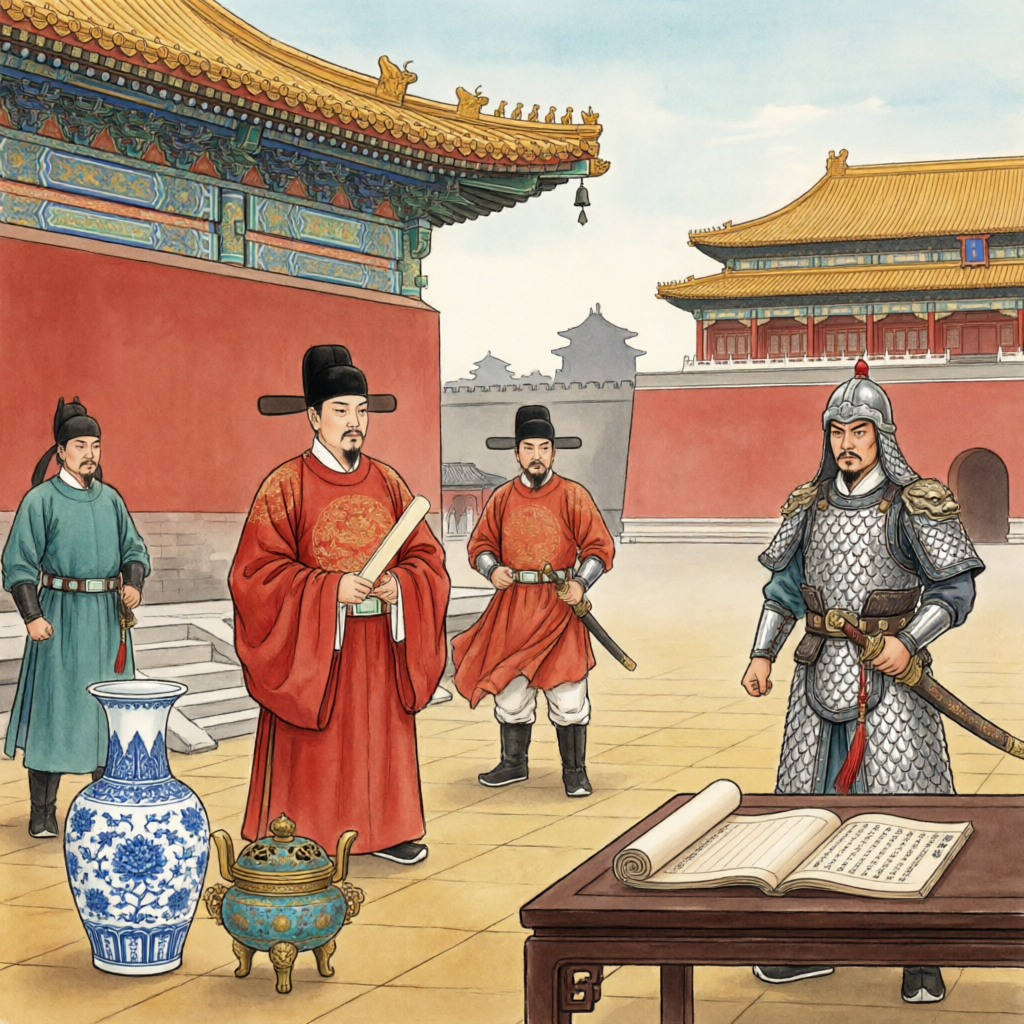
Ming Dynasty
Overview
The Ming Dynasty (明朝) was the ruling dynasty of China from 1368 to 1644, following the collapse of the Mongol-led Yuan Dynasty and preceding the Manchu-led Qing Dynasty. "Ming" means "bright" in Chinese, and the dynasty was also known as "Great Ming" (大明) or "Imperial Ming" (皇明) during its reign, and as "Former Ming" (前明) by the subsequent Qing Dynasty. The Ming period is considered one of China's golden ages, characterized by economic prosperity, cultural flourishing, and significant technological and artistic achievements.
History
Founding and Unification
The Ming Dynasty emerged from the Red Turban Rebellion, a widespread uprising against the Yuan Dynasty's Mongol rulers. In 1351, Han Shantong and Liu Futong led a major rebellion, which inspired Zhu Yuanzhang (later known as the Hongwu Emperor) to join Guo Zixing's forces in 1352. Through military prowess and strategic alliances, Zhu gradually consolidated power, following the advice of his military advisor Zhu Shen to "build high walls, store grain, and delay proclaiming himself king."
By 1356, Zhu had captured Jiankang (modern-day Nanjing), renaming it Yingtian Fu (应天府), and established a secure base. Through a series of military campaigns between 1357 and 1367, Zhu eliminated his rivals, including Chen Youliang at the Battle of Poyang Lake (1363) and Zhang Shicheng at Pingjiang (1367). In 1367, Zhu launched a northern expedition to drive out the remaining Yuan forces, issuing the "Proclamation to the Central Plains" which called for "expelling the barbarian rulers, restoring Chinese governance, establishing proper order, and relieving the people."
On January 23, 1368, Zhu Yuanzhang proclaimed himself emperor in Yingtian (Nanjing), establishing the Ming Dynasty with the reign name Hongwu. By August of that year, Ming forces had captured Dadu (modern-day Beijing), the Yuan capital, forcing the Yuan emperor to flee north, effectively ending Mongol rule in China. The Ming Dynasty also reclaimed the "Sixteen Prefectures" (幽云十六州) that had been lost to the Khitans centuries earlier.
Early Ming Prosperity
The Hongwu Emperor implemented numerous reforms to consolidate his rule and restore China's economy. He abolished the position of Chancellor and centralized power by directly controlling the Six Ministries. He established the Grand Secretariat (内阁) to assist with administrative matters. The emperor promoted agricultural recovery through land reclamation projects, tax reductions, and irrigation improvements. He also implemented the lijia (里甲) system for local governance and created the Yellow Register (黄册) and Fish Scale Register (鱼鳞图册) for tax assessment.
However, Hongwu's reign was also marked by political purges, most notably the Hu Weiyong (1380) and Lan Yu (1393) cases, which resulted in the execution of tens of thousands of officials and potential rivals. These purges weakened the Ming bureaucracy and contributed to the subsequent "Jingnan Campaign" (靖难之役) when Zhu Di (the Yongle Emperor) usurped the throne from his nephew.
The Yongle Emperor (r. 1402-1424) moved the capital from Nanjing to Beijing and constructed the Forbidden City. He launched five northern expeditions against the Mongols, expanded China's influence in Southeast Asia by conquering Vietnam (1407-1427), and sent Zheng He on seven maritime expeditions to establish Chinese dominance in the Indian Ocean. The Yongle Encyclopedia (永乐大典), one of the world's largest encyclopedias, was compiled during his reign.
The "Ren-Xuan Governance" (仁宣之治) period under the Hongxi (r. 1424-1425) and Xuande (r. 1425-1435) emperors marked another era of stability and prosperity, with reduced military campaigns and attention to domestic affairs.
Decline and Fall
The Ming Dynasty began to decline during the reign of the Zhengtong Emperor (r. 1435-1449). In 1449, the emperor and his powerful eunuch advisor Wang Zhen led a disastrous military campaign against the Oirat Mongols, resulting in the "Tumu Crisis" (土木之变). The Ming army was annihilated, and the emperor was captured. This catastrophe exposed the dynasty's military weakness and marked a turning point in Ming fortunes.
Although the dynasty recovered under the Jingtai Emperor (r. 1449-1457) and the leadership of the official Yu Qian, who successfully defended Beijing, the Ming never fully regained its earlier strength. Subsequent emperors faced increasing challenges, including factionalism at court, corruption, economic difficulties, and natural disasters. The Wanli Emperor's long reign (1572-1620) was marked by governmental stagnation, while the Chongzhen Emperor (r. 1627-1644) struggled to confront multiple rebellions and the growing threat from the Manchus in the northeast.
The dynasty fell in 1644 when Li Zicheng's rebel forces captured Beijing, and the Chongzhen Emperor committed suicide. The Manchus subsequently seized power, establishing the Qing Dynasty.
Key Information
| Aspect | Details |
|---|---|
| Time Period | 1368-1644 |
| Founding Emperor | Hongwu Emperor (Zhu Yuanzhang) |
| Capital | Initially Nanjing (1368-1421), then Beijing (1421-1644) |
| Major Cities | Nanjing, Beijing, Suzhou, Hangzhou, Guangzhou |
| Currency | Copper cash (宝钞), silver (银两) |
| Population | Approximately 160 million at its peak (1600s) |
| Ethnic Groups | Predominantly Han Chinese |
| Succession | Hereditary, with occasional usurpation and succession crises |
| Government Structure | Centralized bureaucracy with Six Ministries, Grand Secretariat, and Censorate |
| Military System | Wei-Suo system (卫所制度) with hereditary soldiers |
| Notable Events | Zheng He's voyages, Tumu Crisis, Spanish and Portuguese contact, Jesuit missions |
Cultural Significance
The Ming Dynasty was a period of remarkable cultural and artistic achievement. The period saw the flourishing of the novel as a literary form, with works such as Journey to the West (西游记), Water Margin (水浒传), and Dream of the Red Chamber (红楼梦) becoming classics. The Ming also produced notable painters such as Shen Zhou, Wen Zhengming, and Dong Qichen of the Wu School.
In philosophy, Wang Yangming's School of the Mind (心学) challenged the dominant Neo-Confucian orthodoxy. The Ming period also witnessed significant developments in porcelain production, with the famous blue-and-white porcelain (青花瓷) reaching new heights of technical and artistic excellence.
The Ming Dynasty was also a time of significant contact with the outside world. While initially pursuing a policy of isolation, the Ming engaged in extensive trade with European and Asian nations. Jesuit missionaries such as Matteo Ricci brought Western science, mathematics, and Christianity to China, while Chinese goods, technology, and ideas spread to Europe and beyond.
Modern Status
Today, the Ming Dynasty is remembered as one of China's great dynasties, representing a period of cultural renaissance, economic prosperity, and technological innovation. The Forbidden City in Beijing, the Great Wall as it largely appears today, and many of China's most famous cultural treasures date from the Ming period.
Modern scholarship on the Ming Dynasty has benefited from archaeological discoveries, improved access to historical documents, and interdisciplinary approaches. Historians continue to debate various aspects of Ming history, including the reasons for its decline, the nature of its relations with foreign powers, and the extent of its cultural achievements.
References
-
Fairbank, John King, and Merle Goldman. China: A New History. Harvard University Press, 2006.
-
Brook, Timothy. The Confusions of Pleasure: Commerce and Culture in Ming China. University of California Press, 1998.
-
Mote, Frederick W. Imperial China: 900-1800. Harvard University Press, 1999.
-
Spence, Jonathan D. The Search for Modern China. W.W. Norton & Company, 2011.
-
Twitchett, Denis, and Frederick W. Mote, eds. The Cambridge History of China, Vol. 7: The Ming Dynasty, 1368-1644. Cambridge University Press, 1988.