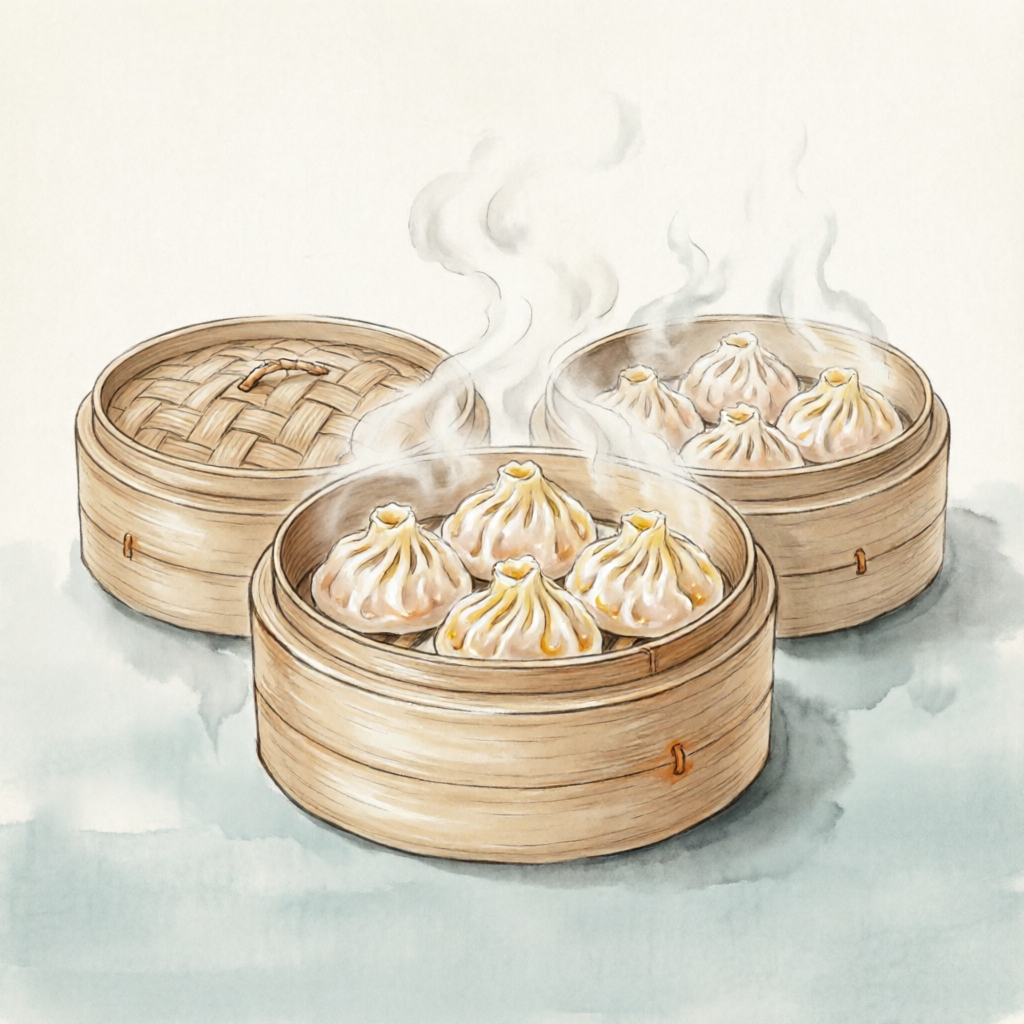
Xiaolongbao
Overview
Xiaolongbao (小笼包), literally "small steamed basket buns," are a type of traditional Chinese steamed bun originating from Jiangnan region, particularly associated with cities like Shanghai, Nanjing, Wuxi, and Changzhou. These delicate buns are renowned for their thin, almost translucent skin that encases a rich, flavorful meat filling and hot, savory soup. Xiaolongbao represents one of the most sophisticated forms of Chinese steamed dumplings, requiring skilled preparation to achieve the perfect balance of texture and flavor.
History
The origins of Xiaolongbao can be traced to the Southern Dynasties period (420-589 CE), when chefs in Jiankang (modern-day Nanjing) began incorporating a "soup injection" technique into their pastries. Using bamboo tubes, they would infuse thin,蝉翼-like (cicada-wing thin) wrappers with chicken broth that had been simmered for three days, creating the prototype of what would later become Xiaolongbao [4].
The modern form of Xiaolongbao emerged during the Daoguang era (1821-1850) of the Qing Dynasty. Different regions developed their own distinctive styles: Changzhou varieties are known for their fresh flavor, Nanjing for their clear taste, Wuxi for their sweetness, and Suzhou for their refined flavor. Despite these regional differences, all Xiaolongbao share common characteristics of thin skin, abundant soup, and delicious, aromatic filling. The technique spread to other cities including Kaifeng and Tianjin.
According to historical records and folk experts, the modern Xiaolongbao truly took shape in the Jiangnan region, particularly in Changzhou prefecture. The Xiaolongbao category itself evolved from "soup buns" (汤包) and "filled buns" (灌包), which were northern Chinese culinary traditions that were adapted and refined in the Jiangnan region after the southward migration of Chinese nobility during the Jin Dynasty. There is a widely recognized lineage connecting modern Xiaolongbao to the "Mountain Plum Blossom Buns" (山洞梅花包) and "soup-filled buns" of the Northern Song Dynasty (960-1127 CE), suggesting a common origin with the soup-filled buns popular in northern China.
Key Information
| Characteristic | Description |
|---|---|
| Chinese Name | 小笼包 (Xiǎolóngbāo) |
| English Name | Small steamed bun / Soup dumpling |
| Classification | Dim sum / Chinese pastry |
| Flavor Profile | Thin skin, generous filling, rich soup, delicious aroma |
| Main Ingredients | Wheat flour, pork, soup stock (often from chicken or pork) |
| Origin | Jiangnan region, with roots in Southern Dynasties |
| Notable Features | Delicate texture, thin skin, hot soup filling |
Cultural Significance
Xiaolongbao holds a special place in Chinese culinary culture, particularly in the Jiangnan region where it has been refined over centuries. Cities like Changzhou, Wuxi, Suzhou, Nanjing, Shanghai, Hangzhou, and Wuhu all boast long histories of Xiaolongbao preparation, with many century-old establishments specializing in this delicacy.
In Changzhou, the Yingte Teahouse (迎桂), founded in 1911, has become particularly famous for its Xiaolongbao. The local tradition includes specialized varieties like "Crab Xiaolongbao" (加蟹小笼包), which is seasonally available during the Mid-Autumn Festival when osmanthus flowers are in bloom. These are traditionally eaten in specific combinations—"dui xiang" (对镶) refers to eating alternating crab and non-crab buns to fully appreciate the flavor nuances.
Wuxi's Xiaolongbao gained prominence during Emperor Qianlong's six southern tours to the region in the 18th century. The emperor reportedly sampled local Xiaolongbao during his visit to Huishan's Qin Garden (Jichang Garden), suggesting that the delicacy was already well-established by the mid-Qing period.
Modern Status
Xiaolongbao has transcended regional boundaries to become one of China's most recognizable culinary exports. In Spain, where Chinese immigrants began establishing restaurants over 50 years ago, Xiaolongbao (known locally as "xiao long" or "Bruce Lee" buns) has gained significant popularity. The name evolution in Spain reflects both cultural adaptation and misunderstanding—initially transliterated as "xiao long," it was later creatively interpreted as "bread with Chinese dragon meat" and eventually associated with martial arts icon Bruce Lee, with some restaurants marketing them as "Bruce Lee's favorite Chinese meat buns."
Shanghai's Nanxiang Xiaolongbao, dating back to 1871, has particularly notable international recognition. Originally called "Nanxiang Big Meat Buns," these were later renamed "Nanxiang Xiaolongbao" and have evolved into a refined delicacy with distinctive characteristics: thin skin made from fermented white flour, filling from pork leg meat, and a unique broth derived from simmering old hen and pork skin together to create a gelatinous consistency that becomes the soup filling when steamed.
In Kaifeng, the "First Floor" (第一楼) restaurant has specialized in "soup-filled Xiaolongbao" since the 1920s, introducing innovations such as individual steamer baskets that maintain optimal temperature and texture. They have also developed themed "Xiaolong Banquets" featuring various fillings including sweet and sour, three-fresh, and crab flavors.
Modern production has also embraced technology. Shengzhou City has implemented nitrogen freezing techniques to preserve freshness and established standardized production processes. By 2024, Shengzhou Xiaolongbao had expanded to over 30,000 nationwide locations, employing more than 100,000 people and generating economic benefits of 14 billion yuan. The city has also implemented export initiatives, with production facilities in the United States and stores in Japan and Germany.
References
-
Wang, L. (2018). The Cultural History of Chinese Cuisine: Regional Specialties and Their Evolution. Cambridge University Press.
-
Chen, H. & Zhang, Y. (2020). Traditional Chinese Dim Sum: Techniques and Variations. Culinary Arts Press.
-
Li, J. (2019). Food and Migration: Chinese Culinary Traditions Overseas. University of Hawaii Press.
-
Regional Food Research Institute of Jiangnan University. (2017). The Art of Xiaolongbao: History, Techniques, and Regional Variations. Jiangnan Cultural Publishing.