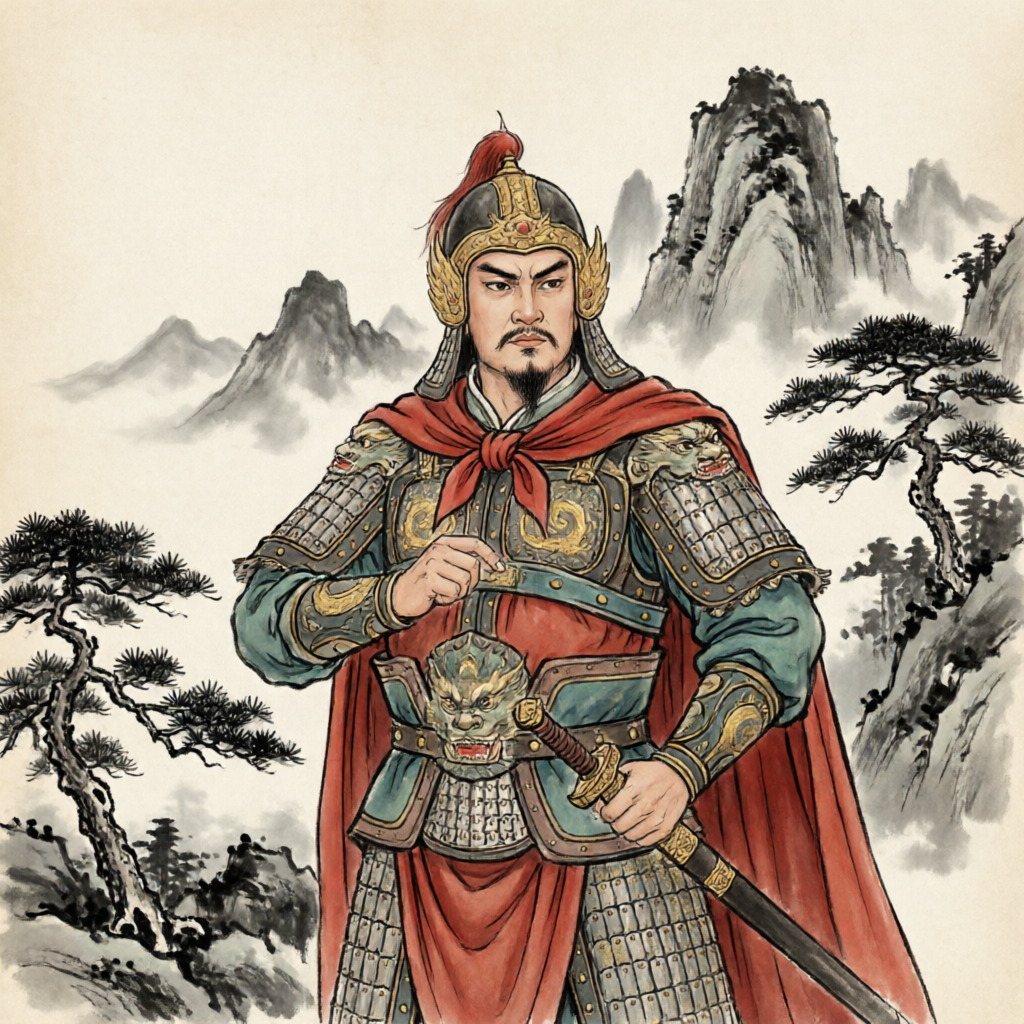
Yue Fei
Overview
Yue Fei (March 24, 1103 - January 27, 1142) was a prominent military general who served during the Southern Song dynasty in China. He is celebrated as a national hero for his military achievements against the Jurchen invaders of the Jin dynasty and his unwavering loyalty to the Song emperor. Yue Fei's military career spanned several decades, during which he developed innovative tactics that proved highly effective against the Jin forces. Despite his successes, his career was cut short when he was executed on trumped-up charges, a decision that has been the subject of historical debate and controversy.
History
Early Life and Military Beginnings
Yue Fei was born on February 15, 1103, during the reign of Emperor Huizong of the Northern Song dynasty, in Tangyin County, Xiangzhou, Hebei West Circuit (present-day Tangyin County, Henan Province). His family was of modest means, with only a few acres of poor-quality farmland that barely provided subsistence. According to legend, at his birth, a large bird resembling a swan flew over his family home, crying loudly, which led his parents to name him Fei (meaning "to fly") and style him Pengju (meaning "to rise like a roc").
From a young age, Yue Fei demonstrated remarkable determination and integrity. He was quiet, straightforward, and showed a strong moral compass. Despite his family's poverty, he was an avid reader, particularly fond of the Zuo Zhuan and Sun Tzu's Art of War, often reading through the night. Unable to afford candles regularly, he would collect firewood during the day for evening study. Unlike many scholars of his time, Yue Fei did not confine himself to rote learning; once he grasped the essence of a text, he moved on without getting bogged down in details.
Before the age of twenty, Yue Fei could draw a bow requiring 300 jin (approximately 180 kg) of force and operate a crossbow with eight dan (approximately 480 kg) of draw weight. He studied archery with the local master Zhou Tong, eventually becoming skilled enough to shoot accurately with either hand. After Zhou Tong's death, Yue Fei mourned deeply, visiting his grave on the first and fifteenth day of each lunar month, offering wine and meat in sacrifice. He later studied martial arts under Chen Guang, becoming "unmatched in the county" in sword and spear techniques.
Early Military Career
In 1122, during the Xuanhe era, Yue Fei first joined military service when Liu Ge, the military commissioner of Zhending Prefecture, recruited brave warriors to defend against Liao incursions. Impressed by Yue Fei's abilities, Liu Ge immediately appointed him as a squad leader. When local bandits Tao Jun and Jia Jin ravaged the region, government forces had repeatedly failed to suppress them. Yue Fei requested permission to lead 100 cavalry to eliminate the threat, and Liu Ge provided him with 200 infantry and cavalry. Yue Fei devised a clever plan: he sent 30 men disguised as merchants into bandit territory, who pretended to be captured and infiltrated the bandit ranks. That night, Yue Fei ambushed the bandits from a hillside while leading a direct assault on their camp. The bandits, underestimating his small force, engaged in battle. Tao Jun, arrogantly seated on his horse, cursed and directed the attack. Yue Fei feigned retreat, drawing the bandits into pursuit, at which point his hidden forces attacked simultaneously. The 30 disguised men captured Tao Jun and Jia Jin, causing the bandit force to disarray with most being captured and the rest fleeing.
For this achievement, Wang Jing, the prefect of Xiangzhou, recommended Yue Fei for the position of Chengxinlang. However, before the appointment was officially granted, Yue Fei received news of his father's death and returned home to observe mourning. The appointment was never finalized due to subsequent military reorganizations.
In 1124, Yue Fei joined the army in Pingding Command as an "yongli shi" (utility soldier) and was soon promoted to "pian xiao" (subordinate officer). Later that year, he distinguished himself again when bandit leader Zhang Chao led several hundred men to surround the former residence of Han Qi. Yue Fei, who was at Han's estate purchasing grain, declared, "How dare bandits invade the place I protect!" He climbed a low wall, shot an arrow that hit Zhang Chao in the throat, killing him instantly. The remaining bandits fled, saving the estate.
Rising Prominence
In the sixth month of 1126 (Jingkang era), Yue Fei was sent on a reconnaissance mission ("yingtan" or hard reconnaissance) to Shouyang and Yuci counties with over 100 cavalry. They unexpectedly encountered a Jin force. The other cavalrymen retreated in fear, but Yue Fei charged alone into the enemy formation, killing several Jin cavalry officers in successive charges. The enemy forces fled,不敢 to approach further. That night, Yue Fei infiltrated the Jin camp in disguise, conversing with sentries in Jurchen language to gather intelligence about their strength and disposition. For this achievement, he was promoted to Jinyi Fuwei. However, he later lost his official appointment document ("gaoshen") during a night river crossing and returned to Xiangzhou by a back route.
During the winter of 1126, Emperor Gaozong (Zhao Gou) established a marshal headquarters in Hebei and appointed himself Commander-in-Chief. Yue Fei, serving under Liu Hao, was summoned to meet the emperor. Liu Hao ordered Yue Fei to persuade the bandit leader Ji Qian and his followers to surrender. With 100 cavalry, Yue Fei approached the bandit camp at dusk. He and four riders entered directly, surprising the bandits. Yue Fei spoke to Ji Qian, saying: "The Jin are creating chaos, yet instead of serving the state and achieving merit, you have become bandits. Today, I am ordered by the Marshal to offer you amnesty—a chance to turn disaster into fortune." Ji Qian, knowing of Yue Fei's reputation and moved by his sincerity, hosted a feast. During the banquet, Ji Qian expressed concern about their fate if they surrendered. Yue Fei reassured them, and as they were about to agree, one bandit suddenly attacked Yue Fei. Yue Fei struck him down and drew his sword, at which point Ji Qian and others surrendered, bringing 380 men with them. For this success, Yue Fei was appointed Chengxinlang and given command of 300 iron cavalry.
Service Under Zong Ze
In the first month of 1127, Yue Fei fought in Kaide Prefecture, killing two Jin standard-bearers with two arrows before leading a cavalry charge that routed the enemy. He was promoted to Xiuwulang. In the second month, at Cao Prefecture, Yue Fei led a charge into the Jin army with a four-bladed iron mace, inspiring his troops to fight with such valor that they defeated a much larger force. He was promoted to Wuyilang.
Zong Ze, the military governor, was impressed by Yue Fei's abilities but noted his preference for unconventional tactics over traditional battle formations. When Zong Ze asked Yue Fei about this, he replied: "The battle formations you gave me, I have studied carefully, but they are merely fixed layouts. Circumstances change, terrain varies—how can we be bound by a single formation? The key to warfare is achieving unexpected victory, keeping the enemy guessing. If we suddenly encounter the enemy on open ground, there is no time to arrange formations. Besides, I am merely a subordinate commander with limited troops. If we maintain a fixed formation, the enemy will discern our strengths and weaknesses and crush us with cavalry." Zong Ze was silent for a long time before conceding, "You are right."
In May 1127, Emperor Gaozong ascended the throne, establishing the Southern Song dynasty with the Jianyan era. Yue Fei submitted a memorial arguing that the emperor should return to the capital and launch a northern expedition to recover lost territories. This angered the ruling ministers, who considered Yue Fei a junior official overstepping his bounds. He was stripped of his position and sent home.
Return to Service and Southern Campaigns
In August 1127, Yue Fei joined Zhang Suo, the Pacification Commissioner of Hebei, who treated him with great respect. Zhang Suo appointed Yue Fei as Xiuwulang and gate attendant, serving as commander of the central army. When Zhang Suo asked Yue Fei how many enemies he could defeat, Yue Fei replied that courage alone was insufficient; strategy was paramount. He cited historical examples of victory through careful planning, impressing Zhang Suo, who appointed him as Wujing Lang.
Following Zhang Suo, Yue Fei served under Wang Yan, crossing the Yellow River to Xinxiang County. When Wang Yan refused to engage the Jin forces, Yue Fei accused him of disloyalty and led his troops into battle alone, capturing the Jin standard and defeating the enemy. Despite this success, Yue Fei's independent action caused tension with Wang Yan. When Yue Fei later returned to Wang's camp to apologize, Wang Yan considered executing him but relented, recognizing Yue Fei's value during a time of national crisis.
After parting ways with Wang Yan, Yue Fei joined Zong Ze again, who appointed him as commander of the headquarters guard. After Zong Ze's death, Du Chong replaced him as military governor of the Eastern Capital.
In 1128, Yue Fei achieved several victories against Jin forces in various locations, including Heixongtan and Guanqiao. His tactical innovations, such as using torches to create the illusion of reinforcements, proved effective. In 1129, he defended the Southern Song capital against a massive force led by bandit leaders Wang Shan, Cheng Cheng, and others, despite being outnumbered. His leadership during this battle earned him promotion to Wujing Dafu.
Defense of Jiankang
In 1130, Yue Fei was involved in defending Jiankang (modern Nanjing) against Jin forces. When Jin forces attacked Changzhou, Yue Fei moved to Yixing to deal with the bandit Guo Ji. Upon arrival, Guo Ji fled with his ships, but Yue Fei pursued and defeated him. He also persuaded other bandit leaders to surrender, except for Zhang Wuwu, whom he personally captured and executed. The people of Changzhou, grateful for Yue Fei's protection, fled to Yixing, bringing their portraits of Yue Fei to worship in their homes.
In April 1130, Yue Fei intercepted Jin forces attacking Changzhou, winning four consecutive battles. He pursued the enemy to the eastern part of Zhenjiang Prefecture, consistently victorious. In May, when Jin forces led by Wuzhu (the fourth son of Jin Emperor Taizu) advanced on Jiankang, Yue Fei ambushed them at Niutou Mountain. His troops, dressed in black, infiltrated the Jin camp, causing confusion and internal conflict. When Jin forces invaded Liyang County, Yue Fei sent Liu Jing to lead a night attack that captured over 500 enemy soldiers, including several Jin commanders.
Recovery of Jiankang
In January 1130, Jin forces attacked Changzhou again. Yue Fei intercepted them, winning four more battles. He pursued the Jin forces to the eastern part of Zhenjiang Prefecture, achieving repeated victories. When ordered to Jiankang, Yue Fei personally led his troops there. On the 25th, at Qingshui Pavilion, Yue Fei defeated the Jin forces decisively, leaving corpses strewn over 15 li. He captured 175 Jin heads with gold and silver earrings, 45 Jin and Chinese soldiers, and seized a large quantity of weapons and equipment.
In May 1130, Wuzhu again advanced on Jiankang. Yue Fei set up an ambush at Niutou Mountain. That night, he ordered his soldiers to wear black clothes and infiltrate the Jin camp, causing panic and infighting among the Jin forces. The Jin increased patrols but were unable to locate the source of the disturbance. Yue Fei's tactics demonstrated his innovative approach to warfare, combining psychological operations with direct military action.
Key Information
| Aspect | Details |
|---|---|
| Full Name | Yue Fei (岳飞) |
| Courtesy Name | Pengju (鹏举) |
| Posthumous Names | Wumu (武穆), Shaobao (少保), Zhongwu (忠武) |
| Noble Titles | Prince of E (鄂王), Duke of Wuchang (武昌郡开国公) |
| Birth Date | March 24, 1103 |
| Death Date | January 27, 1142 |
| Birthplace | Tangyin County, Xiangzhou (modern Henan Province) |
| Death Place | Lin'an (modern Hangzhou) |
| Era | Southern Song Dynasty (南宋) |
| Key Achievements | Military victories against Jin forces, development of innovative tactics, brief recovery of territories north of the Yangtze River |
| Notable Works | "Man Jiang Hong" (满江红 - poem), "Xiao Chong Zhan" (小重山 - poem) |
| Legacy | Symbol of patriotism and military prowess in Chinese culture, subject of numerous literary and artistic works |
Cultural Significance
Yue Fei has become an enduring symbol of patriotism, loyalty, and military excellence in Chinese culture. His story has been immortalized in literature, art, and popular media. The most famous literary work associated with him is the poem "Man Jiang Hong" (满江红), traditionally attributed to Yue Fei, which expresses his determination to recover the lost northern territories and his unwavering loyalty to the Song dynasty. The poem's opening lines, "怒发冲冠,凭栏处、潇潇雨歇" (My fury makes my hair stand on end as I lean on the railing in the light rain), have become iconic expressions of patriotic sentiment.
Yue Fei's image has been depicted in numerous paintings, sculptures, and operas throughout Chinese history. In traditional Chinese opera, particularly in the Peking Opera tradition, stories about Yue Fei are popular performances that highlight his military achievements and tragic end. The Yue Fei Temple in Hangzhou, built at the site of his execution, has become a place of pilgrimage for those who admire his loyalty and patriotism.
Yue Fei's legacy extends beyond China to other East Asian cultures influenced by Chinese history. In Japan and Korea, he is also recognized as a heroic military figure, though with varying interpretations of his historical significance.
Modern Status
In contemporary China, Yue Fei is widely revered as a national hero. His image appears in textbooks, and his story is taught in schools as an example of patriotism and moral integrity. The Chinese government has promoted his legacy as part of patriotic education, emphasizing his loyalty to the nation and resistance to foreign invasion.
Historical research on Yue Fei has continued into the modern era, with scholars examining both his military achievements and the political circumstances surrounding his execution. While traditional accounts portray him as a loyal martyr executed through political intrigue, some modern historians have suggested a more complex relationship with the Song court, noting that his aggressive military policies may have conflicted with the political establishment's approach to dealing with the Jin dynasty.
Cultural references to Yue Fei remain prevalent in modern China. His name and image appear in literature, films, television programs, and video games. The phrase "精忠报国" (jing zhong bao guo - serve the country with utmost loyalty), traditionally associated with Yue Fei, continues to be used in modern Chinese political discourse as an expression of patriotic duty.
References
-
Ebrey, Patricia Buckley. The Cambridge Illustrated History of China. Cambridge University Press, 1999.
-
Hucker, Charles O. A Dictionary of Official Titles in Imperial China. Stanford University Press, 1985.
-
Franke, Herbert. China Under the T'ang and Sung Dynasties. University of Michigan Press, 1977.
-
Spence, Jonathan D. The Search for Modern China. W.W. Norton & Company, 2011.
-
Di Cosmo, Nicola. Ancient China and Its Enemies: The Rise of Nomadic Power in East Asian History. Cambridge University Press, 2002.