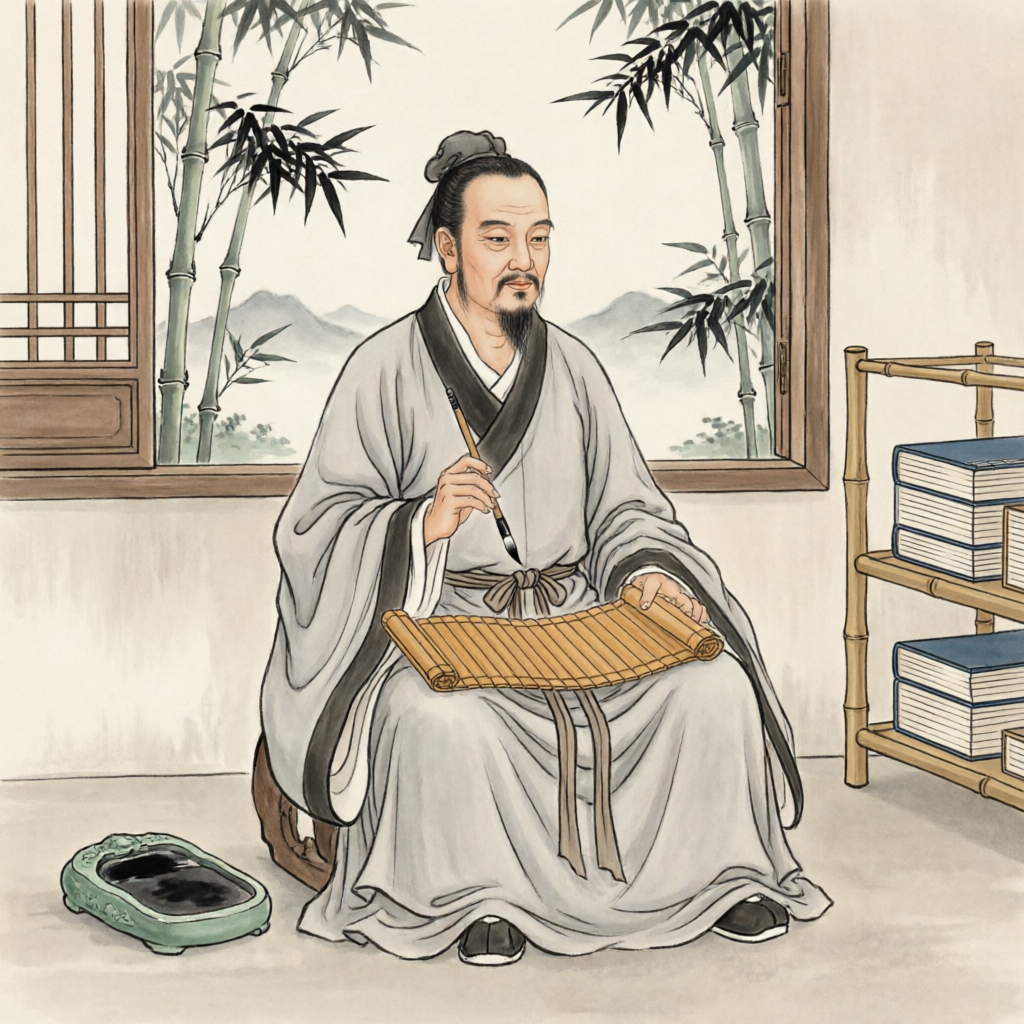
Lu Jiuyuan
Overview
Lu Jiuyuan (1139-1193), courtesy name Zijing and self-styled Xiangshan Weng, was a Chinese philosopher, educator, and official who lived during the Southern Song Dynasty. He is best known as the founder of the School of the Mind (Xinxue), a philosophical tradition that emphasized the innate moral knowledge of the human heart-mind. His teachings, often summarized in the famous phrase "my mind is the universe" (吾心即是宇宙), represented a significant departure from the dominant Neo-Confucianism of his time, which was primarily associated with Zhu Xi. Lu's philosophy exerted profound influence on later Chinese thought, particularly through its development by Wang Yangming in the Ming Dynasty.
History
Family Background
Lu Jiuyuan was born on March 26, 1139, in Jinxian, Fuzhou Prefecture, into a once-prominent but by then declining family. His family traced its ancestry to Lu Xisheng, who had served as chancellor during the Tang Dynasty. By Lu Jiuyuan's time, the family's fortunes had declined, possessing only about 10 mu of vegetable fields, one pharmacy, and one private school. Nevertheless, the Lu family maintained a reputation for strict adherence to Confucian rituals and ethical principles, which earned them respect even from Emperor Xiaozong of Song.
Raised in such an environment, Lu was immersed in Confucian teachings from an early age. He displayed exceptional intellectual curiosity, questioning fundamental concepts about the nature of the universe and the cosmos. As a child, he pondered the question of how heaven and earth could be infinite, and later achieved enlightenment when studying the concept of "cosmos" (宇宙) in classical texts. By age thirteen, he had already developed his own critical perspective on Confucian classics, finding Confucius's teachings clear and concise while considering those of Zizhi (a disciple of Confucius) disorganized.
Scholarly Career and Teaching
In 1172, at the age of 34, Lu Jiuyuan passed the imperial examination and became a Jinshi. He initially returned to his hometown in Jinxian, where he established his first school in a room of his residence called "Huaitang" (槐堂). As his reputation grew, students from neighboring regions flocked to study with him. During this period, he was offered official positions but declined them, preferring to focus on teaching.
Lu's teaching philosophy emphasized direct personal realization over rote learning. He encouraged students to "discover their original mind" (发明本心) rather than merely memorizing texts. His approach was revolutionary for its time, focusing on moral cultivation and intuitive understanding rather than scholastic analysis. This attracted numerous disciples, including Yang Jian, Yuan Xie, Shu Lin, and Fu Ziyun, who would later become important disseminators of his teachings.
Official Career
In 1182, Lu was appointed as a professor at the Imperial University (Guozijian) in Lin'an (modern-day Hangzhou). There, he gave lectures on the Spring and Autumn Annals, emphasizing the distinction between Chinese (Huaxia) and barbarian peoples, and the importance of ritual propriety (礼义) in governance. His lectures reflected his concerns about the political situation of the Southern Song, which faced threats from northern Jurchen Jin dynasty and internal corruption.
In 1184, Lu had the opportunity to present his political philosophy to Emperor Xiaozong in a series of five memorials. In these, he advocated for sincere relations between ruler and ministers, the pursuit of the "Way" (道) as the foundation of governance, and the importance of recognizing and employing talented officials. He also advised against hasty political reforms, using Wang Anshi's New Policies as an example of disruptive change implemented too quickly.
In 1191, Lu was appointed as the prefect of Jingmen, a strategically important border region. Despite its significance, Jingmen lacked proper fortifications and suffered from various administrative problems. Lu implemented comprehensive reforms, including:
- Military: Building defensive walls and improving training
- Economic: Simplifying tax collection and reforming currency practices
- Educational: Rebuilding schools and replacing superstitious practices with moral education
- Disaster relief: Managing floods and organizing grain reserves
- Public security: Establishing neighborhood watch systems and personally handling legal cases
These measures transformed Jingmen within a short period, though Lu's tenure there was cut short by his death.
Key Information
| Aspect | Details |
|---|---|
| Birth Name | Lu Jiuyuan (陆九渊) |
| Courtesy Name | Zijing (子静) |
| Style Name | Xiangshan Weng (象山翁) |
| Birth Date | March 26, 1139 |
| Death Date | January 18, 1193 |
| Birthplace | Jinxian, Fuzhou (抚州金溪) |
| Death Place | Jinxian, Fuzhou (抚州金溪) |
| Dynasty | Southern Song Dynasty (南宋) |
| School of Thought | School of the Mind (心学, Xinxue) |
| Major Works | Complete Works of Lu Jiuyuan (《陆九渊全集》) |
| Posthumous Title | Wen'an (文安) |
Cultural Significance
Lu Jiuyuan's philosophical contributions represent a significant development in Chinese intellectual history. As the founder of the School of the Mind, he challenged the dominant Neo-Confucian paradigm established by Zhu Xi, which emphasized investigating principles (格物) through the study of external phenomena. Lu instead argued that the fundamental principles of the universe are inherently present in the human mind, stating that "the mind is the principle" (心即理).
This perspective had profound implications for both epistemology and ethics. Epistemologically, it suggested that true understanding comes not from external investigation but from introspective realization of one's innate moral knowledge. Ethically, it emphasized the importance of cultivating one's original mind (本心) to achieve moral perfection.
Lu's influence extended beyond philosophy into education. He pioneered teaching methods that emphasized personal realization over rote learning, encouraging students to question and think independently rather than merely accepting established doctrines. His approach represented a significant departure from contemporary educational practices and anticipated later developments in progressive education.
Modern Status
Today, Lu Jiuyuan is recognized as one of the most important philosophers in Chinese intellectual history. His School of the Mind continued to develop through his disciples and later thinkers like Wang Yangming, who further systematized and popularized his teachings. During the Ming Dynasty, Lu's philosophy experienced a revival and became particularly influential among literati officials.
In contemporary scholarship, Lu is studied both for his philosophical originality and his practical contributions to governance and education. His ideas continue to inform discussions about Chinese philosophy, ethics, and educational theory. The Xiangshan Academy (象山书院) he founded has been preserved as a historical site, and his teachings remain an important subject of academic research.
In the broader context of world philosophy, Lu's thought represents a distinctive approach to understanding the relationship between the individual and the cosmos, emphasizing the unity of inner moral awareness and external reality. This perspective has drawn comparisons to various Western philosophical traditions, including aspects of phenomenology and existentialism, though such comparisons remain the subject of scholarly debate.
References
Chen, Lai. Neo-Confucianism in History. Harvard University Asia Center, 2006.
Chan, Wing-tsit. A Source Book in Chinese Philosophy. Princeton University Press, 1963.
Angle, Stephen C. Neo-Confucianism and Chinese Practical Thought. State University of New York Press, 2009.